Thursday, November 30, 2006

You Can Do Something This World AIDS Day

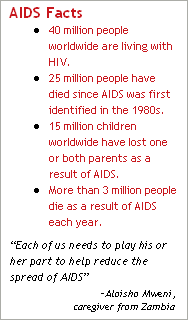
AIDS FactsTomorrow, December 1, is World AIDS Day. And you can do something to make a difference in the battle to defeat the biggest pandemic ever to hit the planet!

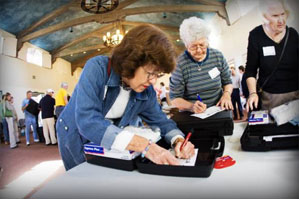
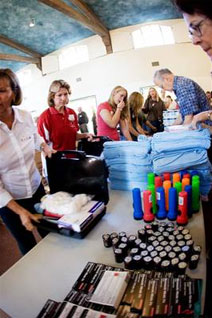
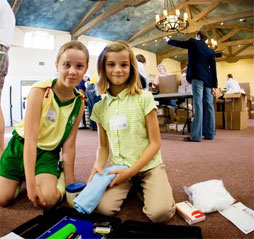
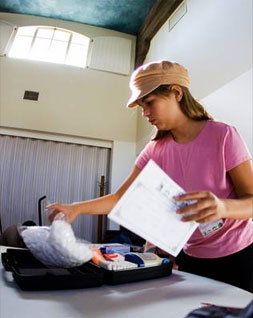
Four churches in Santa Barbara, California, recently got together to assemble "Caregiver Kits." These are packets which provide desperately needed resources for families and health workers in Africa who are giving care to people living with AIDS.

On hand was photographer Mark Kuroda, who took these great shots of the attendees at work, writing messages of encouragement to the caregivers, assembling the kits and even praying over them before they went out.

For more of Mark's work, check out www.markkuroda.com/worldvision.

Event participants write messages of encouragement to be included in Caregiver Kits assembled at El Montecito Presbyterian Church.


Event participants assemble Caregiver Kits at El Montecito Presbyterian Church.


Event participants assemble Caregiver Kits at El Montecito Presbyterian Church.


Event participants pray over assembled Caregiver Kits at El Montecito Presbyterian Church.


Event participants assemble Caregiver Kits at El Montecito Presbyterian Church.


Event leaders pose in front of stacks of assembled Caregiver Kits at El Montecito Presbyterian Church.


For a more detailed list of ideas of things you can do tomorrow, see this page of 12 things you can do this World AIDS Day.

If you'd like to help build AIDS Caregiver Kits tomorrow, join Menlo Park Presbyterian Church in Menlo Park, California. Other similar Caregiver Kit events are also being held at these locations:


- Back to Top -

Tuesday, November 21, 2006

It's Time To Take a Stand


Click to play videoJames Pedrick is an advocacy associate for World Vision, working with the "Acting on AIDS" college advocacy organization. Click the link at left to play a brief video of James explaining about this site.

World AIDS Day has been commemorated on December 1 for several years to draw worldwide attention to the global pandemic that is destroying so many lives and making millions of children into orphans.

But this year promises to be different. For the first time, college students, young people, and churchgoers from across the country are going to be standing up, through a variety of events, to say "We've had enough. We must do something about AIDS."

World Vision has created this site to share with you information about many of the events which are scheduled. Hopefully you can participate in an event near you.

Also, we would like to hear from you. What are you planning this World AIDS Day? How has your life been changed by the fight against AIDS? Simply click the "Comment" link at the bottom of this blog and submit your comment for our blog editor to review and publish, or review other comments which have been posted.

And stay tuned. Return to this site on Thursday, November 30, when we will begin our complete coverage of World AIDS Day events across the nation.

- James Pedrick

Read how "Acting on AIDS" got its start at Seattle Pacific University.

PARTIAL SCHEDULE OF WORLD AIDS DAY EVENTS IN THE U.S.

"Lives Are at Stake" events, occurring on CCCU member campuses nationwide on World AIDS Day, December 1.

Acting on AIDS' Fall Tour events on college campuses:

Thursday, Nov. 30 - John Brown University, Siloam Springs, Arkansas

Friday, Dec. 1 (World AIDS Day):

Monday, Dec. 4- King College, Bristol, Tennessee
Tuesday, Dec. 5 - Princeton Theological Seminary, Princeton, New Jersey
Waynesburg College, Waynesburg, Pennsylvania
Wednesday, Dec. 6 - George Mason University, Fairfax, Virginia

World Vision AIDS Experience (interactive exhibit) at these locations on December 1:

  • Charlotte, North Carolina
  • New York (mini-exhibit)
  • Seattle (mini-exhibit at Seattle Pacific University)


- Back to Top -

Thursday, August 31, 2006

Hands off the Children!

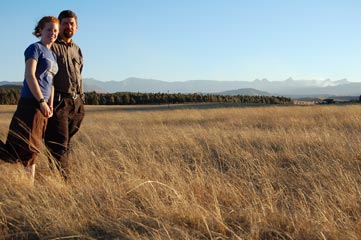
Larry Short, 49, is web editor for World Vision's office in the U.S. He is visiting World Vision projects in four countries in Southern Africa along with his daughter, Amanda, 20, a Safety Technician for Recreational Equipment Inc. (REI) in Sumner, Washington. Daughter and father are shown here in the Okhahlamba / Drakensberg area of South Africa. The mountains of eastern Lesotho are in the background.


I am so glad that the tragic situation of the Congo's so-called "sorcery children" (see article below) is getting some traction in the media. The Los Angeles Times just posted an excellent piece on the topic, intriguingly titled "They say I ate my father. But I didn't."

The article focuses on the plight of a 5-year-old girl who was accused of killing her parents ... through sorcery.

I was pleased to read that the Congolese constitution actually has made an accusation of sorcery against a child illegal. But plainly in this case there is a large gap between what is legal and what is common practice in the large cities of this troubled country. With up to 30,000 children on the streets of Kinshasa -- at least 20,000 of them there due to a sorcery allegation -- and 3,000 on the streets of Lubumbashi, the majority for the same reason, something must be done to protect the lives and welfare of these innocents.

And the same thing holds for the elderly, who (in the Congo and also in countries such as Ghana) are also being scapegoatted for societal problems.

Enforcing the law is a start. The next step is providing badly needed resources to take "sorcery children" off the dangerous streets of the Congo's large cities, and get them back into loving homes, or provide them with food, healthcare and shelter, and back to school. World Vision is helping with this, but much more is needed.

And, finally, we also need to work with "independent" church leaders in the DRC who are perpetuating this tragedy through their ignorance or misinterpretation of biblical teaching.

Out of all the gut-wrenching stories I was able to gather in the Congo this summer, this is the one that has really burned a hole in my heart since I returned. We all need to pray for these innocent children who are being abused in unimaginable ways because of the superstitions of the adults around them.

Monday, July 24, 2006

Sponsored Children Grateful for Gift of Goats

While in the Congo we had the privilege of working alongside World Vision's Communications Manager for the DRC, Vianney Dong Tshisekedi. Please pray for this wonderful woman, who has the enormous task of covering (alone!) the entire Congo ... an area larger than Texas and Alaska combined ... during a very challenging time in their history.

And pray for the results of Congo's historic democratic elections which began on July 30. Results won't be known for about a month. But this process is obviously very important to long-term peace and stability in this troubled country.

Vianney wrote the attached account of one of the interviews we did together in the Katanga Province.

Gifts given from a heart of love have a funny way of multiplying in impact. Just ask Manfela Musambo Julias, 12, and his sister Nialu Netty Lydia, 8, who are sponsored children in Kolwezi, Congo.

Their sponsor recently gave the family a special gift, above and beyond their ordinary monthly sponsorship gift. With the money, the children received new clothing and also two goats ... which can be a very important source of income and sustenance in this part of the world.

The children's father, Musambo Kamota, 76, is a subsistence farmer who cultivates maize (similar to corn), cassava, beans and sweet potatoes. He does not have regular source of income apart from his harvest, which makes keeping his nine children clothed and fed a challenging task.

The children's mother, Manfela Lydia, 36, explained why the goats were so important: "What we harvest cannot allow us meet our basic needs." Musambo added that their plot is too small to provide sufficient food for the family.

But the goats changed the outlook for the family. "We started with two goats and we have been blessed so far with six more," Lydia explained. "We can sell in order to meet other basic needs of the family, such as school fees and food."

"We are really grateful to our child‘s sponsor for the gift allowing us to develop an income generating activity on top of our farming," Lydia said. "Please convey our gratitude to him!"

Julias is in the third grade at Maleozo primary school, while his sister is in grade 2. His favorite subject is French and he says he would like to become a doctor in order to help others. During his leisure time, Julias plays football with his friends. "I like to play with my friend and it makes me happy," he said.

In addition to the special gift from their sponsor, Julias and Netty have benefitted from other assistance, such as school fees, school supplies, and health care.

Thanks to World Vision, the Diur community where they live now has access to a neighborhood health center, safe water, and school supplies. "We used to walk more than 10 kilometers for health care," said Julias’ mother.

Since Julias and Netty have been sponsored by World Vision, many things changed in their families. They are very happy to be sponsored children and expressed their gratitude to their sponsors, Livingstone and Lynne.

"Look at my sponsor’s family picture!" Netty showed the photo and pointed to her sponsor, Lynne, while holding tightly to a small toy, a stuffed animal she received as a precious gift from her sponsor two years ago.

Thursday, July 20, 2006

Sapalo Survives a Silent Killer

Ten-year-old Sapalo Satshilenge was walking peacefully along the relatively deserted and lonely country road in the pre-dawn darkness when there came, unexpectedly, a moment he would never forget.

He never heard the approaching motorcycle. It wasn't until some time after the motorcycle struck him that he learned exactly what had happened.

It wasn't that the motorcycle was silent. Most vehicles on such roads on the Congo make a lot of noise as they navigate, usually honking their horns every time they see a pedestrian to warn them that they have no intention of slowing down.

But for Sapalo, a deaf-mute, the warning of the oncoming danger was never received.

Fortunately, Sapalo survived the terrible accident, and now has scars on his head and elsewhere to show how lucky to be alive he really is. Many other pedestrians in similar situations haven't survived an accident on the Congo's treacherous roads, where any kind of emergency medical help, if it is available at all, is most likely many hours away.

Sapalo was on the road in the darkness because, like many of the deaf-mute students at the World Vision-assisted Ephrata school, they have no other option but to walk long miles to and from the school each day. Some students walk as far as 20 miles, each way, to reach the school, their only hope of living a life freed from the worst effects of the poverty that enslaves so many families in the Congo.

It is at Ephrata, which is one of four schools established for the deaf and mute in the Congo's enormous Katanga Province, that these students are taught not only a classical education but also valuable career skills such as sewing and carpentry.

And they are taught something else as well: hope for a better life, both now and in eternity to come. For Ephrata carefully and strategically conveys Christian values to its students and isn't afraid to help equip them to grapple with what the Bible has to say about how to truly be successful in life, despite whatever disabilities you may be born with or accumulate along the way.

Unfortunately, the vast majority of families of Ephrata's students are far too poor to figure out any better way to get them to and from school each day. In this part of the Congo, school buses are unheard of, and very few people own cars. Only the "upper crust" even own rudimentary bicycles, which are usually used like small trucks for conveying various goods to and fro for business purposes.

So most of the students walk the distance. And it is because of this walking, on very hazardous roads under poor conditions, that Sapalo was just one of two of Ephrata's students, in May alone, who were struck by vehicles in separate incidents.

To address the hazard, the leadership of Ephrata is hoping to build dormitory facilities on the school's ample land to house students during the week. They are seeking special funding for this project, and accumulating piles of bricks that will eventually be used in the construction.

World Vision is supporting Ephrata and the three other deaf-mute schools in Katanga Province, and their enthusiastic and hopeful students, in a variety of ways: with educational supplies, teacher training, desks, sewing machines, and more. This support is a vital investment in the future of the Democratic Republic of Congo, and that of many families and their disabled children in the Katanga Province.


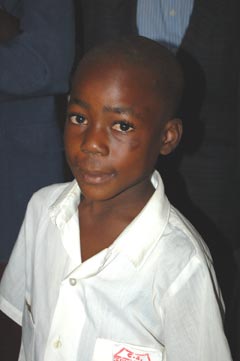
Top photo: The marks of Sapolo's run-in with a motorcycle are evident on his face and head.

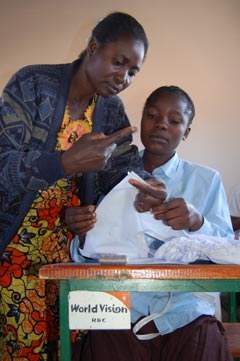
Bottom photo: One of Ephrata's teachers demonstrates a sewing technique to a female student.

Tuesday, July 11, 2006

Another Killer in the Congo: Diabetes

"I AM NOW ALONE"

In the southern Katanga Province, in or near cities such as Lubumbashi, Kipushi, and Kolwezi, World Vision is assisting large numbers of orphans and vulnerable children. As the killer pandemic of AIDS strikes and divides families, so many children lose one or both parents. Typically they are "adopted" by extended family members, but the stress of AIDS on a society already devastated by war and economic catastrophe makes the challenge especially difficult for these families who are now caring for the children of their deceased relatives.

"HopeChild" support provided by our donors is assisting in meeting the needs of orphans and vulnerable children. The latter may not have lost parents, but they nonetheless have special levels of critical need in an impoverished society, due to a debilitating illness such as AIDS.

In addition to HIV, there are also a number of other serious illnesses which can make a child vulnerable. Diabetes and sickle cell anemia are common examples of illnesses which affect children in the Democratic Republic of Congo (DRC).

Felicite Nzabandora is one such vulnerable child, due to a 15-year fight with diabetes. Felicite's surname means "I will see" ... which is sadly ironic, as Felicite is in the process of losing her eyesight. She also has other complications resulting from her battle with a disease which might be relatively easy to control in places where access to medical care is taken for granted; but here in the Congo, in Felicite's home town of Kolwesi, such a disease can and often does create early childhood mortality.

But her first name, "Felicite," means "Joy," and World Vision is working with the Nzabandora family to try and create a hope for a brighter future and a reason for joy for Felicite. Though she has recently turned 18, her small frame and childlike face could easily be mistaken for a child four years younger. In addition to struggles with her eyesight, she also experiences pain and circulation problems in her hands due to the disease.

Felicite is the sixth in a family of seven children, but even her younger sister is a head taller and looks older than she. Her father, Joseph, is a civil engineer, and her mother, Agnes, is a registered nurse ... which is good fortune for Felicitee, since Agnes takes such an active role in trying to ensure her good health in the face of such a debilitating disease. Agnes ensures that Felicite faithfully takes her daily injections of insulin, provided by World Vision, which has helped to arrest the negative progress of the disease.

However, unlike a country such as the U.S. where blood sugar testing tools are readily available and affordable, and diabetics can therefore test their need for insulin several times each day -- enabling them a finer level of control in their administration of the important but dangerous substance -- unfortunately, in the Congo, the only place where blood sugar testing can be done is in a medical clinic or hospital. So Felicitee is only able to get her blood sugar tested occasionally, when World Vision takes her to a nearby clinic for checkups.

In addition, Felicite is now in need of surgery to remove the cataracts which have developed in her eyes. She was forced to suspend her schooling because of her inability to read due to the deterioration in her eyesight.

“I cannot see properly," Felicite explains. "And it is very difficult for me to make a fist. I cannot go to school and it is painful for me. When I see other children going to school, I am really sad. I wish I could also join them, but ….” and she begins to cry.

After she is able to speak again, Felicite says her career goal is to become a medical doctor, so she can help other children who are suffering with diseases such as diabetes.

When asked if she has other friends who struggle with diabetes, Felicite nods her head but remains silent for a moment. Then she explains, through her tears: "All my colleagues suffering from diabetes have already died." At one time, her mother explains, she had four friends suffering from the disease. But each has since died of complications. "I am now alone," Felicite says sadly.

In addition to her health care and medicines, World Vision is also providing food assistance to Felicite and her large family, in the form of milk, rice, potatoes, biscuits, and apples.

I had the privilege of praying for Felicite and her mother, Agnes, during our time together. Please join me in praying for a full recovery of her eyesight and use of her hands.

Friday, July 07, 2006

"Sorcery Children"


Sometimes, when things in life don't go the way we planned, we blame our children. Sad, but sometimes true.

In the Congo, we discovered an extraordinary tale of what is happening as some adults are taking this sad reality to a frightening extreme.

Meet Belinda Kaji Manengu. At only 8 years of age, Belinda should (like other children her age) be enjoying all the carefree fun that life has to offer a child.

Instead, her parents both died of AIDS, and she went for a time to live with an uncle. But, angry about his brother's death, her uncle and his family accused Belinda of witchcraft and blamed her for the tragedy.

Unbelievably, this is a fairly common occurrence in the Congo. In Lubumbashi alone -- a major city near the southern border with Zambia, and an area with a relatively high prevalence of HIV thanks to thousands of truck drivers who cross the border every day -- there are an estimated 2,000 to 3,000 children living on the streets, and the majority of these are there because they have been accused of witchraft. The locals here call them "sorcery children."

In Kinshasa, Congo's capital in the west and largest city, the number of street children is estimated at between 25,000 and 30,000, and at least 60% of them are estimated to be on the streets because of a sorcery accusation. Children as young as 5 have been abused or thrown out onto the streets because of a sorcery allegation.

We were told that pastors and churches are sometimes complicit in this tragic practice. Families upset about a misfortune, such as the death of a family member due to AIDS, will consult ill-informed pastors, who -- for a fee -- "diagnose" the root of the problem as a child practicing withcraft. These children are then subjected to a horrific cure -- "exorcism."

In this case, exorcism doesn't mean what you probably think it does. In order to "cure" these children of their supposed inclination to sorcery, they are basically abused -- even tortured.

We were told about one girl whose skin was burned with fire in order to "cast out the demon." And they are even expelled from their homes and left to wander the streets. Fending for themselves and sleeping in public areas such as parks, alleys, or train stations, they become all-too-easy prey for child sex predators. In addition to being victimized by HIV or violence, they also have a high rate of accidents, being struck by vehicles or run over by trains.

And naturally, many simply run away to escape the abuse. We asked the founder of the World Vision-assisted Faradja Center for orphans and vulnerable children, Mrs. Maguy Numbi, 47, how Belinda came to be at the center. "She ran away. After sleeping at the train station and other places for a number of months," she said, "one morning we discovered her sleeping under the window of our office here and took her in."

"And why did you run away?" we asked Belinda.

"I cannot go back to my family," she replied. "I was beaten every day."

The Faradja Center is far too small to house all of the 230 children they are working with. They have one small bedroom with a bunk bed, where nine boys sleep each night -- two to a mattress, and five on the floor. The room is a third the size of most hotel rooms.

As for Belinda, Mrs. Numbi managed to get her placed with another relative who now cares for her and shields her from abuse. With World Vision's help, providing school fees and uniforms and funds for health care, she also works to ensure that the children are placed in local schools so they can resume their education, and gets them regular checkups and urgent medical attention at local clinics.

But for the Faradja Center, this daily struggle to get children off the streets is a life and death matter. World Vision assists by providing food for meals and other needs, and the 15 volunteer caregivers who work with the children have all received training from UNICEF. They also employ creative means to pay the rent and purchase more of the food they need; the older girls knit sweaters and other garments by hand and they barter them in the market for the cash and supplies they need to stay afloat.

They need far more than they have to work with ... more space, more financial resources (every staff member is 100% volunteer, including Mrs. Numbi, who has nine children of her own to feed), more trained volunteers, and simply more capacity to help children. Mrs. Numbi says that every time they venture out into the marketplace or other public places, they find more "sorcery children" who need to be rescued from almost certain victimization on the streets.

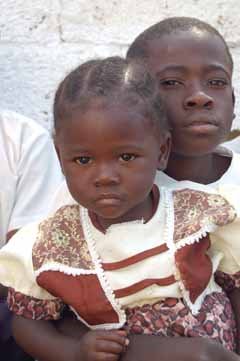
Captions: Top photo -- Belinda's eyes betray just a fraction of the tragedy that has thus far marked her young life.

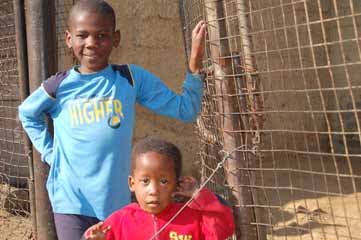
Bottom -- Two more "sorcery children" at the Faradja Center. In addition to all the other struggles these children have to deal with, many of the orphans served by the Center are themselves also HIV-positive, as a result of sexual abuse or vertical transmission from infected mothers (in utero or sometimes due to breastfeeding).

More Info on Sorcery Children -- April 2006 Human Rights Watch report highlighted by BBC News, Worldwide Religious News, and ReliefWeb.

"They say I ate my father. But I didn't." Los Angeles Times, August 29, 2006.

Watchlist Report on child trafficking and exploitation in the Congo

U.S. State Department information on sorcery as a religious practice in the DRC.

Congolese blame Ebola deaths on "sorcery"

IRIN News: NGOs, public authorities denounce killings of suspected "sorcerers" in the Congo

Wikipedia article on how indigenous beliefs in sorcery intersect with Christian faith in the Congo

March 2004 New Humanist article on the torture of child "sorcerers" in the Congo

May 2002 Global Action on Aging article about how sorcery is used as an excuse to abandon the elderly in the Congo

Information about shelters offered by the Catholic Church in the Congo for children and the elderly accused of sorcery and expelled

Saturday, June 24, 2006

The Heart of Africa

Ever have an experience so wonderful that afterwards you thought, "Okay, I could just die happy right now!"

That's the week we just had, and it was in one of the last places you'd expect -- the war-torn Democratic Republic of the Congo (DRC).

We visited World Vision projects in three cities in the southern part of the Congo's Katanga Province: Lubumbashi, Kipushi and Kolwesi.

Time Magazine (see "Congo: The Hidden Toll of the World's Deadliest War") called Katanga "a cursed province." An estimated 4 million people have been killed by conflict in the last eight years. Nothing short of a holocaust, even though you probably haven't heard much about it in the media. And the impact of all this trauma is nearly unfathomable, as recounted by a very interesting article in Christianity Today (see "Hope in the Heart of Darkness").

So, we wondered exactly what we were getting ourselves into as we approached Katanga Province from the south. Certainly, getting there was half the fun. We flew from Johannesburg, South Africa, to Ndola, Zambia, and were then driven overland two hours north to the border with the DRC. Then came the border crossing, a scene of utter and incomprehensible chaos. Cash changes hands at so many points when you cross a border outpost like the one we crossed. The whole crossing took about two hours and included a visit to the office of the DRC commandante in charge of the entire border crossing operation, who said he just wanted to see for himself the white people who were trying to get into his country. Hmmm.

Then another two hours north, and we arrived in Lubumbashi, as bustling and noisy a city as I have ever seen. Horns honking, goats bleating, taxi drivers calling out for fares at every hour of the day or night, music blaring: the city is a blur of frenetic activity. Add the white UN peacekeeper vehicles with their armed soldiers everywhere and it reflects an interesting atmosphere of tension, balanced with hope for a better future to come out of next month's long-awaited democratic elections.

Once in Katanga, we were grateful for the cautious supervision of the World Vision staff who accompanied us and made us feel both welcome and secure. But one of the things I had a hard time getting used to is seeing young men (hired police officers) guarding the entrance to a World Vision office ... wielding automatic weapons.

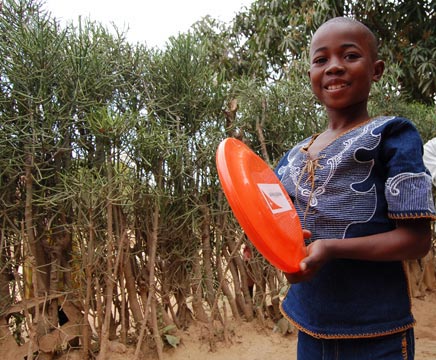
One of the purposes of our visit was our source of greatest joy, and that was the opportunity to meet our sponsored child, Gracia, and her family in Kipushi. Gracia is a pretty and very intelligent young girl of 8. She seemed understandably shy at first. We brought a few simple gifts, including an orange "frisbee," which we had to try out for size out of doors. Our demonstration drew a curious crowd of dozens of friends and neighbors to witness a game which probably isn't played very often in the Congo!

Gracia's father and mother are street vendors, and her mother was in Zambia when we visited so we missed her. But we enjoyed very much the time spent with her father, brothers and sisters, and aunt and uncle. The day's activities included attending a soccer game together, where Gracia helped us with our videotaping.

Despite the language difference, by the end of the day we had become such fast friends that parting ways was difficult indeed.


I know it's not possible, and that what we experienced was an enormous privilege, but I wish that somehow every sponsor was able to visit his or her sponsored child. If so, you could see for yourself what an amazing difference sponsorship makes.

The entire south portion of the Congo was once ruled by large mining company interests, which provided a large portion of the population with work and also built a significant amount of infrastructure ... including schools, hospitals, roadworks, public utilities and even tracts of homes ... for their communities of workers. Unfortunately these mining interests have largely collapsed, and now large portions of the population are unemployed and in desperate poverty, turning to subsistence farming and street vending in order to survive.

I found the Congolese to be a highly creative, resourceful and industrious people. They understand the importance of relationships and know how to take time to build them. They laugh a lot, sing a lot, and dance a lot. They seem to find great joy in simply living. In the midst of great challenges, they have great hope for the future.

And the challenges are enormous. Government is in large part unable to provide even the most basic services. Health care is a significant challenge, with 80 or 90% of the population suffering from malaria and various other serious illnesses. HIV and STDs are also a serious problem, particularly in the south where thousands of trucks stream across the border with Zambia every day, delivering goods from South Africa and elsewhere. In addition to their goods, the foreign truckers are exposing large numbers of girls and women to HIV.

During the week in the DRC I discovered several significant stories I am eager to tell. I visited:
  • a nearly abandoned hospital which is a last vestige of hope for a number of sickle cell anemia sufferers

  • a school for the deaf and mute which draws students from all over the province ... many walking long miles each day, on treacherous roads, in predawn hours to reach it

  • a support center for street children, run completely by volunteers, which feeds and helps hundreds of children each day, many of whom have been abused and expelled from their homes as "sorcerers" because of suspicion that they have somehow brought AIDS on their parents

and more!

I hope to present these stories on this blog in the days to come. However, early Monday morning we catch our flight to our next destination: Harare, Zimbabwe. The one thing we weren't able to do in the Congo is to get a solid internet connection that we could use to upload our daily blogs, which is why you haven't heard from us in so long! Hopefully we will be able to post more regularly from Zimbabwe. So stay tuned! Or else check back next weekend, after we return to Johannesburg.

Thursday, June 15, 2006

A Model of Hope for Fathers Everywhere

"BABA" BRIAN XHALA

Have you ever been stabbed in the back before? I think all of us would answer "yes" to that question ... but we would be speaking figuratively, not literally.

After we arrived in Bergville, South Africa ... a town where World Vision's "Okhahlamba Area Development Program" is headquartered ... we met a man who, quite literally, had been stabbed in the back. It happened during a train robbery that occurred when he was just a young man of 20-something. He left the hospital, after six months, in a wheelchair as a paraplegic. He now walks with the aid of crutches -- thanks to sheer determination -- and even drives a car with a manual transmission. Which is no small feat, as I have been trying hard to do the same thing here!

"Baba" Brian Xhala is now 55 years old and his life has undergone a remarkable transformation. (By the way, like "Mama," "Baba" is a term of respect and endearment here.)

He was raised in Durban but after his injury lived with his grandparents on their farm in the Okhahlamba area. Like most people he knew, he hated anyone whose skin was white because they represented the oppressive Apartheid regime. "We told ourselves that our hatred was merely political, but that wasn't what it was. It was simply hatred."

Thus his life, already quite complicated as a disabled person in a very impoverished place, became even more complicated when he learned that this organization called World Vision, led in Okhahlamba by a white-skinned Canadienne named Monika Holst, was moving into his neighborhood. "We were sure that they would soon move their fences and try to take over our land," he recalls.

He tried to avoid World Vision. But Xhala, a natural born leader and eloquent spokeman for his cause, soon found this to be daunting. He was serving on various civic committees representing the disabled, and World Vision soon began partnering with these organizations.

After several years of exposure to World Vision and its growing ministry among children in the area, Xhala says he gradually became convinced of the truth. "It was the love World Vision has for children. The way they helped them without reservation." He began attending meetings with World Vision. And in these meetings, something else happened. The Bible was opened. People prayed, and they worshipped.

Xhala was not a man of faith; like many around him, he believed "white man's religion" was just another tool of oppression. But what he read in the Bible startled him. The Bible proclaimed justice, and freedom from oppression for all people. Its hero, the Son of God, was crushed to bring freedom to the captives. Like Xhala's own back, Jesus' back was also scarred by human sin ... but he bared it willingly to the scourging so that others could be healed by His stripes.

Soon Xhala found that, just as he could not avoid World Vision, neither could he any longer avoid the Savior who loved him and gave His life for him.

Eventually Xhala became World Vision's director of disability ministries. He works specifically with a group of disabled sponsored children and others in the communities of Okhahlamba. His heart's desire, he says, is to teach and model for them a vision and a hope for a future bright with promise, even for those whose very disabilities tend to rob them of courage and hope.

"Training is the key," he proclaims. He has arranged computer skills training for many of the disabled students, and is very pleased at how well they have done. Some have already obtained very good jobs using their newfound knowledge; computer skills are very valuable in a society like South Africa's which is on the very verge of such technological advancements.

He is also working toward the startup, with microeconomic development funding from World Vision donors, of a casket-making business with mostly disabled staff. Casket-making is big business in South Africa, with its one-in-four prevalence of HIV.

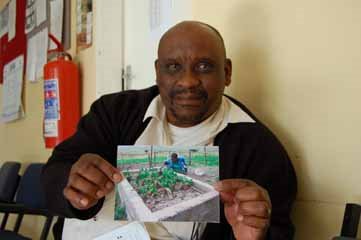
And he finds that hope thrives in even the simplest achievements. While we were speaking, he produced a photo of a young woman in a wheelchair, who was tending a raised garden bed. "What her family really needed was food. When I suggested a garden, at first she scoffed. But together we came up with a plan on how it could work. Now she has one of the best gardens around."

Baba is a busy man, but he is well aware that he can't do it all. This knowledge gives rise to his focus on mentorship. He is pouring himself into the young people God brings into his life, and has already identified at least one that he can turn the reins of leadership over to when he retires.

Xhala, who is married and has two daughters of his own, now grown, is modeling hope for many in South Africa who were simply surviving before. I don't believe Father's Day is celebrated here in South Africa as it is at home in the U.S. (at least not on June 18), but I was sure Baba's story would be a great encouragement for the many fathers, like me, who want our lives to be an example of hope and faith to those around us.

Wednesday, June 14, 2006

Imagine a World Without AIDS

Well, Africa is certainly a wondrous place, but there is one particular lesson I am learning the hard way.

Nothing seems to happen exactly when you expect (or want ... or even hope) it to!

To wit, each time I post a blog to this site, I have been ending by saying things like, "Tomorrow, I will talk about such and such." Well, tomorrow doesn't seem to come for at least 3 or 4 days, most of the time, simply due to how much of a challenge it is to find a decent internet connection and get everything uploaded. The stars have to align before all the equipment and connectivity seems to come together.

I am learning patience! A.k.a., "Africa time."

At any rate, in my last blog, I said I would talk about how our colleagues here in South Africa are working to prepare children for an AIDS-free world. There are two parallel efforts to try and make this happen.

#1: Simply Keeping Children Alive

One is simply to keep children alive and healthy TODAY. With their parents and others around them struggling with AIDS, children themselves are often struggling simply to survive. And World Vision is working hard to help swing the odds in their favor.

In Soweto, for instance, while the famous 1976 Soweto Uprising may have signaled the beginning of the end for Apartheid, many things haven’t changed in this boyhood home of Nelson Mandela which is counted among the world’s largest slums. People are now theoretically free to come and go as they please, but the harsh reality of poverty keeps millions within the township’s boundaries. Unemployment, disease, overcrowding, crime and child abuse seem endemic here. And harshest of all is the scourge of HIV, which afflicts more than one out of every three of the ghetto’s inhabitants.


In the Orlando East Township in Soweto, World Vision staff and volunteers work five days a week to prepare food for about 1,300 sponsored children who swing by the World Vision office in Orlando East on their way home from school each day. Today it is a container full of flavored rice, enough to last the child and one or two siblings through several meals. Different courses are prepared on different days in order to ensure a balanced diet for the children.

Without this food assistance, many of these children would be more vulnerable to malnutrition and disease, and hunger would prevent them from concentrating on their school studies. About 900 of these 1,300 children have lost one or both parents to AIDS and are usually staying with extended family members. With more than 50 percent unemployment in Soweto, these families are among the poorest of the poor and World Vision’s assistance is desperately needed and appreciated.

#2: Keeping Them Safe From Predators and Social Pressure To Have Sex

South Africa has one of the highest rates of child abuse and exploitation in the world. In ghettoes like Soweto (an acronym for “South Western Township” since it is an urban area southwest of Johannesburg), with its desperate poverty, unemployment, disease, and people crowded together sometimes dozens to a small shack-like dwelling, the sad reality of rampant child abuse has prompted the government to partner with organizations like World Vision to seek to address the causes and change the conditions that create the problem.

“Child Rights Week,” celebrated the week before the "Soweto Uprising" anniversary, is one such effort. To commemorate Child Rights Week, World Vision’s Orlando East Area Development Program, which operates in one of the townships in Soweto, helped to organize a special event for children ages 3-6 to empower them and those who care for them to recognize and stand up against child abuse.

The event brought hundreds of students from crèches throughout the East Orlando Township (a “crèche” is a preschool or daycare program) together to a school in the township for a day of teaching, song and dance, food, and special activities, all designed around equipping them to be able to recognize and tell a safe person if they are becoming involved in a situation of sexual or other abuse.


The message being given to children is designed both to empower them to take control of situations where they are being victimized, and to instill the fear of consequence into the victimizers. Cece, one of the crèche teachers who brought her students to the event, said: “We tell them, if somebody asks you to do something you know is wrong, you don't have to keep quiet about it. You can report to your mother, to your neighbor, to your aunt, to your sister, to people you can be comfortable to report to.”

Cece acknowledged that sometimes children are afraid of their parents, so they are given other options of people they can talk to. “They are very young, but they do understand,” she assured. “They are so bright. They understand that if they are told to keep quiet because somebody is doing something bad to them, they can talk with their parents. If they are afraid to talk with their mother, there are other things they can do.”

The event has been taking place annually for several years. Is it making a difference? “Absolutely,” said Cece, citing instances she was aware of where abusive parents had even been arrested and the children removed to protective custody.


Next Time ...

Okay, I'm not going to promise "tomorrow!" Mandy and I have moved from the Big City into the countryside, and today are visiting Okhahlamba (pronounced "Oka-schlamba," with a gutteral schl sound, if you dare to try that), a large rural area to the east of the mountainous eastern border with Lesotho, about four hours journey south of Johannesburg (and therefore halfway to the coast). It is an area of astonishing geological beauty, but great poverty, with many orphans and other children made vulnerable by the AIDS pandemic. World Vision's project here is working in amazing ways to bring hope and help to some of the earth's most vulnerable and impoverished people, and I can't wait to tell you more about it tomorrow ... I mean, "Next time!"
Until then, stay safe, stay well.

Monday, June 12, 2006

THE MAN WITH THE GREEN THUMB

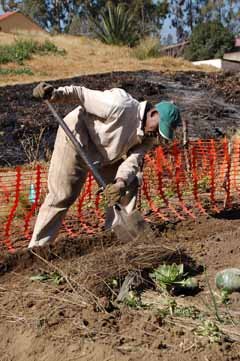
I mentioned at the end of my last blog that, in the battle against AIDS, everyone can contribute something. That truth was driven home to me by a man named Osborn.

Mama Mavimbela and the caregivers I wrote about, such as Maria, are making an obvious and dramatic contribution. They studied hard and have received intensive training in order to offer the care that they are providing in homes. They walk miles each day to minister mercy to many people suffering with AIDS, and their orphans.

But others are using their own skills, as well, to make a difference in the battle. Osborn is doing what he does best and loves most, and is doing it in a way that helps orphans and vulnerable children, as well as people suffering from AIDS in the East Orlando Township.


Osborn’s gift is gardening. He had never before heard the term “green thumb,” but when I told him that's what he was, he smiled. He admits that he has a special gift for growing anything green. Behind the church property where the Tlhokomelo support group meets, Osborn lovingly cultivates a series of garden plots into fresh vegetables that grow year-round in Johannesburg’s mild climate. The edibles are harvested and prepared for the benefit of the patients and orphans that Tlhokomelo is ministering to each week.

Each plot in the garden contains a layer of topsoil established on a deep bed of refuse. The garbage helps to hold in the moisture and create compost, Osborn says. The sight of healthy green vegetables springing up from a foundation of decay is an interesting metaphor for the role of Tlhokomelo’s caregivers in this AIDS-plagued township.

What he likes to grow most, Osborn says, is flowers. “But you cannot eat them,” he grins.


“I develop this garden for the community,” Osborn says, “for those that are affected by HIV and AIDS. They need something to eat.”

I was deeply impressed by Osborn's humility, honesty, and commitment. He was doing what he loves doing and is good at ... using the gifts that God has endowed him with ... to make a difference in the battle against AIDS, to help people overcome. God bless him!

My question for you is, what has God gifted you with? What do you love doing? And how can you, like Osborn and Maria and Mama Mavimbela and others, employ those gifts in the battle to save millions of suffering people from the scourge of AIDS?

Tomorrow, we look at what World Vision in South Africa is doing to equip the children and strengthen them for the battle.

Friday, June 09, 2006

ACQUAINTED WITH SUFFERING, FAMILIAR WITH GRIEF

One of the challenges of the global AIDS pandemic is the fact that it is so big, the suffering and death and poverty so vast, that it is mind-numbing. How do you put a human face on statistics that tell you things like:

  • There were 4.9 million new HIV infections worldwide in 2004, according to UNAIDS. 3.1 million of these occurred in sub-Saharan Africa.
  • During 2004, 3.1 million people died of AIDS -- 2.3 million of them in Africa.
  • That same year, 2.2 million children worldwide were living with HIV. More than half a million perished.

Too mind-boggling, you can't wrap your heart around it. It simply doesn't hurt.

Well, there's a cure for that. Go and visit one person whose life has been devastated by HIV.

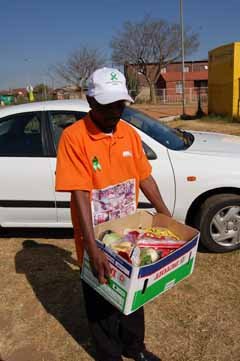
After we left the Home-Based Caregivers group we told you about yesterday, we went with one of the caregivers, a softspoken young gentleman named Mandla. By the way, everyone you meet here always tells you not only their name, but what it means. I think that's kind of cool, that everyone lives constantly with the meaning of their name. "Mandla," we were told, means "strength." He proceeded to demonstrate, carrying a large box of vegetables and other food from the car toward the home of one of his patients, a 42-year-old woman named Sinnah.

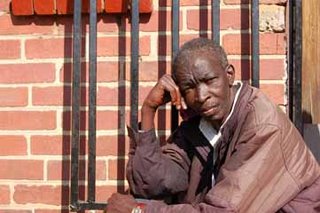
The red brick home looks comfortable and peaceful. A large yellow container, half the size of a railroad car, is located in one corner; we are told that's a set of portable telephone booths for the neighborhood's use. Apparently the family derives some income from renting the precious space. Outside the home, a gentleman sits and contemplates us silently. The lines etched into his face makes him seem incredibly sad.

Inside the home we meet his wife, Sinnahme, and her daughter, who lies pallidly beneath a large woolen blanket. Her gaunt face and tufts of scruffy black hair accentuate the size of her eyes and make them look both enormous and probing, though dull with pain. We try to gauge, by looking at the space occupied by her form beneath the blanket, her emaciated frame. I don't think she could have weighed more than 70 or 80 pounds.

Several of Sinnah’s children, ages 5 through 22, are in school as we visit. The sixth, a daughter -- born shortly after Sinnah’s discovery of her illness -- contracted the virus in utero and died two months after birth. Sinnah whispers her name sadly then explains, “It means: ‘Hidden.’”

Sinnah’s husband, too, succumbed to the disease last year. His name, Silloh, means “Moaning.”

The compassion shown to Sinnah by her mother is, sadly, not the norm in this society. Many parents ostracize their children after learning of their illness, sometimes forcing them to spend their days wasting away in one of the corrugated metal shacks which are so common in Soweto. The stigma of AIDS is a powerful enemy. While she is accepted by her mother, their friends and neighbors whisper and point. “It kills you,” Sinnahme says. Even Sinnah’s own brothers refuse to visit her in her sickbed.

But Mama Sinnahme explains, with a tear: “I’ve got four boys and this is the only girl, and she is a gift from God, so we must care for her.”

Mandla delivers his food and encourages Sinnah and her mother to prepare something that she can begin eating. Antiretroviral drugs (ARVs) have recently been made available to patients like Sinnah by the South African government, but she needs to eat before she can begin taking them. If she can eat and keep food down, then take her ARVs, her strength may return and her situation could improve dramatically. It happens all the time, the caregivers know. So they counsel, and encourage, and pray. And hope.

Tomorrow: We meet one man who is doing something to help. Something very simple.

Everyone can do something!

Wednesday, June 07, 2006

WHO CARES???


Soweto has to be one of the most intensely human places on earth. An acronym for "South Western Township" -- since it is the urban area on the southwestern side of Johannesburg -- Soweto is home to nearly 5 million people, and it is only 30 miles by about 25 miles in size.

There are many different individual townships within Soweto, and World Vision is working most intensively in "Orlando East."

There are so many people packed into Orlando East that it seems a world unto itself. We visited in one home that was occupied by an unbelievable 45 people! Mothers, fathers, brothers, sisters, aunts, uncles, cousins, grandparents and grandchildren, great-grandparents and great-grandchildren, all live together on a piece of property far smaller than the one occupied near Seattle by my wife and daughter and me.

There are rows and rows of similarly constructed home sites, and each of these sites also contains on average several "shacks" (small, corrugated tin outbuildings, maybe 10 or 15 feet on a side, which are themselves homes that are rented to others, usually family members), often so close they are almost touching.

Before apartheid ended, people had to live in Soweto ... they couldn't leave. Now they don't have to, per se ... but many people are still trapped in the ghetto, by economic circumstance. Others, like our guide Guguletha, World Vision's "Netcare Program Manager" for the Orlando East Area Development Program (ADP), simply consider it home. I'm not sure about how they feel about the crowds, but they love the people.

And much love is required. Every other person in Orlando East is unemployed ... and one out of three is HIV-positive. We saw more funeral businesses than any other kind of establishment. Business is booming for the undertakers in a place so devastated by the scourge of AIDS.

It takes a special kind of person to dish out simple human caring and compassion in a place of such overwhelming needs. We met a whole roomful of such special people when we visited the Tlhokomelo Home-Based Care Project.
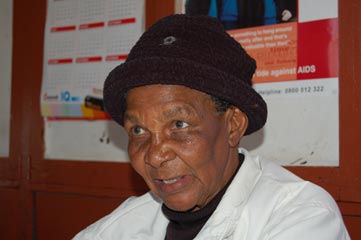

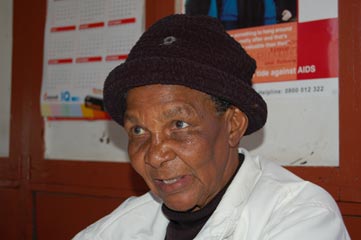
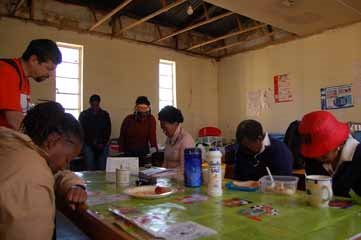
Under the direction of "Mama" Jakobel Matilda Mavimbela, a nurse who began her professional career in the 1940s, the project employs 14 "home-based caregivers," 10 of whom have completed special government certification that makes them the equivalent of a nursing assistant or better. These compassionate angels walk miles and miles every day, five days a week, to visit a minimum of 5 (usually closer to 10) people, most of whom are AIDS sufferers, but also the elderly and infirm with other conditions. They provide food, help people with their medicines, wash their wounds, pray with them, care for them and in general try to get them well enough to attend weekly group meetings at the center.
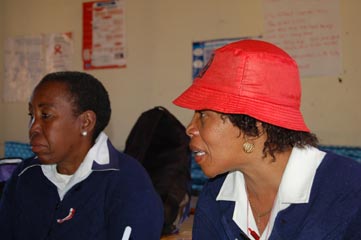

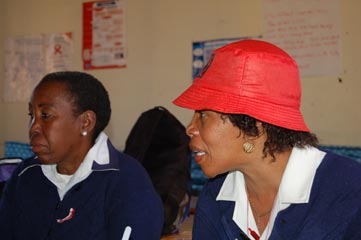
Maria (wearing the red hat) was one of the caregivers who held me spellbound by her testimony and commitment to this very difficult cause. When I asked her, "Why do you do this? What makes you get up in the morning to come to a job like this?" her answer was shockingly straightforward:

"I am HIV-positive," she said softly. "This is my fourth year. Doing this job wasn't what I wanted to do after finishing school, in 2003. Then I started working at other companies. But I started falling in love with the job when I started working here.

"I never wanted to be a nurse, I wanted to work in an office. Then I started to come here one day, and I saw what the ladies were doing, and I started to fall in love with the job."

"What do you love about it?" I asked.

"Meeting different kinds of people," she told me. "Telling people about my status. Because I know, particularly when I say, I am HIV-positive, they look at me in amazement ... 'Oh! You?' It really opens doors. They want to know how many years, and it proves that I am able to work, and it helps take the stigma away. I can help these people. Even if I cannot give them anything, I can give some of myself."

Maria acknowledged that her job is a lot of work. Even just the walking, the miles they put on each day, is a lot of work. "But we really love doing it," she assured me. "The feeling we get when we see a patient coming to the support group for the first time, when they get feeling better and are up and around ..."

I told her I thought that one of the hardest parts of her job, for me, would be losing people that she became close to, and she agreed. "Sometimes we blame ourselves," she admitted. "We think, maybe I didn't do enough."

I asked them what they needed to keep on doing what they are doing, and the list was long: Prayer; encouragement; training; bicycles; more gloves and bandages, practical things like that. My prayer is that we can help provide for them some of the things they need to make their lives and jobs easier.
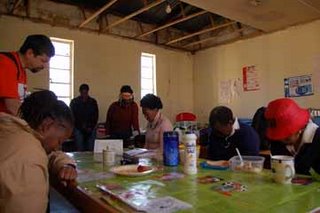

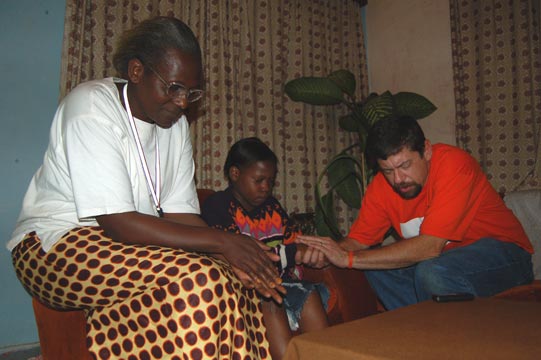
At the close of our time together, it was a privilege for me to pray with and for this group of compassionate caregivers, who were, in more ways than anyone I have yet to meet, the hands and feet of Jesus.

The day wasn't over, but my blogging energy for the moment is exhausted! Next we had the privilege of accompanying one of the caregivers on his rounds. More on that tomorrow!

Photo captions:

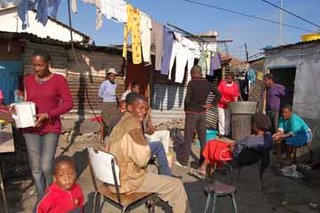
Top left: 45 people live in this household in the Orlando East Township in Soweto.

Right: Mama Mavimbela is director of the Tlhokomelo Home-Based Care Project. Fourteen caregivers report to her, and they care for more than 100 people each week, many of them AIDS sufferers, in addition to their families and orphans.

Left: Maria (at right in the photo) has been HIV-positive for four years, which creates a common bond with the people she is ministering to on a daily basis. Her love for her job is strong.

Right: I appreciated the opportunity to pray with and for these wonderful women before we left, with a caregiver named Mandla, to visit an AIDS sufferer named Sinnah as a part of his daily rounds. (More on this tomorrow!)

Tuesday, June 06, 2006

A DREAM COME TRUE

We are here in South Africa, at the beginning of what is planned to be a five-nation tour of World Vision projects seeking to address the suffering of Africans battling the HIV/AIDS pandemic, as the fulfillment of a lifelong dream ... not only to visit such a wonderful and amazing place, but to do it together as father and daughter. What could be better?

And we have come at a truly amazing time. June 16 is celebrated in South Africa as "Youth Day," commemorating the start of the Soweto riots of 1976. The riots were initially sparked by a government edict that all instruction in black schools would be held in the Afrikaans language, the language of white power and privilege here in South Africa. Peaceful student demonstrators were met by police violence, and a number of black schoolchildren were shot by the police. The tragedy brought home to many people within and outside South Africa the brutalities of the Apartheid regime.

Today is June 6 (6/6/06 ... does anyone else feel a little creeped out by that?), 10 days before Youth Day, and it is the beginning of our fourth day in South Africa. I think we have finally overcome the jetlag and are adapting to our surroundings, including "re-learning" how to drive a stickshift when everything left/right is reversed from the way we are normally accustomed.

While it is the beginning of summer at home, near beautiful Seattle, here the winter is coming on. The nights are cool and crisp, but so far the days, though shorter than we are used to, have been warm and sunny. Where we are staying in Roodeport (a busy suburb of Johannesburg), the night air is filled with the smell of many campfires, but in daytime this is nothing but a bustling city that looks for all the world like Los Angeles.

Our transition has been helped by the wonderful and warm staff in World Vision's Southern Africa Regional Office, as well the gracious and dignified people, black and white, who inhabit this beautiful country.

We are so excited because today is our first real day "in the field." The Soweto Townships, site of the original Soweto Riots, are still among the most impoverished ghettos on earth, and World Vision is working hard to help South Africans improve their quality of life there. We are only minutes away from departing for the Townships for a very special youth event, facilitated by World Vision, designed to empower children in our projects to be aware of their rights and able to speak for themselves.

Too often the most vulnerable people on our planet are the ones, like children, who have the least options in speaking out for their own welfare and making their circumstances known. We are grateful that here in South Africa children are being valued and taken seriously and will be very interested to get to know some of these children and their stories, and hopefully be able to share some of these with you in this space, this time tomorrow!

Tuesday, January 31, 2006

Katie Roland and Amber JohnsonDay 9: BUILD BACK BETTER ... AN OPPORTUNITY TO HELP!


Posted from Pakistan on Friday, Jan. 27, 2006
By Katie Roland, Metro Marketing &
Communications Director for New York
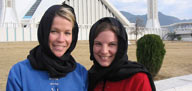
Katie Roland (L) & Amber Johnson (R)
are directors with World Vision's
Metro Marketing & Communications
offices in New York and Chicago


Well, we are back in Islamabad now, wrapping up our trip. As I sit here in my hotel room, processing the experiences of the past week or so, I am both overwhelmed by all the devastation and destruction I have seen, and am hopeful for the recovery of this beautiful country. Continued below.


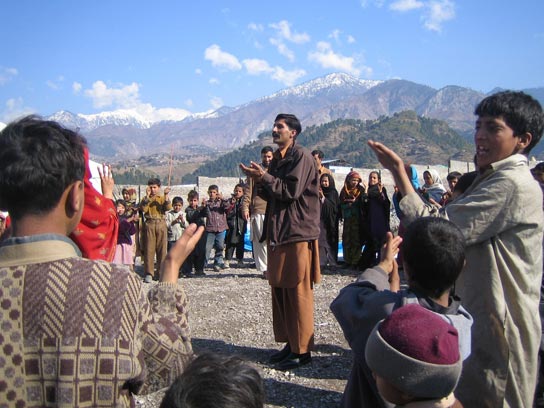
Children are safe at one of World Vision's "Child Friendly Spaces."


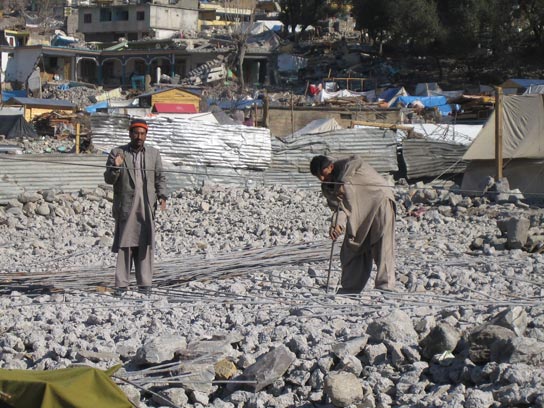
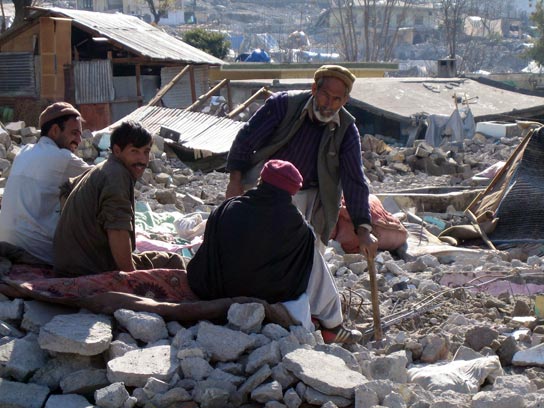
Pakistani men working to rebuild their earthquake-devastated community.


I have been welcomed by the people of Pakistan, in a place that typically has a good deal of apprehension toward Americans. I have met people who are eager to move on with their lives, who are picking up shovels, axes and hammers and are beginning to rebuild where they can.

I have met children who were once too scared to go to school and watched them join in games and singing at World Vision’s Child Friendly Spaces, places that enable them to overcome their fears and rebuild their self-confidence. I have met World Vision field staff who are deeply committed to seeing Pakistan restored and who are humbly and compassionately caring for children and their families.

I have seen amazing partnership between World Vision, the Pakistan Army and other nongovernmental organizations, and know that this rebuilding process is being done with a high level of integrity and a good deal of strategic planning.

And most importantly, I have had the opportunity to get to know some of the people who have been impacted by this quake, to learn their names, to hear their stories first-hand, and to grieve alongside them.

A reporter I spoke with this week asked me how I was handling the suffering I had witnessed. What a difficult question to answer, especially because some aspects of suffering can’t fully be explained. But the one thing I was able to share in my interview is that suffering provides an opportunity for those of us who can help to get involved. It enables people to bring healing and hope to those who might not be able to find it on their own.

As the world helps Pakistanis begin to rebuild their country, a common saying has emerged to frame the rebuilding process: “Build back better.” Though we may or may not know the kind of suffering so many Pakistanis are experiencing, we have an opportunity before us. We have the opportunity to participate in God’s plan for healing in a place that has been shaken. We have the option to pray, to hope, to give in ways that we’ve never done before. And we have the ability to help those in deep need to rebuild their communities better than they were before.

“For the mountains may depart and the hills be removed,
but my steadfast love shall not depart from you,
and my covenant of peace shall not be removed,”
says the Lord, who has compassion on you.
O afflicted one, storm-tossed and not comforted,
Behold, I will set your stones in antimony,
and lay your foundations with sapphires.
I will make your pinnacles of agate
your gates of carbuncles,
and all your wall of precious stones.
All your children shall be taught by the Lord,
and great shall be the peace of your children.
In righteousness you shall be established;
You shall be far from oppression, for you shall not fear;
and from terror, for it shall not come near you.