
To help:
Friday, May 09, 2008

Thursday, February 28, 2008
Tired but Happy Northern Uganda Lobbyists Head Home
 On Tuesday, February 26, a wave of neon green shirts descended on Capitol Hill. More than 700 representatives visited their states' senators and state representatives to advocate in the Lobby Days for Northern Uganda.
Before taking the Hill, participants met beforehand to go over tips on lobbying. The crowd greeted Grace Akallo, a former child soldier, with a standing ovation worthy of rock star. "War/Dance is real, not just a movie." she told them.
 Then the teams were off. The gray skies and drizzle outside only served to make their green shirts more vibrant and noticeable. People in the halls of the Senate office building stopped team members to ask about their cause.
Kathleen, from the West Virginia team said, "I didn't know that much about the issue before coming here, but I learned so much."
Jessy and Jenny from Colorado are young mothers. "I most certainly don't want to get to heaven and tell God that, you know, I didn't do what You told me to do. You told us to help the widows and the orphans. I didn't do anything. I just had a great life in America all by myself," Jenny says. "There has to be some point where people feel accountable for the atrocities going on and feel like you need to do something about that."
 Jessy said she knows a lot about the crisis in Darfur, but first learned about Uganda by watching the movie Invisible Children in a social work class at Colorado State University. Jessy seeks to raise awareness with her clothing and bag line called "Who Cares." The bags and clothing carry attention-grabbing phrases that provide a jumping-off point to start a conversation. She then donates half the net profits to causes.
Near the end of the day, they met up with their district's representative, Congresswoman Marilyn Musgrave, who told the entire Colorado group, "I'm proud of you for doing this."
Wendy and Patricia, from Massachusetts, felt called to do something about the crisis in northern Uganda when Grace Akallo came to speak at their church. The two friends journeyed to Washington, D.C. to learn more about the issue so they can share with their church the Sunday they return. They hope that what they share will encourage the church members to "put their faith in action in northern Uganda," Patricia said.
 "I wish more people could see how active the youth are," she continued. "We get a lot of bad news about youth in the news. You don't hear so much about the positive."
Wendy said, "I've never attempted anything like this. They made it easy for non-advocates. You're not facing your senator all by yourself."
At day's end, Alison Jones of Resolve Uganda thanks the group and says, "This is the largest lobby event ever for an African Initiative. Thank you!" She tells the group that their efforts have definitely been noticed. She talked to Senator Feingold (D-CA) earlier in the day (a co-author, along with Senator Brownback (R-KS), of a letter urging the U.S. Government to allocate funds to northern Uganda), who said, "I've seen a ton of green shirts on the Hill. Thank you for what you're doing."
 The success of the Lobby Days can be seen on multiple levels. The event reached out to people across the generations. People feel more knowledgeable about the crisis now. The prospect of being advocates and lobbyists for their cause is not quite so intimidating anymore. "I'm definitely going to write follow-up letters," said Jake, from Ohio.
The most important result of the Lobby Days for Northern Uganda is that the voices of all the people in vibrant green t-shirts could help secure financial aid from the U.S. Government so the Acholi people in northern Uganda can return to their homes and live with dignity.
 Posted by Larry Short on behalf of Laura Reinhardt in Washington D.C. Laura is Assignment Editor for World Vision in the United States and has just completed her coverage of Lobby Days for Northern Uganda.
Wednesday, February 27, 2008
'An Atrocity of the Highest Degree ... Happening on Our Watch'
 Hello from Lobby Days for Uganda. My name is Cherish Newman. I am 30-year-old mother of four from Utah. I am here at Lobby Days with my dad, sister, brother-in-law, and my 10-month-old baby girl.
We have a family foundation that looks to help “the world’s most vulnerable.” We are fairly new to the crisis in Uganda, but we feel that the people in northern Uganda are on the top of the "most vulnerable" list.
 I think the biggest reason I am here is that I have an 8-year-old little boy who is so innocent and sweet and my worst fear as a mother would be to see him ripped from my arms, brutalized, and taught to be a killer. That is an atrocity of the highest degree and it is happening in our world, on our watch. My mother's heart cries out for those children who feel like my children, and those mothers who are my sisters.
They must feel so powerless! But, after these couple of days I feel empowered on their behalf. I have been so impressed at the enthusiasm and commitment of the organizers of this event. I am amazed at the knowledge and thoughtfulness of the speakers and panelists. I am humbled by the truth of the power of the people to amplify the stories of our brother and sisters in Uganda to our leaders. I am also thankful to the good people we have met on this adventure -- some great policy advocates named Bob, Corryne, and Sue who showed us the ropes on Capitol Hill today.
 It has been an education and an adventure. We are glad we came and we feel like a difference was made. Most of all, I am grateful to my Father in Heaven who has blessed my family so greatly and has spoken to the hearts of so many good people to advocate for this cause.
Posted by Laura Reinhardt on behalf of Cherish Newman at "Lobby Days for Northern Uganda" in Washington D.C.
Tuesday, February 26, 2008
Speaking Out for the Voiceless
 Can one person make a difference? This question was on the mind of many who arrived in Washington D.C. for the "Lobby Days for Northern Uganda" event. The lobby was packed with a crowd that spanned the decades from pre-teens to those nearing retirement age, the majority being college-age and twenty-somethings. They have all come to make a change in Northern Uganda.
The three-day event began with a screening of the Academy Award-nominated documentary "War/Dance." The moving film follows the story of three children whose lived have been horribly altered because of the atrocities in Northern Uganda. However, through a national dance and music competition, all three children had found renewed hope.
 Hope was on Lisa Coggin's mind on Monday morning. She believes that the war in Northern Uganda has robbed the Acholi people of their hope and their sense of purpose. Lisa and her husband, Keith, are missionaries in Uganda who are home on furlough. They heard about Lobby Days for Northern Uganda through a World Vision e-mail. "The more I read about it," she says, "the more I thought that I would just love to go there and see what they're doing."
She continues, "We don't really know what to expect from [the Lobby Days]. We're a bit vague. We're not very political. We live our life in a village so even America has shocked us, coming back. This is out of our element. We're very timid of it. We're willing to be involved and to do what we can and to speak out."
It's plain to see how deeply Northern Uganda and the Acholi people have touched Lisa's heart. "They deserve dignity. They deserve a hope. They deserve a future."
She thinks the people in the village where they live and the people in the displacement camps will be encouraged to know that people are speaking out for them. She says, "I think it will help for them to know that people are trying; that people care enough.
 "The Acholi people have lost their voice. No one has heard them for 22 years. They have not spoken. I just thank God for people who step in and have become their voice and have relayed their voice to others and their cry."
Can one person make a difference? Most definitely! That is what the Lobby Days for Northern Uganda is about -- making a difference. But if people band together, they will amplify the cries of Uganda so that their voices carry farther.
Posted by Larry Short on behalf of Laura Reinhardt in Washington D.C. Laura is Assignment Editor for World Vision in the United States and is currently on assignment at Lobby Days for Northern Uganda.Monday, February 25, 2008
Hundreds advocate for peace in northern Uganda
This week, several hundred participants are attending the Lobby Days and Symposium for Northern Uganda in Washington, D.C.
 This three-day event (Feb. 24-26) is bringing together concerned citizens from around the country to speak out for children affected by the 22-year war in that region — a war that has turned thousands of children into soldiers and sex slaves. World Vision is a key sponsor and co-organizer of this event.
Participants will have the opportunity to learn more about the ongoing crisis in northern Uganda, and then urge policymakers to do what they can to end it.The event includes a daylong advocacy training symposium, where attendees will hear from experts on the northern Uganda crisis and other areas of conflict, as well as grassroots and media outreach. Event components are designed to increase understanding of the crisis and expand the movement by maximizing grassroots mobilization.
On the final day of the symposium, attendees will meet with congressional staff to press their lawmakers to do more to achieve a sustainable resolution to the conflict.
Can't be at the Lobby Days event yourself?
This three-day event (Feb. 24-26) is bringing together concerned citizens from around the country to speak out for children affected by the 22-year war in that region — a war that has turned thousands of children into soldiers and sex slaves. World Vision is a key sponsor and co-organizer of this event.Participants will have the opportunity to learn more about the ongoing crisis in northern Uganda, and then urge policymakers to do what they can to end it.The event includes a daylong advocacy training symposium, where attendees will hear from experts on the northern Uganda crisis and other areas of conflict, as well as grassroots and media outreach. Event components are designed to increase understanding of the crisis and expand the movement by maximizing grassroots mobilization.
On the final day of the symposium, attendees will meet with congressional staff to press their lawmakers to do more to achieve a sustainable resolution to the conflict.
Can't be at the Lobby Days event yourself?
You can still participate -- through this blog! Over the next few days of the symposium we will be asking special "guest bloggers" to share with us their perspective on what is happening. Please check back over the next few days and read what they have to say, then add your own comments by clicking the "Comments" link at the bottom of each blog posting.
 Please pray for peace in northern Uganda and that our government leaders would increase their presence as peacemakers. Together, we can say that peace is possible and that no child should ever be a soldier.
You can join your voice with these advocates by adding your name to our "No Child Soldiers" Declaration.
A child soldier in Uganda.
Photo by Jon Warren, copyright World Vision 2008.
Thursday, February 07, 2008
Helping hands
 We landed in Goma this afternoon. Tomorrow, I head back to Lubumbashi, and from there I will fly to Johannesburg, South Africa for two days of meetings before I leave for home in the USA.
When we arrived in Goma, before going to the office, we made a stop to say hello to Horeb's sister, Claudine, a customs agent at the road which forms a border between Goma, DRC, and Gisenyi, Rwanda.
She was beautiful, and greeted me like a sister. As we were talking, Horeb and his sister froze, and signaled me to stand perfectly still. It was 6 p.m. and they were taking the DRC national flag down.
Whenever the flag is raised (at 7 a.m.) or lowered (at 6 p.m.), all must stand still in reverence until the flag is in place. Otherwise, you could be charged stiff penalties.
I was amazed and inspired. I had never seen such reverence shown in the U.S., but even in the midst of this war-torn country, occupied by many foreigners over the course of its history, a real sense of pride and national unity could rise out of it all, enough to bring everyone to a reverent standstill.
 And, at this border which has seen so many crossings of soldiers, refugees, and everything in between, all were respectfully still until the flag was neatly folded and put away.
"You must come by tonight and have dinner!" cried Claudine. Now that our adventures were over, Horeb was staying in Goma to finish up other project work.
"You are always welcome, my little sister, Rory," Horeb smiled. "You are family now. Please come and join us tonight."
Yes, I do feel like I am among family here. I do feel at home. So, I promised that I would stop by for dinner. Horeb and I waved to his sister and piled into the car, promising to be to her house around 7 p.m. We continued to wave to Claudine out of the window, but the car would not move. The driver could not get the car started; the engine wouldn't turn over.
Horeb and I got out. "Do you think it needs a jump, or a charge to the battery from another car?" I asked. "No, it just needs a push," Horeb replied. And so I watched as Horeb and 2 other guys pushed the car until it started.
 Horeb smiled, shook the two guys' hands, thanking them for their help; he then smiled at me and we both piled back into the car, waving back to Claudine as we drove down the road.
As I leave the Congo that image stays with me, as a fitting and prophetic way to end this trip -- with helping hands, pushing in the right direction, I know that the Congo will move forward.
Posted by Larry Short on behalf of Rory Anderson in the Congo.
Wednesday, February 06, 2008
Searching for Baraka
 We stayed in Butembo on Friday night. On Saturday we drove for miles and miles, through hills and forests, trying to find Baraka.
Baraka was rumored to be between only 7 and 12 years old, the "general" of a contingent of Mai-Mai soldiers, who use traditional witchcraft to give them power. The Mai-Mai date back to the 1960s, around the time Che Guevara was in the Congo, and they have ebbed and flowed through the DRC's history. Most recently, they have been comprised of local forces who have fought against both Rwandan, Ugandan and even Congolese troops in the defense of their area.
"I think we can find him, and I'm sure he'll talk if we find him," said Horeb. "But, we may have to walk in the jungle a bit. My Mai-Mai contacts say he is not far from Virundu, but he will be in the jungle, so we will have to leave the vehicle and walk. Will you walk?"
"In the jungle, with snakes, Horeb? I need to think about that. Besides, I only have sandals, not boots like what you have. Are you sure he won't come out to the town to talk with us? I don't want to walk five miles in the jungle. I'm not cut out for that."
"We'll see, Rory."
We drove and made many stops among many villages, talking with many chiefs, but we saw no sign of any Mai-Mai soldiers. In fact, we saw only FARDC soldiers. Apparently, the Mai-Mai had been pushed back into the jungle; many had been killed or scattered abroad.
We drove and made many stops among many villages, talking with many chiefs, but we saw no sign of any Mai-Mai soldiers. In fact, we saw only FARDC soldiers. Apparently, the Mai-Mai had been pushed back into the jungle; many had been killed or scattered abroad.
Toward the end of the day, we made our way back to chat with one of the area sub-chiefs and a FARDC major. This time, we point blank came out and asked about Baraka and if they knew of his whereabouts. This struck up a lively and spirited conversation.
Baraka still lives, the major told us, but his forces had been pushed back -- "They are bandits!" The sub-chief began to recount how Baraka's parents were once Mai-Mai warriors, and how his father, in particular, had performed many miracles in battle.
However, his father and some of the Mai-Mai troops eventually began looting local villages. As a result, he began to lose power and was eventually killed. But before he died, he was reported to have transferred some of his "ju-ju" to Baraka, his son, who was just an infant at the time.
"Is his mother still fighting?" I asked.
"No," the chief replied. "She is staying in Beni. She left the Mai-Mai, but the boy is still in the bush."
With that intelligence, we headed to Beni, which was about an hour's drive from Butembo. For the moment, we gave up searching for Baraka, realizing that since his forces had been beaten back they would likely be desperate and more dangerous. Horeb and Faustin were disappointed, as they both really wanted to meet Baraka, the young general.
With that intelligence, we headed to Beni, which was about an hour's drive from Butembo. For the moment, we gave up searching for Baraka, realizing that since his forces had been beaten back they would likely be desperate and more dangerous. Horeb and Faustin were disappointed, as they both really wanted to meet Baraka, the young general.
"This is still worthwhile, guys," I chimed. "We now have a new target -- Baraka's mother. That's our story now. Can you imagine a mother's agony as she knows that her child is soldiering somewhere in the bush? Let's see if we can track her down." And so, off to Beni we went. What a nice drive it was, through lovely tea plantations and forest, until we got to another small town.
 Horeb has many friends, and his wife has relatives who live here in Beni. Through these contacts, and through several visits with different people, and many drives around the town, we eventually found Baraka's mother -- not a warrior at all, but a pretty young woman laying in a hospital bed. She was reluctant to talk with us, but she finally came around. She did not share much of her own story, but she shared her pain as a mother -- how badly she wanted her son back.
"They [the Mai-Mai] are using him. They have brainwashed him and he won't come out." She told us that Baraka was abducted from her when he was only 2, and that he is now 7 years old. He was demobilized and passed through a child reintegration center, after which she put him in school, but the Mai-Mai soldiers re-abducted him from the school and took him back to the bush.
They believe somehow that this little 7-year-old holds the key to victory. But his mother pleads, "I want him to go school. I just want him to go to school." Horeb and I sat silent, so near the end of our journey, saddened and broken by her story and her plea.
"We need to help her," I told Horeb. "Do you think the Mai-Mai would work with us to hand Baraka over?" Horeb asked her about this, and she was convinced that the Mai-Mai might just listen to someone from World Vision and perhaps turn 7-year-old Baraka over to us.
"But we would have to move him out of the area, Rory, otherwise they will take him again," explained Horeb. "I think I could go into the bush and talk with the Mai-Mai," said Horeb, "but I'll need permission from World Vision in order to do so. Will you talk with the director for me? I want to help and see if we can save Baraka." We must, I thought. We must help!
We reluctantly left Beni the next day. Horeb and I flew back to Goma; Faustin drove the vehicle to Goma (thankfully he arrived safely, without any problems). Horeb and I planned how we might continue our search for Baraka.
We reluctantly left Beni the next day. Horeb and I flew back to Goma; Faustin drove the vehicle to Goma (thankfully he arrived safely, without any problems). Horeb and I planned how we might continue our search for Baraka.
Horeb said he would be free to go back to the area in about two weeks, to go into the jungle, to talk and negotiate with the Mai-Mai to see if they might hand Baraka over to World Vision. The Mai-Mai know of World Vision, as we have done service delivery in that area, so they may just trust us with Baraka; it might possibly work. If anyone could negotiate with these people, Horeb is the one, and he is willing to try.
Horeb is amazing. Truly amazing. We must help Baraka. We must help this mother get her 7-year-old son back.
So, I did not actually find Baraka this time, but I was close. I will make certain to ask the director of World Vision in the DRC about this. We made a promise to Baraka's mother to help her and her son. I hope we can follow through.
So, I did not actually find Baraka this time, but I was close. I will make certain to ask the director of World Vision in the DRC about this. We made a promise to Baraka's mother to help her and her son. I hope we can follow through.
Posted by Larry Short on behalf of Rory Anderson in the Congo.
Tuesday, February 05, 2008
Bigger even than Rambo
It's been a while since I logged on, due to acute travel fatigue, sickness, and lack of an internet connection -- but I must write about what happened on Friday. Horeb and I left Katanga on Thursday to travel to the eastern part of the Democratic Republic of the Congo -- specifically, North Kivu province.
A beautiful place of great lakes, mists clinging to rolling green hills, tea plantations, and chilly temperatures exists in sharp contrast to some of the worst violence against civilians in the world, especially women and children. Ongoing violence is perpetrated by several armed groups from Rwanda, Uganda and the Congo.
I wanted to get stories and footage on child soldiers, and to check up on some of our child protection work being done in the Beni area of North Kivu, so into the mix we flew, taking a long flight from Lubumbashi (four stops along the way) up to Goma, the main town in North Kivu that sits right on Lake Kivu, with a sweeping view of Rwanda on the other side of the lake.
But, how to get there?
"Let's get a security update from MONUC." Horeb suggested this as we were waiting for our World Vision colleagues to pick us up from the airport. MONUC is the acronym for the United Nations Peace Keeping mission in the Congo, which is currently the largest UN peacekeeping deployment in the world.
"It may be better to drive than to fly, but let's also check on getting a plane reservation to Beni as well. It's good to have more than one choice in the Congo, Rory," he advised. "And you said when you first proposed this trip back in December that you would be flexible, so ... let's be flexible ...." Horeb made such suggestions with a broad smile.
"You keep throwing that word back in my face," I smiled in return. "But, no problem."
"You'll like the drive," Horeb assured me. "A beautiful view of the Congo River basin and the Nile River basin as you drive along, and many plateaus and views. It's amazing!"
"Wow. Sounds wonderful! Let's drive, Horeb! That's my choice! I'd much rather drive than fly!"
"Okay. But first let's check with MONUC on the security situation. And I want to pick the right driver for this mission and get a new vehicle to make sure it can handle the trip." I should have tuned in better to the fine print, but I was so excited to see Congo by road! I couldn't wait to take pictures and actually be a "tourist" in eastern Congo, for a change.
After the typical back-and-forth to many different offices and talking with a couple of different people at the MONUC-Goma compound, they said they would give us a military escort from Rutshuro up to Kanyabayonga. The commander said they had a convoy going in that direction anyway, so we could drive along with it. Great! One option in the bag.
We also did the requisite running around to see if we could get a flight from Goma to Beni, instead of driving, but that didn't quite work out, as there was only one seat available. So, we were forced to drive anyway. No problem -- I had already set my mind on driving.
But Horeb softly asked again while we were trying to negotiate a flight -- "Are you sure you want to drive? You can take the flight up and Christian should be in Beni by now, so he can take you."
"No," I responded enthusiastically, "let's just drive. You've got the contacts of the people we are meeting in Beni, so you should come. It's safe, right? And MONUC told us that security in that area has been good, so why not?"
"Okay. No problem. Let' make arrangements to get a good vehicle. Oh, and be sure and leave your computer in Goma as well as anything valuable, just in case."
"Sure thing. I told you I could be flexible, Horeb!" Silly me, I was still only thinking of taking pretty pictures of Congo by road ....
I thought Rutshuro was a section of Goma. Nope, it's actually a town unto itself, about two hours north of Goma. We left Goma at 6 a.m. to meet the MONUC convoy which was scheduled to leave Rutshuro at 8 a.m.
Faustin was our driver, an old schoolmate buddy of Horeb's, who is the head driver for World Vision's operations in Goma. Another Rambo, Horeb called him. "He's gone with me on many dangerous missions, and has many contacts with the FARDC [Congolese Army]. He is the only one I'd take on such a mission."
And along the road there was a heavy military presence. About every quarter of a mile, you could see FARDC troops along the roadside. "Don't worry, Rory. This is a good sign, it means no rebel activity in the area."
Okay. But I do recall reading in many of the reports I read that the FARDC were among the worst perpetrators of rape. In the back of my mind I thought of the case of a European aid worker who was gang raped by troops in South Kivu; she committed suicide afterward.
"No problem, Horeb," I assured, masking my nervousness. "It's good to know we have security along the way."
The road was pretty good, mostly tarmac, and Faustin knew how to drive fast while dodging the potholes; we made it to the MONUC-Rutshuro compound by 7:30 a.m.
We pulled up to see a convoy going back south in the direction of Goma. Apparently the communications from MONUC-Goma to Rutshuro got mixed up. "Please have a seat and wait," said one of the Indian officers. "I think we can arrange something." We sat for awhile in the visitor waiting area, and then we were escorted to a canopied sitting area facing the officers mess hall.
Prattling on about George
The MONUC mission in North Kivu was mostly filled with troops from India. Although the compound was made of canvas tents, the area was quite nice, actually. They had planted grass and many flowers, and laid the area out quite nicely. We sat and waited and chatted with different officers, in hopes of securing some sort of escort along the way.
One handsome officer said to me, "We are quite busy. Some people from New York are here, so all of our vehicles are tied up. Please, would you like some tea?" Sure. It's rude to refuse, so we sat and drank lots of tea and chatted about everything ... from the weather, to Hinduism and Christianity, to finding meaning in life, to arranged marriages. A nice long conversation.
Around 9:30 a.m., we saw some people file in to the officers' mess hall -- "Must be the New York contingent," I said aloud, wondering how long we would have to wait until we got an escort and could be on our way. A few civilian white faces filed in along the walkway before us -- and then I did a doubletake -- I couldn't believe it! George Clooney was walking among them. My jaw dropped.
 "That's George Clooney!" I said to Horeb. By then, the Indian officers went into the mess hall to facilitate the visitors from headquarters. Horeb, Faustin and I sat as we watched about 15 people file past into the mess hall.
"Oh my gosh, that was GEORGE CLOONEY! I can't believe it!"
"Who?" Horeb asked.
"I just saw George Clooney! What's HE doing here!?! Oh my gosh!"
"What?" Horeb asked again, wondering what I was prattling on about.
"He's a big film star in America. Even bigger than your favorite, Rambo!"
"No! Really?"
"Yes. I can't believe he's here!" I squealed. How weird. Waiting in the midst of hills, jungle, and possible danger; hoping for a military escort out of danger, and we see George Clooney file in, as comfortable and modest as if he was supposed to be there.
"Would you like to come in for breakfast?" asked one of the officers who had been chatting with us. "Sure!" I wasn't hungry, but I wasn't going to pass this meal up.
We joined the line circling the table which had laid out boiled eggs, chapatis, chutney, naan bread, fried cheese, potato patties and meat sandwiches. There were plastic chairs arranged in a circle next to the table with food. As the honored guest, George Clooney was among the first to go around, and he took a seat on his own, rather shyly looking at his plate.
The officers were very kind to us, and let us go ahead of them. I quickly picked up a sandwich, chapati and some chutney and sat down about four chairs away from George. I picked at my food, and then I finally plucked up the nerve to sit in the empty chair next to him. Then something clicked and I went into my "Washington mode."
"So, what in the world brings George Clooney to Eastern Congo?" I started the conversation as I settled in beside him (just before one of his handlers could zoom in to try and take the seat).
"I'm just here checking things out," he responded, modestly, still looking at his plate, but with a shy smile. He was a pleasant, modest fellow. He is of rather small build, not much taller than I, but just as handsome in real life as he is onscreen. Same beautiful eyes.
At this point I could easily descend into drooling over episodes of ER and Oceans 13 and make a complete fool of myself. So, I had to put those out of my head.
"Where are you from?" he asked.
"Washington, D.C."
"That's rare, to find a native from D.C."
"Actually, not among African-Americans," I responded. "My family goes back about four generations in DC. And many Blacks have been in DC since the time of Fredrick Douglass."
"Right," he nodded in polite acknowledgement to my lecture. "But what brings you here to eastern Congo?" Mr. Clooney flipped my question back at me with a shy smile, never quite looking me in the eye.
"I work for World Vision, a relief and development agency that is doing work in the area. But I work in the DC office as a lobbyist, doing advocacy for those impacted by the conflict in the Congo. Everyone works the system in DC. I figure we ought to work the system to help the poor in the Congo, too."
"Hmm, interesting." We quipped a bit about the DC scene. Then I asked him for his impressions of the Congo. He recalled his trip to Darfur; he expressed more optimism and saw more potential in the Congo. I asked why he cared to come all, particularly because he did not have to. He briefly talked about his father ... as a TV journalist, his father covered a lot of the conflicts in Central America, making many efforts to try and get attention and action to those forgotten areas.
"I hope that by coming here we may get a bit more attention to the Congo." I smiled and nodded. "Yes, I'm sure your visit will. Thank you for coming. It is much needed."
Inside my head, I was screaming: MOM, I MET, GEORGE CLOONEY!!!!!!
Yes, girls, I met George Clooney and I even talked with him!
So what were my impressions of George Clooney? A pleasant, modest fellow. In this setting, he seemed taciturn, yet strong. He had a natural air of confidence which comes from traveling among those of influence.
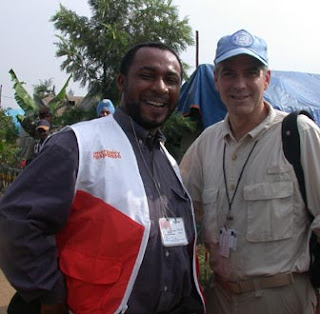
In the midst of our conversation, I remembered to introduce Horeb to George Clooney: "This is my colleague, Horeb Bulambo. He also makes films and has made his own films on sexual violence in the east."
Horeb and George Clooney shook hands. "Hello, Mr. Clooney. I am a big fan of yours. We know you here in the Congo. If possible, I'd love to take a picture with you."
"Sure! No problem," he replied. At that moment, some announcements were made and thanks given. One of Mr. Clooney's UN handlers came by and asked that I keep the visit hush-hush, etc.
Sure thing (even though a BBC reporter was traveling with him)! No problem. I understood that he wanted to keep a low profile, etc.
"No problem. I understand. We were just here trying to get a military escort up to Kanyabayanga. And then you guys come. Looks like we'll have to wait on our escort."
"Yeah, must be surreal," his UN handler responded. Indeed. His handler asked for my business card, which I had left in our jeep, so I made my way back to the parking lot. By the time I got some cards, George Clooney and the group had migrated out of the mess hall and were making their way toward the parking lot. I passed my card to his handler, then found Horeb in the midst of the crowd. I plucked up my courage again, returned to "Washington-mode," and wedged my way up to Mr. Clooney again. I gave him my business card and wished him luck. "We are traveling up north in search of a 9 year-old child soldier who is reported to be a general in a child army," I said as I handed George Clooney my card.
"What?!?" he responded, with true incredulity.
"Yep," I replied. "I think we can get video of this, and I'd be glad to share it with you so that we can get more publicity about the tragedy of child soldiers in this area."
"A 9-year-old general?" He looked me dead in the eye this time (I almost fainted!). "Wow, good luck with your trip! Safe travels to you." He folded my card and put it in his pocket, then the crowd swallowed him. He paused briefly, turned around and pointed to Horeb -- "You! I promised I'd take a picture with you. Come, let's take a picture."
So, Horeb gave me his camera and I fumbled with it, not knowing how to use a digital camera; Horeb had to break out of his pose to show me where the shutter button was as Mr. Clooney and his crowd waited patiently for me.
I took the picture and then George Clooney and the crowd evaporated, and Horeb and I were left standing and watching as they disappeared with an escort out of the compound.
Surviving Virunga National Park
After George Clooney left, we waited about another two hours, intermittently making conversation with the Indian officers, drinking tea and eating biscuits, and twiddling our thumbs with increasing anxiety.
By 11 a.m., Faustin, our driver, was getting nervous. "It's getting late," Faustin said, in English, pointing to his watch. "We need to be out of the park and in Butembo before dark." I didn't quite understand the problem--it wasn't even noon, so how could it be late? Still, when your local staff get nervous, especially one known as "Rambo," I knew I needed to be concerned as well.
Horeb spoke to me in French so that the Indian officers would not hear his urgency and concern, asking that I play the fussy American and demand an escort. I cleared my throat, and with the biggest smile and the sweetest voice I could muster, I asked about our escort. "No problem, ma'am. We should be able to escort you guys to the bridge."
"No, to Kanaybayanga, we need you to go to Kanyabayanga," urged Horeb. There was a back and forth between Horeb and the Indian logistics officer. "No we can't spare any other vehicles, as they have all gone with the New York contingent. I've got two cars coming back in the next 20 minutes. They can escort you to the bridge. No problem, but only to the bridge."
Horeb and I both sighed. I thanked them. Horeb explained to Faustin in French that we would only get an escort about a fourth of the way. Faustin shook his head, got up and walked away, making some calls to his military friends on his cell phone.
"Well, that is the most dangerous part. Faustin will call his FARDC people and we should be okay through the park." We left Rutshuro at 11:30 a.m. with a military escort, one before our vehicle and another behind us. It was mostly a dirt road along the way to the bridge. Along the way we saw some Mai-Mai (local militia) standing guard, and a few FARDC troops, but mostly, we saw forest and savanna. We got to the bridge without incident, waved goodbye to the Indian officers, and then Faustin kicked up dust.
 "Now, you need to sit in the back, Rory. I don't want the officers to disturb you." I crawled in the back, and we drove about 300 miles for the next eight hours along a relatively good road (by African standards), but still very bumpy all the same. We were entering Virunga National Park -- which used to be a major tourist attraction during the 1960s, with big game like what you would see in the Serengeti -- but now home to rebels and armed factions.
The road was long, and much of the way we saw many, many FARDC officers. "But I see many antelope," Horeb chirped. "See the antelope, Rory? That is a good sign. It means that the lions will come soon."
"And once the lions come, so will the people," I replied.
"Yes, in 10 years there will be no war here; instead, people. Tourists will come to see this beautiful land." Every time we passed a group of antelope, Horeb would point them out to me; and every time we passed a group of FARDC troops, Horeb would wave and smile and shout "thank you!" out of the vehicle as we sped along. They would wave back at us.
Faustin kept speeding along. About an hour after we parted from the MONUC escort, we came upon a truck piled high with soldiers and some sort of cargo, blocking part of the road. We were forced to stop. I could see many of the officers looking at me; some were pacing the road.
One of the officers came up to us and peered into the window. He eyed me in the back seat. He and Horeb had a few exchanges in the local Swahili. The officer looked back at me again and then walked along. Horeb lifted his hands and said "Merci!" The officer shook his head and Faustin slowly maneuvered our vehicle around the truck.
Once again we were speeding along the windy road. "What did you say to that guy, Horeb?" I asked.
"Nothing much. He asked me for money, but I said that I was with my boss [referring to me] and that I wouldn't approve."
"Oh," was all I could say.
 We were stopped only one other time, but Faustin knew the commander at that point so we were fine. The road continued to snake upwards into the hills, past beautiful forests, military checkpoints, and even across the equator. I got my pictures and my views of both the Nile and Congo River basins.
Once we got to Kanaybayanga, the village-town up in the hills, beyond the point of danger, Horeb exhaled and exclaimed, "Rory, this drive was dangerous! Did you know that?!"
"No, I didn't. But you told me it was safe! And MONUC said it was ok."
"Rory, MONUC is not God. You must like danger," he smiled.
No, I definitely do not -- but I had a feeling we would make it through. Or maybe it was just blissful ignorance which enabled me to trust that we would be okay. And, by God's grace, we made it safely through Virunga National Park, once home to the big game ... and now to some of the most violent guerillas in the world.
Posted by Larry Short on behalf of Rory Anderson in the Congo.
A beautiful place of great lakes, mists clinging to rolling green hills, tea plantations, and chilly temperatures exists in sharp contrast to some of the worst violence against civilians in the world, especially women and children. Ongoing violence is perpetrated by several armed groups from Rwanda, Uganda and the Congo.
I wanted to get stories and footage on child soldiers, and to check up on some of our child protection work being done in the Beni area of North Kivu, so into the mix we flew, taking a long flight from Lubumbashi (four stops along the way) up to Goma, the main town in North Kivu that sits right on Lake Kivu, with a sweeping view of Rwanda on the other side of the lake.
But, how to get there?
"Let's get a security update from MONUC." Horeb suggested this as we were waiting for our World Vision colleagues to pick us up from the airport. MONUC is the acronym for the United Nations Peace Keeping mission in the Congo, which is currently the largest UN peacekeeping deployment in the world.
"It may be better to drive than to fly, but let's also check on getting a plane reservation to Beni as well. It's good to have more than one choice in the Congo, Rory," he advised. "And you said when you first proposed this trip back in December that you would be flexible, so ... let's be flexible ...." Horeb made such suggestions with a broad smile.
"You keep throwing that word back in my face," I smiled in return. "But, no problem."
"You'll like the drive," Horeb assured me. "A beautiful view of the Congo River basin and the Nile River basin as you drive along, and many plateaus and views. It's amazing!"
"Wow. Sounds wonderful! Let's drive, Horeb! That's my choice! I'd much rather drive than fly!"
"Okay. But first let's check with MONUC on the security situation. And I want to pick the right driver for this mission and get a new vehicle to make sure it can handle the trip." I should have tuned in better to the fine print, but I was so excited to see Congo by road! I couldn't wait to take pictures and actually be a "tourist" in eastern Congo, for a change.
After the typical back-and-forth to many different offices and talking with a couple of different people at the MONUC-Goma compound, they said they would give us a military escort from Rutshuro up to Kanyabayonga. The commander said they had a convoy going in that direction anyway, so we could drive along with it. Great! One option in the bag.
We also did the requisite running around to see if we could get a flight from Goma to Beni, instead of driving, but that didn't quite work out, as there was only one seat available. So, we were forced to drive anyway. No problem -- I had already set my mind on driving.
But Horeb softly asked again while we were trying to negotiate a flight -- "Are you sure you want to drive? You can take the flight up and Christian should be in Beni by now, so he can take you."
"No," I responded enthusiastically, "let's just drive. You've got the contacts of the people we are meeting in Beni, so you should come. It's safe, right? And MONUC told us that security in that area has been good, so why not?"
"Okay. No problem. Let' make arrangements to get a good vehicle. Oh, and be sure and leave your computer in Goma as well as anything valuable, just in case."
"Sure thing. I told you I could be flexible, Horeb!" Silly me, I was still only thinking of taking pretty pictures of Congo by road ....
I thought Rutshuro was a section of Goma. Nope, it's actually a town unto itself, about two hours north of Goma. We left Goma at 6 a.m. to meet the MONUC convoy which was scheduled to leave Rutshuro at 8 a.m.
Faustin was our driver, an old schoolmate buddy of Horeb's, who is the head driver for World Vision's operations in Goma. Another Rambo, Horeb called him. "He's gone with me on many dangerous missions, and has many contacts with the FARDC [Congolese Army]. He is the only one I'd take on such a mission."
And along the road there was a heavy military presence. About every quarter of a mile, you could see FARDC troops along the roadside. "Don't worry, Rory. This is a good sign, it means no rebel activity in the area."
Okay. But I do recall reading in many of the reports I read that the FARDC were among the worst perpetrators of rape. In the back of my mind I thought of the case of a European aid worker who was gang raped by troops in South Kivu; she committed suicide afterward.
"No problem, Horeb," I assured, masking my nervousness. "It's good to know we have security along the way."
The road was pretty good, mostly tarmac, and Faustin knew how to drive fast while dodging the potholes; we made it to the MONUC-Rutshuro compound by 7:30 a.m.
We pulled up to see a convoy going back south in the direction of Goma. Apparently the communications from MONUC-Goma to Rutshuro got mixed up. "Please have a seat and wait," said one of the Indian officers. "I think we can arrange something." We sat for awhile in the visitor waiting area, and then we were escorted to a canopied sitting area facing the officers mess hall.
Prattling on about George
The MONUC mission in North Kivu was mostly filled with troops from India. Although the compound was made of canvas tents, the area was quite nice, actually. They had planted grass and many flowers, and laid the area out quite nicely. We sat and waited and chatted with different officers, in hopes of securing some sort of escort along the way.
One handsome officer said to me, "We are quite busy. Some people from New York are here, so all of our vehicles are tied up. Please, would you like some tea?" Sure. It's rude to refuse, so we sat and drank lots of tea and chatted about everything ... from the weather, to Hinduism and Christianity, to finding meaning in life, to arranged marriages. A nice long conversation.
Around 9:30 a.m., we saw some people file in to the officers' mess hall -- "Must be the New York contingent," I said aloud, wondering how long we would have to wait until we got an escort and could be on our way. A few civilian white faces filed in along the walkway before us -- and then I did a doubletake -- I couldn't believe it! George Clooney was walking among them. My jaw dropped.
 "That's George Clooney!" I said to Horeb. By then, the Indian officers went into the mess hall to facilitate the visitors from headquarters. Horeb, Faustin and I sat as we watched about 15 people file past into the mess hall.
"Oh my gosh, that was GEORGE CLOONEY! I can't believe it!"
"Who?" Horeb asked.
"I just saw George Clooney! What's HE doing here!?! Oh my gosh!"
"What?" Horeb asked again, wondering what I was prattling on about.
"He's a big film star in America. Even bigger than your favorite, Rambo!"
"No! Really?"
"Yes. I can't believe he's here!" I squealed. How weird. Waiting in the midst of hills, jungle, and possible danger; hoping for a military escort out of danger, and we see George Clooney file in, as comfortable and modest as if he was supposed to be there.
"Would you like to come in for breakfast?" asked one of the officers who had been chatting with us. "Sure!" I wasn't hungry, but I wasn't going to pass this meal up.
We joined the line circling the table which had laid out boiled eggs, chapatis, chutney, naan bread, fried cheese, potato patties and meat sandwiches. There were plastic chairs arranged in a circle next to the table with food. As the honored guest, George Clooney was among the first to go around, and he took a seat on his own, rather shyly looking at his plate.
The officers were very kind to us, and let us go ahead of them. I quickly picked up a sandwich, chapati and some chutney and sat down about four chairs away from George. I picked at my food, and then I finally plucked up the nerve to sit in the empty chair next to him. Then something clicked and I went into my "Washington mode."
"So, what in the world brings George Clooney to Eastern Congo?" I started the conversation as I settled in beside him (just before one of his handlers could zoom in to try and take the seat).
"I'm just here checking things out," he responded, modestly, still looking at his plate, but with a shy smile. He was a pleasant, modest fellow. He is of rather small build, not much taller than I, but just as handsome in real life as he is onscreen. Same beautiful eyes.
At this point I could easily descend into drooling over episodes of ER and Oceans 13 and make a complete fool of myself. So, I had to put those out of my head.
"Where are you from?" he asked.
"Washington, D.C."
"That's rare, to find a native from D.C."
"Actually, not among African-Americans," I responded. "My family goes back about four generations in DC. And many Blacks have been in DC since the time of Fredrick Douglass."
"Right," he nodded in polite acknowledgement to my lecture. "But what brings you here to eastern Congo?" Mr. Clooney flipped my question back at me with a shy smile, never quite looking me in the eye.
"I work for World Vision, a relief and development agency that is doing work in the area. But I work in the DC office as a lobbyist, doing advocacy for those impacted by the conflict in the Congo. Everyone works the system in DC. I figure we ought to work the system to help the poor in the Congo, too."
"Hmm, interesting." We quipped a bit about the DC scene. Then I asked him for his impressions of the Congo. He recalled his trip to Darfur; he expressed more optimism and saw more potential in the Congo. I asked why he cared to come all, particularly because he did not have to. He briefly talked about his father ... as a TV journalist, his father covered a lot of the conflicts in Central America, making many efforts to try and get attention and action to those forgotten areas.
"I hope that by coming here we may get a bit more attention to the Congo." I smiled and nodded. "Yes, I'm sure your visit will. Thank you for coming. It is much needed."
Inside my head, I was screaming: MOM, I MET, GEORGE CLOONEY!!!!!!
Yes, girls, I met George Clooney and I even talked with him!
So what were my impressions of George Clooney? A pleasant, modest fellow. In this setting, he seemed taciturn, yet strong. He had a natural air of confidence which comes from traveling among those of influence.
In the midst of our conversation, I remembered to introduce Horeb to George Clooney: "This is my colleague, Horeb Bulambo. He also makes films and has made his own films on sexual violence in the east."
Horeb and George Clooney shook hands. "Hello, Mr. Clooney. I am a big fan of yours. We know you here in the Congo. If possible, I'd love to take a picture with you."
"Sure! No problem," he replied. At that moment, some announcements were made and thanks given. One of Mr. Clooney's UN handlers came by and asked that I keep the visit hush-hush, etc.
Sure thing (even though a BBC reporter was traveling with him)! No problem. I understood that he wanted to keep a low profile, etc.
"No problem. I understand. We were just here trying to get a military escort up to Kanyabayanga. And then you guys come. Looks like we'll have to wait on our escort."
"Yeah, must be surreal," his UN handler responded. Indeed. His handler asked for my business card, which I had left in our jeep, so I made my way back to the parking lot. By the time I got some cards, George Clooney and the group had migrated out of the mess hall and were making their way toward the parking lot. I passed my card to his handler, then found Horeb in the midst of the crowd. I plucked up my courage again, returned to "Washington-mode," and wedged my way up to Mr. Clooney again. I gave him my business card and wished him luck. "We are traveling up north in search of a 9 year-old child soldier who is reported to be a general in a child army," I said as I handed George Clooney my card.
"What?!?" he responded, with true incredulity.
"Yep," I replied. "I think we can get video of this, and I'd be glad to share it with you so that we can get more publicity about the tragedy of child soldiers in this area."
"A 9-year-old general?" He looked me dead in the eye this time (I almost fainted!). "Wow, good luck with your trip! Safe travels to you." He folded my card and put it in his pocket, then the crowd swallowed him. He paused briefly, turned around and pointed to Horeb -- "You! I promised I'd take a picture with you. Come, let's take a picture."
So, Horeb gave me his camera and I fumbled with it, not knowing how to use a digital camera; Horeb had to break out of his pose to show me where the shutter button was as Mr. Clooney and his crowd waited patiently for me.
I took the picture and then George Clooney and the crowd evaporated, and Horeb and I were left standing and watching as they disappeared with an escort out of the compound.
Surviving Virunga National Park
After George Clooney left, we waited about another two hours, intermittently making conversation with the Indian officers, drinking tea and eating biscuits, and twiddling our thumbs with increasing anxiety.
By 11 a.m., Faustin, our driver, was getting nervous. "It's getting late," Faustin said, in English, pointing to his watch. "We need to be out of the park and in Butembo before dark." I didn't quite understand the problem--it wasn't even noon, so how could it be late? Still, when your local staff get nervous, especially one known as "Rambo," I knew I needed to be concerned as well.
Horeb spoke to me in French so that the Indian officers would not hear his urgency and concern, asking that I play the fussy American and demand an escort. I cleared my throat, and with the biggest smile and the sweetest voice I could muster, I asked about our escort. "No problem, ma'am. We should be able to escort you guys to the bridge."
"No, to Kanaybayanga, we need you to go to Kanyabayanga," urged Horeb. There was a back and forth between Horeb and the Indian logistics officer. "No we can't spare any other vehicles, as they have all gone with the New York contingent. I've got two cars coming back in the next 20 minutes. They can escort you to the bridge. No problem, but only to the bridge."
Horeb and I both sighed. I thanked them. Horeb explained to Faustin in French that we would only get an escort about a fourth of the way. Faustin shook his head, got up and walked away, making some calls to his military friends on his cell phone.
"Well, that is the most dangerous part. Faustin will call his FARDC people and we should be okay through the park." We left Rutshuro at 11:30 a.m. with a military escort, one before our vehicle and another behind us. It was mostly a dirt road along the way to the bridge. Along the way we saw some Mai-Mai (local militia) standing guard, and a few FARDC troops, but mostly, we saw forest and savanna. We got to the bridge without incident, waved goodbye to the Indian officers, and then Faustin kicked up dust.
"Now, you need to sit in the back, Rory. I don't want the officers to disturb you." I crawled in the back, and we drove about 300 miles for the next eight hours along a relatively good road (by African standards), but still very bumpy all the same. We were entering Virunga National Park -- which used to be a major tourist attraction during the 1960s, with big game like what you would see in the Serengeti -- but now home to rebels and armed factions.The road was long, and much of the way we saw many, many FARDC officers. "But I see many antelope," Horeb chirped. "See the antelope, Rory? That is a good sign. It means that the lions will come soon."
"And once the lions come, so will the people," I replied.
"Yes, in 10 years there will be no war here; instead, people. Tourists will come to see this beautiful land." Every time we passed a group of antelope, Horeb would point them out to me; and every time we passed a group of FARDC troops, Horeb would wave and smile and shout "thank you!" out of the vehicle as we sped along. They would wave back at us.
Faustin kept speeding along. About an hour after we parted from the MONUC escort, we came upon a truck piled high with soldiers and some sort of cargo, blocking part of the road. We were forced to stop. I could see many of the officers looking at me; some were pacing the road.
One of the officers came up to us and peered into the window. He eyed me in the back seat. He and Horeb had a few exchanges in the local Swahili. The officer looked back at me again and then walked along. Horeb lifted his hands and said "Merci!" The officer shook his head and Faustin slowly maneuvered our vehicle around the truck.
Once again we were speeding along the windy road. "What did you say to that guy, Horeb?" I asked.
"Nothing much. He asked me for money, but I said that I was with my boss [referring to me] and that I wouldn't approve."
"Oh," was all I could say.
 We were stopped only one other time, but Faustin knew the commander at that point so we were fine. The road continued to snake upwards into the hills, past beautiful forests, military checkpoints, and even across the equator. I got my pictures and my views of both the Nile and Congo River basins.
Once we got to Kanaybayanga, the village-town up in the hills, beyond the point of danger, Horeb exhaled and exclaimed, "Rory, this drive was dangerous! Did you know that?!"
"No, I didn't. But you told me it was safe! And MONUC said it was ok."
"Rory, MONUC is not God. You must like danger," he smiled.
No, I definitely do not -- but I had a feeling we would make it through. Or maybe it was just blissful ignorance which enabled me to trust that we would be okay. And, by God's grace, we made it safely through Virunga National Park, once home to the big game ... and now to some of the most violent guerillas in the world.
Posted by Larry Short on behalf of Rory Anderson in the Congo.
Tuesday, January 29, 2008
Just a Dumb Muzungu
 Yesterday, we traveled to see the king, or the paramount chief of the area. During our first visit to the mines, we met with the various sub-chiefs of the mining area, retroactively asking their permission after we had taken photos and talked with people in the mining area.
We didn't follow protocol, so all the sub-chiefs and their relatives were insistent that we visit the king. So, on Sunday we drove along a relatively good (not flooded out, no major holes) dirt road, about 14 miles from the mining area, to visit the paramount chief who, by traditional law, owned most of the land in the area around Likasi town.
The few surrounding houses in the village were made of mud bricks with thatched roofs. But the chief had a tiny brick house, perhaps 15 feet by 7 feet, with a tin roof and two windows facing a dirt driveway that cut through tall grasses adjacent to a patchy front yard.
In the front yard was a shady mango tree and an open square shelter-- a thatched roof held up by four wooden poles, about 10 foot by 10 foot. As we drove up and parked on the lawn, we saw an old man sitting alone under the shelter, waiting, planted like a bush, smoking a cigarette.
The chief was perhaps in his late 60s, dark-skinned, wizened, with a salt-and-pepper afro and mustache. Dressed in western clothing, he wore a pink, green and white diagonally-striped button downed shirt, dark brown dress slacks, and black, shiny leather dress shoes. Underneath his chair was a pad and pen, just in case we said anything worth writing down.
We piled out of the car -- Horeb, Maitre, and Christian (another friend and colleague who does media and communications for World Vision in the eastern DRC). He and Horeb are childhood friends; they are both hilarious. We have lots of good conversations and laughs together.
Along the way we also picked up the chief's daughter, her husband and her child, who came to present us to the chief.
"You must bow before the chief. Keep bowing." Okay. Monkey see, monkey do. Making myself as small as possible, I followed the line and came behind, bowing.
Four of the chief's sons brought out blue plastic chairs, and under the shelter we formed a semi-circle facing the chief. Many adorable toddlers and young children hovered and played nearby, watching with interest this delegation of strangers. I, the "muzungu," drew the most stares. Throughout the visit, I frequently smiled and waved at the children in response.
We sat silent for a bit. Then Horeb asked the chief's daughter to introduce us.
A local variation of Swahili and some French was spoken. The chief nodded to each of us as we were introduced. He welcomed us, and then spent some time scolding us, saying that his small square brick house was the capital of the area and should have been our first stop before going anywhere in his territory. He then entreated us, as representatives from World Vision, to do more in the area to help the people. Silence, and many nodding heads.
Sometimes, protocol can obstruct progress. Shrewdly, at Horeb's direction, we had gone straight to the mines, relying upon Maitre, our local mining contact, to walk us around, rather than going to the paramount chief, knowing that the chief would most likely notify the authorities of our visit, who would have then prevented us from taking pictures and video or talking with people.
In cases like this, it is sometimes best to ask for forgiveness rather than permission. Recognizing this, I decided to apologize, hoping to ameliorate our insolence. "Is it alright for me to speak?" I whispered to Horeb. "Yes," he replied, "go ahead."
I spoke in English. Horeb translated. I earnestly thanked the chief for taking the time to meet with us, and profusely apologized -- "I am a dumb muzungu, and did not know to stop by here, the capital, first. Please forgive me. I am very, very sorry."
I think my apology was accepted, and that seemed to break some of the ice. The chief mildly nodded in acceptance and continued on, pragmatically asking World Vision to build a school and a hospital. He had a gravelly, raspy voice, like Charlie Rangel, and as he spoke, he smoked, poking fun at us ... "Many people like you have come by, seemingly like tall white warriors ready to fight, saying many words, writing things down, but no action."
All of us in the circle laughed. He was absolutely right. Many promises and no action is meaningless. I admired his pragmatism. By now, the chief was on his third or fourth cigarette.
"I will pray, but I won't hope. But I am glad you are here. Perhaps it is a sign from God." Under the shade of the shelter and the tree, the group continued in dialogue for about an hour, and the chief continued to crack sardonic, pragmatic quips at the promises of NGOs and outsiders.
"Are there other needs in the community?" Horeb asked.
"Yes, many," the chief replied, "but I won't ask, for fear that you will do nothing. Let's go slowly -- slowly. The most important thing is to at least build a school for our children, delivering us from this slavery."
Yes, indeed. Though we never raised the issue of children in the mines, the chief was aware of the problem and also grasped the solution.
I liked the chief; I admired his pragmatism and wit.
After our talk, the group briefly walked around the area. We stopped by the village well, a covered cistern with a crude metal ladle attached to the lid. Horeb took pictures. The water inside looked like watery chocolate milk.
"This is what they drink," said Christian.
"God, how awful," I replied. "The children must suffer with diarrhea and sickness."
"Yes, and cholera is a big problem in this area."
 We walked back to the chief's house, through a small field of tall grasses. "Horeb, are there snakes in these grasses?"
"No, Rory, those are only in the jungle, in Ituri, and in North Kivu." Yeah, right.
"Here, only small snakes."
"I'd better not get eaten like that UN guy who got swallowed by a boa in his tent!" I exclaimed. "Can you imagine calling home to my dear sweet mother and telling her that her daughter got swallowed by a snake in the Congo! She would hunt you down and cut you guys!"
My mom is 5'3" and about 110 pounds, but, indeed, I have no doubt she would.
"No, Rory, we are putting you in the middle, so no snake will get you," said Christian, smiling. "And I'm telling you, they are not here."
"Never fear. We have you protected," promised Horeb.
"Just like George Bush," I answered. We all laughed.
"George Bush. I like that man!" Horeb declared, wagging his finger. "Small words, big actions. I like that man!"
As we walked through the grasses, Horeb and Christian continued to laugh and joke about snakes and how different plants can make you strong. We returned and again thanked the chief before piling back into the LandRover. As a group, we left laughing, but with resolve to urge our World Vision colleagues to help this community.
We were glad and relieved at the pleasant, patient exchange with the chain-smoking chief.
Posted by Larry Short on behalf of Rory Anderson in the Congo.
Friday, January 25, 2008
Under the Mango Tree
 Still in Likasi. We visited the same copper mine site, this time to shoot video. With hindsight, Thursday was a cakewalk, but, the second visit brought the local authorities and more attention.
Local Congolese authorities were not happy that we were taking video. Not happy at all. Yet everyone seemed so friendly and no one was in uniform, so I wasn't aware of the pickle that we were in until Horeb told me, as we were leaving, "You know they were coming to arrest us, actually."
What?!? Perhaps it is a distinct advantage on my part for having very bad French and not being able to speak Swahili. Everyone seemed so friendly and wanted to talk and chat, so, I went along and chatted with the various and sundry chiefs and authorities. Hours of chatting.
At the time, I did not know that these were delay tactics. Yet the whole time I had no idea of the real problems we were encountering. But Horeb is a real star. He is truly a brilliant gem. He got us out of it, without me even knowing that we were about to step into a potential minefield.
The first round of chatting, we sat for about an hour and a half with the son of the local chief, who was trying to delay us. Horeb was superb -- he chatted them up, made jokes about different local customs, and generally charmed them all. After that, we managed to get down to the river area again, and Horeb was able to film and take some video for internal use.
The sun was strong and I was starting to burn (I forgot to bring sunblock. Stupid! I get arrogant because I'm black, thinking that I won't burn, but I do burn and was starting to get a bad burn on my neck and shoulders.)
So our local contact, Mme. Maitre, and I started walking up the Hill to a more shady area, but we were stopped. One of the local authorities asked in Swahili why we were there. No surprise, I stick out like a sore thumb. (They call me a muzungo, which means "whitey" in Swahili, even though I'm black American. I hate it, but, to them I'm foreign, and I'm lighter than many Congolese. I protest over this ignoble title, but what can I do?)
Mme. Maitre responded with zeal that we were doing a humanitarian assessment, and that World Vision hopes to begin doing humanitarian work in the area. We were asked to have a seat under a mango tree. Others joined. We began a pleasant exchange in French and Swahili, talking about the weather, etc. Horeb turned up and more local authorities joined the circle under the mango tree.
With much verve and charm, Horeb began explaining our goal for learning more about the humanitarian needs. I then asked questions about how the U.S. could help. Many people had many things to say, and we had a good exchange.
Perhaps my being single helped also, as I was made several offers. I was able to get a whole mining plot in exchange for my hand in marriage! That's the best offer I've had yet -- certainly trumps the 10,000 camels I was once offered in Egypt! ;-) Perhaps I ought to quit while I'm ahead ...
The incident ended on a happy note, taking lots of photos -- seemed I turned out to be a star. More like a fallen star: I had to promise both the local chief and the provincial minister of mines that we would not use the photos beyond World Vision's use. Indeed.
Posted by Larry Short on behalf of Rory Anderson in the DRC.
Thursday, January 24, 2008
Not Really a Very Good Day
 Well, this is my first time blogging! A dinosaur, blogging -- this ought to be in Ripley's Believe It or Not.
To be honest, this whole blog thing is not exactly my speed -- I think it's quite narcissistic, actually. Are my thoughts so important that people should take time out of their lives to read them? Not really -- and, frankly, I'm not that interested in reading the droning and whining of others. But, I do care about the Congo, and I think it is important that people know about what is going on there, and how Congo's suffering is connected to our lives -- whether they really care to or not.
There. That's off my chest ... I think I like this blog thing! ;-) Now let's see if my mini diatribe/blogga-hater speech gets past the Soviet Sensors.
 I'm writing this from our Likasi provincial office, which is about the 120 kilometers (75 miles) north of Lubumbashi, the regional capital of Katanga province, the southernmost province -- and one of the most mineral rich areas -- of the Democratic Republic of the Congo (DRC). I'm typing this and the lights just went out. We lost power, and I'm leaning the laptop screen over so that I can see the keys!
It's the rainy season, and the generator probably flooded. C'est la vie dans le RDC. "It's life in the Congo ..." I'll just pretend like nothing happened, as that is what everyone else in the office is doing ... just go with the flow, Rory, roll with it.
Today was our first field visit. I arrived in the DRC two days ago, sans luggage. I've learned the lesson of living simply and traveling light; I've washed my underwear for the past three days and have worn the same outfit since I left the States, four days ago.
I hadn't lost any luggage in my travels to Africa during the past 10 years, so I guess I had it coming. They often say, L'Afrique ne marche pas ("things don't work in Africa"), but things worked fine here in Africa, though not in Europe (to my surprise). My bags got lost in Amsterdam, but had no problem getting through South Africa, then flown into the DRC and driven by our staff from Lubumbashi to meet me here in Likasi. And nothing was missing!
We have awesome field staff; I was very sorry to hassle them about schlepping my bag. But I am also glad to have clean underwear and a change of clothes!
I've droned on about myself, which, it seems, this mode of communication somehow encourages. So, let me tell you a bit about today. Our staff have twice attempted to take pictures of this scandal, but today was a good day -- I think. Good in that Horeb (my friend and guide who is one of World Vision's DRC communications managers) and I were able to actually go to a copper mining site, interview children and adult diggers, and take photos.
 But, I hesitate to say this was a good day, because in reality this "good story" is a sad, scandalous story that is their lives. Seeing children -- ages 6, 7, 8, 9, teens, even infants -- in deplorable mining situations, is actually a recipe for a very bad day. Their parents are poor, so they are poor. Their parents are uneducated, so they are uneducated. Their parents dig, and, so do the children.
The nearest schools and hospitals are about a two-hour walk away from the mining settlement where these children are condemned to grueling work and toxic waste poison from handling the copper and the waste from the ore. I picked up some of the blue-green copper ore as a group of adults and children were sorting the ore -- and I could feel a slight burning-tingling in my hands.
These children crawl into dangerous holes to gather the copper ore. They wash it in a murky, stinking river filled with toxic run-off. Then they break and sort the ore, pack it, and many of the children also walk or bike w/these heavy loads or rock to sell the copper to middleman-sellers who work for big international companies in town.
It seemed like there were as many children as there were adults, working in the mines. What kind of a future will Congo have if her children are condemned to mine the copper used for my telephone wires?
No, it was not really a good day.
Posted by Larry Short on behalf of Rory Anderson in the DRC.
Congolese Children: In the Pits
 This week, the government of the Democratic Republic of Congo (DRC) released the devastating and mind-boggling news that more than 5 million people have died, in association with 10 years of regional conflict in the Congo.
This puts some perspective on what many have called "Africa's World War" ... the result of internal conflicts and international intervention in what has become a regional conflict. The good news is that the government has signed a deal with rebels designed to end fighting in the war-torn eastern part of the country.
The remoteness and poverty of this region have certainly contributed to the death toll. So many have died in secret, fleeing into the jungle in an attempt to escape the conflict, only to be confronted by brutality, disease and deprivation there.
World Vision's Rory Anderson to Blog
Over the next two weeks we are privileged to have as a participant in this blog Rory Anderson, from our Washington DC office of Public Policy and Advocacy. As World Vision's deputy director for advocacy & government relations, Rory advocates for increased U.S. attention to human rights, humanitarian and development issues, with a focus on regions affected by conflict or disaster.
Rory is a passionate advocate for children and families who are being devastated by the crisis in the Congo, and she is visiting the war-torn regions over the next three weeks. She will be bringing us daily updates from what she is learning.
Currently dedicated to promoting increased U.S. engagement in the regional conflicts in northern Uganda, Sudan and the DRC, Anderson co-authored “Pawns of Politics: Children, Conflict and Peace in Northern Uganda” [PDF -- 5 pages, 3mb]. This report summarizes the history and devastating impact of Uganda’s 20-year civil war, which includes tens of thousands of children who have been abducted and forcefully conscripted into the rebel Lord’s Resistance Army. More than 1.3 million civilians have been forced from their homes. The report also sets forth recommendations for pursing peace.
Between 2001 and 2002, Anderson helped initiate a multi-agency advocacy campaign to end the trade of “conflict diamonds” that fund wars in several parts of Africa. As part of those efforts, Anderson played a lead advisory role in drafting and enacting the Clean Diamond Trade Act of 2003 and the Kimberley Process Certification Scheme, which regulates the international diamond trade.
Anderson also pressed for 10 percent of global AIDS funding to be dedicated to the care of orphans and children made vulnerable by this disease, as stated in the Global AIDS, TB and Malaria Act. With partner agencies, she also promoted the passage of the Sudan Peace Act.
Anderson holds the Bachelor’s degree in international affairs from George Washington University and the Master of Arts in international development from the University of Leeds in the United Kingdom.
During her last trip to the DRC in January 2007, Rory found that World Vision's local staff spoke repeatedly about children being forced to mine uranium, cobalt, and other toxic substances. "I was both horrified and intrigued," she writes, "as this could be an important issue for World Vision to prioritize into our advocacy and campaigning work, because many of these children are informally mining for U.S. companies.
"The purpose of my current trip, therefore, is to follow up with our staff concerns about child mining, and to begin research for a broader policy and advocacy paper which can be used by our respective offices to begin advocating on behalf of these children both in the DRC and abroad."
Rory is in the DRC for two weeks. The first week she is visiting Katanga province (in the southern DRC), and the second week she is visiting North Kivu to do more research on child soldiers. Her first blog entry will be posted later today, so stay tuned!
Sunday, January 13, 2008
Experience the Experience
The "World Vision Experience: AIDS" is an interactive exhibit which immerses the visitor into the sights, sounds, and even the smells of Africa. As you walk through the exhibit you walk through the story of one of five individuals whose lives have been dramatically impacted by the crisis of HIV and AIDS in Africa.
If you haven't yet had the chance to experience the Experience, you can get a quick foretaste by watching the above video, now on our new YouTube channel at http://www.youtube.com/watch?v=0ufJo6mOqZM.
If you have already been through the Experience, I'd be very interested in hearing what impact it had on your life. Please click the "comments" link at the bottom of this posting and share your thoughts.
For more information about the World Vision Experience: AIDS, visit our Webby-award winning site at http://www.worldvisionexperience.org/.
Friday, January 11, 2008
30 Hour Famine - 2008 Preview Video
Just released on YouTube -- featuring the music of Third Day:
For more information about the Famine, visit the 30 Hour Famine Web site.
Subscribe to World Vision's YouTube channel and be notified of any new videos released -- instantly!
Also, another way go get quick updates on what is happening in World Vision's world is to subscribe to the RSS feed for our Twitter stream.
Wednesday, December 26, 2007
Three Years Later: An Aftermath of Hope
 Today marks the anniversary of one of the world's largest natural disasters. It was on December 26, 2004, that an undersea earthquake triggered massive tidal waves that smashed ashore on multiple continents, killing more than 225,000 people in 11 countries and devastating thousands of miles of coastline with waves that reached up to 100 feet in height.
World Vision already had operations and immediately went to work in five of the hardest-hit countries: Indonesia (closest to the epicenter), Sri Lanka, Thailand, India, and Myanmar. It was the largest emergency relief operation in our 50-plus-year history.
While the scope of the disaster boggled the mind, the outpouring of compassion by a sympathetic world rivaled it. World Vision donors contributed nearly $380 million to tsunami relief operations, including $68 million contributed by private donors in the U.S. Some $347 million of the total amount raised went directly to relief needs in the field, with the balance supporting management and fund-raising operations.
Three years later, it is fair to ask: Did this effort make a difference? Did the outpouring of generosity substantially improve living conditions for the tsunami's survivors and lessen the chances of a similar disaster causing this kind of suffering again in the future?
To celebrate the recent closure of our relief program, World Vision's special Asia Tsunami Relief Team released a final report of the results of this effort. The report measured effectiveness on both objective and subjective levels.
Objectively, it pointed to the construction of more than 12,000 homes, 84 schools, 33 preschools, 27 health clinics, and 200 Child-Friendly Spaces — facilities where children can play, draw, sing, share their feelings, and begin to return to normalcy — as well as the provision of 20 ambulances, hundreds of hospital beds, and assisting more than 40,000 people with support and vocational training to get them back into paid work.
On a more subjective level, World Vision's relief work was heralded by a variety of independent organizations. The Fritz Institute — a non-profit organization that monitors the effectiveness of aid delivery — said World Vision was ranked highest by surveyed beneficiaries in Indonesia for the quality of its aid and the fairness of its distribution.
In India, World Vision shared the highest ranking with the central and state governments and a local organization — Social Need Education and Human Awareness. And in Thailand, TANGO International commended World Vision for its swift and enduring response and found that livelihoods in the organization's operational areas were now close to what they were before the tsunami struck.
And at the most subjective level, to understand the impact of the recovery effort you have to talk with tsunami survivors themselves. Murugesh (center child in the photo above) was only seven when the waves struck three years ago. His father died in the tsunami and the family's home was destroyed.
Murugesh, his three siblings, and his mother survived, but without a home to raise her children in the family's chances seemed slim.
What's more, Murugesh had serious physical disabilities.
However, bouyed with the resources provided by generous donors, World Vision was able to construct 40 apartment-style homes in the Hambantota district of southern Sri Lanka, specially designed to meet the special needs of children like Murugesh who have physical disabilities.
After her husband's death, his mother, Saraswathi, attempted to support her family by cooking and cleaning for others in her neighborhood. Because of her new home, however, she now is saving up to purchase a pushcart to sell her baked goods near the school her children attend.
"I have a kitchen now," she says proudly. "I have the freedom to do a lot more; it means everything to me that we have this house."
In addition to the new apartment complex, World Vision also has built a playground just outside Murugesh's front door. Like other children, Murugesh loves to spin on the merry-go-round and play games with his brothers and sisters. Previously, the family had to plan a monthly, all-day outing to a playground farther away. "Now I can watch Murugesh play with his brothers and sisters from my front door," says Saraswathi.
For Murugesh and his family, hope has been reborn in the aftermath of their darkest day.
(For more information on tsunami recovery, view our video updates or interactive page.)
Subscribe to:
Posts (Atom)