Thursday, July 17, 2008

Ready to Make a Change

On Wednesday, the delegates met one last time. The speakers were four of their peers: Jonathan of Picayune, Miss., Ebony of Tacoma, Wash., Stephanie of Chicago, Ill., and Reggie from Washington, D.C.

Jonathan with his trainer, B.J.Jonathan told of troubles in his past that caused his mother to send him to live with his coach. There he flourished, making straight A's in his classes. Then on June 29, 2007, the coach got a call about a fire at the home of Jonathan's parents. When he and Jonathan arrived at the house, the coach told Jonathan to wait. Jonathan said that he kept waiting for his mother and father to come around the corner and say that everything was OK. They never came. Jonathan's parents both lost their lives in that fire. He said, "In some ways I am still waiting to see them turn the corner."

Despite his grief, Jonathan moved forward. "I refuse to be another statistic," he told those present. He urged his fellow delegates to not let this time in Washington D.C. to just be a trip. He told them to refuse to become complacent. "We [must] demand for our voice to be heard. We are the future!"

Ebony followed and talked about the power of teamwork that she has seen manifested in the Youth Empowerment Project. "We all lean on each other," she said. "Together all of us can hold up the next generation."

Stephanie with Cynthia, the Chicago team's leader.Stephanie's group leader Cynthia made the introduction. "I am blessed that she is part of this program," she said. "But I'm not going to talk too long or I'll start to cry." Stephanie then took the mike. "I've always believed my opinions don't matter," she began. She remained quiet for years, not expressing her opinions. When she got involved in the Youth Empowerment Project, she tried to keep quiet at first, but she was encouraged to speak out. She discovered that her opinions did matter. Also through, the Youth Empowerment Project she said that she "felt adults were truly listening." Stephanie finished her speech saying, "With the confidence that I have received, I believe I've come to show my true self."

Reggie with his team leader, Raimon.Reggie said that he used to be "overwhelmed by the mindset that there's nothing we can do." He saw that he used to allow the issues to control him and take away any hope he had built up. He encouraged the audience to stop letting those issues control them. He urged them to become "advocates of change. Future generations are counting on us!"

Lina Thompson, National Training Director for World Vision U.S. Programs, ended the conference. "You've been about the things of the heart of God," she said. "You are part of God's plan to [take] things that are a wrong [and] to make them right." She asked them to become a generation that would say that power is limitless and be willing to give it away.

Signing the 2008 YEP posterShe described for them some of the future opportunities that would be available for them through the Youth Empowerment Project (YEP): training to become YEP leaders, paid summer YEP internships, a national youth advisory council, and national YEP scholarships to continue their education.

Lina finished by encouraging them to live by Micah 6:8. Do justice. Love mercy. Walk humbly. Then it was time to go. All the delegates crowded around to sign the Youth Empowerment Summit poster. They exchanged contact information, said their goodbyes, and then headed back to their communities, ready to make a change.

Laura Reinhardt, assignment editor for World VisionPosted by Larry Short on behalf of Laura Reinhardt in Washington D.C. Laura is Assignment Editor for World Vision in the United States and is currently on assignment at the Youth Empowerment Summit.

Wednesday, July 16, 2008

Day 4: Taking the Hill

"Are you ready to take the Hill?" asked Seattle youth leader, Paul Patu. And with that, the teams were off to practice their policy presentations. Then it was back to Capitol Hill.

Each of the teams had the opportunity to lobby their members of Congress and let their voices be heard today. This was the culmination of all their work for the past twenty weeks.

Jillian Eloby, second from left, tells of the gun violence in Chicago and the people she has lost, The Chicago delegation started their day with John Marshall, a member of Rep. Bobby Rush's staff. Each team member had written one recommendation and presented it. All the points touched on gun violence and how to combat that. Jillian Eloby talked about the deaths of people she knew. "It hurts my heart," she said. Later in the day, she told Barack Obama's representative that these incidences, "lit a fire in me."

When they finished, Mr. Marshall talked about the Can Do bill he has been working on for Rep. Rush. "A lot of your policy recommendations are going to be in our bill," he said. "We need the community to get involved and demand that this bill move forward." He challenged them, "We need leaders like you to step up." Then he finished with a compliment: "These are excellent policy recommendations."

DeAndria Harris, of Albany, Ga. stands in front of the Capitol Building.Members of the other teams expressed similar positive results. During a debrief time after dinner, each group got to talk about their experiences. Many mentioned being impressed that their representatives and senators would sit and talk to them.

Jonathan Amosa, of the Seattle delegation, said that the one of the biggest learnings he came away from his experience today was that, "Congressmen are people too." Someone with whom he and his friends could hold a conversation. "From beginning to end [of the day], it just seemed like God was on our side," Jonathan continued. "He's doing something."

Valerie Riccio, from West Virginia, exclaimed, "Today was amazing!" She confessed that at the beginning of the day she had felt extremely nervous but afterwards said, "It was the best experience I've ever had in my life. I really feel like I made a difference."

Jonathan Billips of Picayune, Miss. makes a point to Rep. Gene Taylor while teammate Hannah Alley listens.Gabe Hinojosa of Mississippi talked about what he wanted to say to his friends back home. "Now I can't wait to go back and tell them about this experience… It really is a real movement and it can be done. So I'm excited to voice that to my peers and get their support." He continued, "I’m very excited. I feel like we're about to march our seven times around the wall shouting. And we're about to see the walls come down."

Romanita Hairston, vice president of World Vision's U.S. Programs, told the delegates, "It was great to hear you all challenging your leaders." Then she talked about how the young people had affected the adults who work with them. "We are changed every moment we share with you."

Romanita discussed the future impact of the Youth Empowerment Project, "Ten years from now we will look back at these kids and these kids will be the ones who are leading our communities."


Laura Reinhardt, assignment editor for World VisionPosted by Larry Short on behalf of Laura Reinhardt in Washington D.C. Laura is Assignment Editor for World Vision in the United States and is currently on assignment at the Youth Empowerment Summit.

Tuesday, July 15, 2008

Day 3: Learning to Make an Impact

Akira Casch, Fundisha Tibebe, and Luisa Ashenfelter, of the Seattle delegation, stand at the Foggy Bottom Metro stop.
The day began with a ride on the D.C. Metro — a first for many of the delegates visiting from around the nation. "I'm learning my way around. I love a challenge," said Jillian Eloby from Chicago.

The teams traveled by train from Foggy Bottom to Union Station, then walked over to the Dirksen Senate Office Building. There they met with a panel from IMPACT — an organization of people in their 20s who have banded together to increase civic engagement and raise awareness of the political and legislative processes. Hannah Alley from Picayune, Miss., said she was surprised and inspired by the youth of the IMPACT team.

Meeting with members of the IMPACT team on Capitol Hill.YEP delegates got to sit on the very dais where their states' senators sit. Angela Rye of IMPACT encouraged those in attendance, saying, "You're never too young [to get involved in the government process]." She ended her presentation with these words: "You have the power within you to start a movement. You are the change. You can be the change!"

Hannah Alley of Picayune, right, shakes hands with IMPACT member, Angela Rye. Center is Malon Murphy of Los Angeles.During a Q&A session afterward, Angela mentioned the page program available to high school students around the country. It offers them the opportunity to work on Capitol Hill for a quarter or semester. Over lunch, Malon Murphy of the Los Angeles delegation said, "I'm going to apply for that page program. I don't know if I can get in, but I'm going to apply."

Teams spent the afternoon sightseeing. They got to choose between the Holocaust Museum, the Air & Space Museum, the National Cathedral, or the National History Museum. At dinnertime, they met at First Baptist church — a World Vision partner in the Petworth neighborhood.

Tali Hairston of the John M. Perkins Center spoke passionately about creativity as a necessary component of social change. Another principle, he said, is "practicing paradoxical curiosity"
in other words, taking opposing opinions and holding them together. He encouraged the young people to "do what 'they' say can't be done. You're going to have to take a risk to create change in your community," he said. Tali left the delegates with a final thought: "Always believe that the boundaries around you can change because of what's inside you."

Valerie Riccio, Aaron Kittle, and Rodney Feaster, of the Appalachia delegation, visit the White House on the night time tour of the D.C. monumentsHe got a standing ovation. Afterward, the delegates asked questions and shared their thoughts. "You are so empowering," said Nor'Vessa White from Seattle. "You really make me feel like I can make a difference in this world."

The day ended with a nighttime walking tour of the Washington, D.C., monuments. Then it was back to George Washington University for a few hours of sleep before the full day on Capitol Hill meeting with senators and representatives.

Laura Reinhardt, assignment editor for World VisionPosted by Larry Short on behalf of Laura Reinhardt in Washington D.C. Laura is Assignment Editor for World Vision in the United States and is currently on assignment at the Youth Empowerment Summit.

Monday, July 14, 2008

Day 2: In the Classroom

Most of Sunday's agenda involved workshops where the delegates deepened their knowledge of advocacy. They included titles such as "Creative Activism," "Raise Your Hand," "The Power of the Youth Voice," "Environmental Justice," and "Jesus the Troublemaker."

Shauntae, Renee, and Malon from Los Angeles view a film showcasing the Christ of scripture."I find it hard to talk about advocacy without talking about Jesus," said Matt Belgie in the Jesus the Troublemaker workshop he led. In the first exercise, he had people write down some of the images of Jesus portrayed in the media. Words such as white, wimpy, and weak came up repeatedly. Then groups watched video clips of scripture portraying Jesus. His point? The Jesus in scripture is much stronger, much more powerful, and much more of an advocate for the oppressed than he has been portrayed in the media. He spoke out and protected the oppressed.

Creative Activism explored ways to set up an attention-grabbing campaign to raise awareness of issues. This was the one workshop that asked the delegates to remain with their teams so that they could formulate their ideas for their communities. Teams built their campaigns around the policy recommendations they plan to present on Capitol Hill. The Environmental Justice workshop raised the question, "Are environmental concerns an advocacy issue?" Most definitely!

Samuel Everett of the Youth Evaluation Team leads the Raise Your Hand workshop.Raise Your Hand — a workshop on techniques for gathering data — was a unique program because it was taught by a team of young people who attended the 2007 Youth Empowerment Summit. The Youth Evaluation Team was assembled to look over last year's participant evaluation forms and make recommendations on how to improve this year's Summit. "I've learned that evaluation is a lot tougher than it seems," laughs Samuel Everett, who says that he hopes the size of the team increases next year. He also hopes to "get different youth in there because they provide different experiences that will only make [the program] stronger."

Stephanie Villarreal from Chicago found Juan Pacheco's workshop, The Power of the Youth Voice, especially powerful. "He really inspired me," she says. "I actually felt like I could make a difference. It's up to us to make this change."


Juan Pacheco wears the attire of his past in the Power of the Youth Voice workshop.Juan Pacheco, a former gang member who now works with young people in that same community, provides a powerful visual to his message by beginning wearing "colors" often associated with gang members. He ends wearing medical scrubs and a doctor's coat to represent his future. Juan's urged the delegates, "Don't be afraid to go back to that 'hood [their community]. That world needs you."


Monday's schedule will present the delegates with the week's first trip of two to Capitol Hill. That will be followed by a museum tour and night tour of the Washington monuments.Laura Reinhardt, assignment editor for World VisionPosted by Larry Short on behalf of Laura Reinhardt in Washington D.C. Laura is Assignment Editor for World Vision in the United States and is currently on assignment at the Youth Empowerment Summit.

Sunday, July 13, 2008

Emerging Leaders

The theme of the second annual Youth Empowerment Summit is "emerge" — emerging leaders and emerging communities. More than 70 young people from nine cities across the United States are coming together this week to be a voice for change in their communities. While the policies they plan to present to their members of Congress vary, each team has the same goal of bettering their community.

The Albany team performs their cheer for all the YEP delegates.This year upon arrival, each delegate received a backpack filled with goodies, including a disposable camera to document their experiences this week. Both before and after the official program ended, some of the teams took to the streets to get a first-hand look at some of the sites in the nation's capital.

The evening's official program kicked off with each city coming up with its own unique cheer. The creative juices were flowing for that exercise.

Youth culture specialist Jeremy Del Rio was the first speaker of the week. He exhorted the young people to "take to heart the lessons you've learned for the past six months [of the Youth Empowerment Project.]" He encouraged them to "be courageous enough to ask for big favors so that our cities and communities might eventually be transformed."

Hannah Alley, of the Picayune, Miss., team, says of the six months of training involved in the Youth Empowerment Project (YEP): "My mindset definitely changed. I learned that I really can make a difference. We don't have to wait on the government. We can go home and make a difference."

The team from Picayune, Mississippi explores Georgetown.Jacob Hickman, also of the Picayune team, says being involved in YEP was "something I couldn't pass up." He says he sees the policy recommendations his team will present as "a seed that will emerge as a beautiful flower." He describes the training as "exhaustive and exhausting." However, he says he now feels like "every member of our delegation are all qualified to be trainers [now] because of the structure of the [YEP] curriculum."

Tomorrow's schedule is packed full of more training opportunities for the delegates with workshops, lectures, and more time to explore!

Laura Reinhardt, assignment editor for World VisionPosted by Larry Short on behalf of Laura Reinhardt in Washington D.C. Laura is Assignment Editor for World Vision in the United States and is currently on assignment at the Youth Empowerment Summit.

Saturday, July 12, 2008

Youth Empowerment Summit Gets Underway

by Leonetta Espy

In our society, the voice of young people is often discredited. Teenagers can be dismissed as part of the problem and rarely valued as part of the solution — especially in our most vulnerable communities. World Vision’s Youth Empowerment Project (YEP) is working to change that.

Shawn Dunbar, a Youth Empowerment Project participant, is learning to be an advocate for his community.Teen Shawn Dunbar, a current YEP participant in Albany, Ga., says, "[The Youth Empowerment Project has] opened my mind to a lot of things about community problems [and] also how to fix those problems; things that we can do to give a hand in fixing those problems instead of just flowing with the crowd — actually take a stand and do it right." In nine of our U.S. Programs sites across the country, young people are finding and cultivating their voice to impact the world around them.

More than 70 youth like Shawn have completed a six-month intensive training series. The training cultivated skills to help youth find their voice, understand the power it has, and learn how to use that power to impact and create positive change.

The six months of training culminates in this week's Youth Empowerment Summit in Washington, D.C., where the youth are gathering together at George Washington University for four days. During this time, they will share their ideas and visions to improve their communities, be encouraged and inspired by nationally known speakers as well as their peers, and present their own policy recommendations to their respective congressional representatives on Capitol Hill.

Following the summit in D.C., youth participants will continue on in their journey toward becoming agents of change by hosting World Vision-sponsored local projects, participating in YEP internship opportunities, and accessing YEP college scholarships and much more. YEP is designed to help move young people in our most vulnerable communities from disempowerment and apathy to empowered change agents.

Look for daily coverage of this exciting event on this site.

Thursday, February 28, 2008

Tired but Happy Northern Uganda Lobbyists Head Home

Grace Akallo addresses the Lobby Days for Northern Uganda participants. On Tuesday, February 26, a wave of neon green shirts descended on Capitol Hill. More than 700 representatives visited their states' senators and state representatives to advocate in the Lobby Days for Northern Uganda.

Before taking the Hill, participants met beforehand to go over tips on lobbying. The crowd greeted Grace Akallo, a former child soldier, with a standing ovation worthy of rock star. "War/Dance is real, not just a movie." she told them.

The New York team heads to Rep. John Hall's office.Then the teams were off. The gray skies and drizzle outside only served to make their green shirts more vibrant and noticeable. People in the halls of the Senate office building stopped team members to ask about their cause.

Kathleen, from the West Virginia team said, "I didn't know that much about the issue before coming here, but I learned so much."

Jessy and Jenny from Colorado are young mothers. "I most certainly don't want to get to heaven and tell God that, you know, I didn't do what You told me to do. You told us to help the widows and the orphans. I didn't do anything. I just had a great life in America all by myself," Jenny says. "There has to be some point where people feel accountable for the atrocities going on and feel like you need to do something about that."

The Colorado team, from left: Kathleen, Jenny, and Jessy with Congresswoman Marilyn Musgrave outside her office.Jessy said she knows a lot about the crisis in Darfur, but first learned about Uganda by watching the movie Invisible Children in a social work class at Colorado State University. Jessy seeks to raise awareness with her clothing and bag line called "Who Cares." The bags and clothing carry attention-grabbing phrases that provide a jumping-off point to start a conversation. She then donates half the net profits to causes.

Near the end of the day, they met up with their district's representative, Congresswoman Marilyn Musgrave, who told the entire Colorado group, "I'm proud of you for doing this."

Wendy and Patricia, from Massachusetts, felt called to do something about the crisis in northern Uganda when Grace Akallo came to speak at their church. The two friends journeyed to Washington, D.C. to learn more about the issue so they can share with their church the Sunday they return. They hope that what they share will encourage the church members to "put their faith in action in northern Uganda," Patricia said.

Patrica, left, and Wendy, right, with Grace Akallo, whose speech about the crisis in northern Uganda inspired them to get involved."I wish more people could see how active the youth are," she continued. "We get a lot of bad news about youth in the news. You don't hear so much about the positive."

Wendy said, "I've never attempted anything like this. They made it easy for non-advocates. You're not facing your senator all by yourself."

At day's end, Alison Jones of Resolve Uganda thanks the group and says, "This is the largest lobby event ever for an African Initiative. Thank you!" She tells the group that their efforts have definitely been noticed. She talked to Senator Feingold (D-CA) earlier in the day (a co-author, along with Senator Brownback (R-KS), of a letter urging the U.S. Government to allocate funds to northern Uganda), who said, "I've seen a ton of green shirts on the Hill. Thank you for what you're doing."

The West Virginia team flashes the peace sign.The success of the Lobby Days can be seen on multiple levels. The event reached out to people across the generations. People feel more knowledgeable about the crisis now. The prospect of being advocates and lobbyists for their cause is not quite so intimidating anymore. "I'm definitely going to write follow-up letters," said Jake, from Ohio.

The most important result of the Lobby Days for Northern Uganda is that the voices of all the people in vibrant green t-shirts could help secure financial aid from the U.S. G
overnment so the Acholi people in northern Uganda can return to their homes and live with dignity.


Laura Reinhardt, assignment editor for World VisionPosted by Larry Short on behalf of Laura Reinhardt in Washington D.C. Laura is Assignment Editor for World Vision in the United States and has just completed her coverage of Lobby Days for Northern Uganda.

Wednesday, February 27, 2008

'An Atrocity of the Highest Degree ... Happening on Our Watch'

Cherish Newman's family at Lobby Days for Northern Uganda.Hello from Lobby Days for Uganda. My name is Cherish Newman. I am 30-year-old mother of four from Utah. I am here at Lobby Days with my dad, sister, brother-in-law, and my 10-month-old baby girl.

We have a family foundation that looks to help “the world’s most vulnerable.” We are fairly new to the crisis in Uganda, but we feel that the people in northern Uganda are on the top of the "most vulnerable" list.

Cherish Newman and her 10-month-old daughter.
I think the biggest reason I am here is that I have an 8-year-old little boy who is so innocent and sweet and my worst fear as a mother would be to see him ripped from my arms, brutalized, and taught to be a killer. That is an atrocity of the highest degree and it is happening in our world, on our watch. My mother's heart cries out for those children who feel like my children, and those mothers who are my sisters.

They must feel so powerless! But, after these couple of days I feel empowered on their behalf. I have been so impressed at the enthusiasm and commitment of the organizers of this event. I am amazed at the knowledge and thoughtfulness of the speakers and panelists. I am humbled by the truth of the power of the people to amplify the stories of our brother and sisters in Uganda to our leaders. I am also thankful to the good people we have met on this adventure -- some great policy advocates named Bob, Corryne, and Sue who showed us the ropes on Capitol Hill today.

Cherish Newman and her family at Lobby Days for Northern Uganda in Washington DC.It has been an education and an adventure. We are glad we came and we feel like a difference was made. Most of all, I am grateful to my Father in Heaven who has blessed my family so greatly and has spoken to the hearts of so many good people to advocate for this cause.

Posted by Laura Reinhardt on behalf of Cherish Newman at "Lobby Days for Northern Uganda" in Washington D.C.

Tuesday, February 26, 2008

Speaking Out for the Voiceless

Lobby Days for Northern UgandaCan one person make a difference? This question was on the mind of many who arrived in Washington D.C. for the "Lobby Days for Northern Uganda" event. The lobby was packed with a crowd that spanned the decades from pre-teens to those nearing retirement age, the majority being college-age and twenty-somethings. They have all come to make a change in Northern Uganda.

The three-day event began with a screening of the Academy Award-nominated documentary "War/Dance." The moving film follows the story of three children whose lived have been horribly altered because of the atrocities in Northern Uganda. However, through a national dance and music competition, all three children had found renewed hope.

Lisa CogginHope was on Lisa Coggin's mind on Monday morning. She believes that the war in Northern Uganda has robbed the Acholi people of their hope and their sense of purpose. Lisa and her husband, Keith, are missionaries in Uganda who are home on furlough. They heard about Lobby Days for Northern Uganda through a World Vision e-mail. "The more I read about it," she says, "the more I thought that I would just love to go there and see what they're doing."

She continues, "We don't really know what to expect from [the Lobby Days]. We're a bit vague. We're not very political. We live our life in a village so even America has shocked us, coming back. This is out of our element. We're very timid of it. We're willing to be involved and to do what we can and to speak out."


It's plain to see how deeply Northern Uganda and the Acholi people have touched Lisa's heart. "They deserve dignity. They deserve a hope. They deserve a future."

She thinks the people in the village where they live and the people in the displacement camps will be encouraged to know that people are speaking out for them. She says, "I think it will help for them to know that people are trying; that people care enough.

Amplify the voices of northern Ugandans"The Acholi people have lost their voice. No one has heard them for 22 years. They have not spoken. I just thank God for people who step in and have become their voice and have relayed their voice to others and their cry."

Can one person make a difference? Most definitely! That is what the Lobby Days for Northern Uganda is about -- making a difference. But if people band together, they will amplify the cries of Uganda so that their voices carry farther.


Laura Reinhardt, assignment editor for World VisionPosted by Larry Short on behalf of Laura Reinhardt in Washington D.C. Laura is Assignment Editor for World Vision in the United States and is currently on assignment at Lobby Days for Northern Uganda.

Monday, February 25, 2008

Hundreds advocate for peace in northern Uganda

This week, several hundred participants are attending the Lobby Days and Symposium for Northern Uganda in Washington, D.C.

Lobby Days for Northern UgandaThis three-day event (Feb. 24-26) is bringing together concerned citizens from around the country to speak out for children affected by the 22-year war in that region — a war that has turned thousands of children into soldiers and sex slaves. World Vision is a key sponsor and co-organizer of this event.

Participants will have the opportunity to learn more about the ongoing crisis in northern Uganda, and then urge policymakers to do what they can to end it.The event includes a daylong advocacy training symposium, where attendees will hear from experts on the northern Uganda crisis and other areas of conflict, as well as grassroots and media outreach. Event components are designed to increase understanding of the crisis and expand the movement by maximizing grassroots mobilization.

On the final day of the symposium, attendees will meet with congressional staff to press their lawmakers to do more to achieve a sustainable resolution to the conflict.


Can't be at the Lobby Days event yourself?

You can still participate -- through this blog! Over the next few days of the symposium we will be asking special "guest bloggers" to share with us their perspective on what is happening. Please check back over the next few days and read what they have to say, then add your own comments by clicking the "Comments" link at the bottom of each blog posting.

A child soldier in northern Uganda. Photo by Jon Warren, copyright 2008 World Vision.Please pray for peace in northern Uganda and that our government leaders would increase their presence as peacemakers. Together, we can say that peace is possible and that no child should ever be a soldier.

You can join your voice with these advocates by adding your name to our "No Child Soldiers" Declaration.
A child soldier in Uganda.
Photo by Jon Warren, copyright World Vision 2008.

Thursday, February 07, 2008

Helping hands

Children in the pits of the Democratic Republic of Congo.We landed in Goma this afternoon. Tomorrow, I head back to Lubumbashi, and from there I will fly to Johannesburg, South Africa for two days of meetings before I leave for home in the USA.

When we arrived in Goma, before going to the office, we made a stop to say hello to Horeb's sister, Claudine, a customs agent at the road which forms a border between Goma, DRC, and Gisenyi, Rwanda.

She was beautiful, and greeted me like a sister. As we were talking, Horeb and his sister froze, and signaled me to stand perfectly still. It was 6 p.m. and they were taking the DRC national flag down.

Whenever the flag is raised (at 7 a.m.) or lowered (at 6 p.m.), all must stand still in reverence until the flag is in place. Otherwise, you could be charged stiff penalties.

I was amazed and inspired. I had never seen such reverence shown in the U.S., but even in the midst of this war-torn country, occupied by many foreigners over the course of its history, a real sense of pride and national unity could rise out of it all, enough to bring everyone to a reverent standstill.

Copper ore, scrabbled out of the dirt by children.And, at this border which has seen so many crossings of soldiers, refugees, and everything in between, all were respectfully still until the flag was neatly folded and put away.

"You must come by tonight and have dinner!" cried Claudine. Now that our adventures were over, Horeb was staying in Goma to finish up other project work.

"You are always welcome, my little sister, Rory," Horeb smiled. "You are family now. Please come and join us tonight."

Yes, I do feel like I am among family here. I do feel at home. So, I promised that I would stop by for dinner. Horeb and I waved to his sister and piled into the car, promising to be to her house around 7 p.m. We continued to wave to Claudine out of the window, but the car would not move. The driver could not get the car started; the engine wouldn't turn over.

Horeb and I got out. "Do you think it needs a jump, or a charge to the battery from another car?" I asked. "No, it just needs a push," Horeb replied. And so I watched as Horeb and 2 other guys pushed the car until it started.

Children trudging through an open pit mine.Horeb smiled, shook the two guys' hands, thanking them for their help; he then smiled at me and we both piled back into the car, waving back to Claudine as we drove down the road.

As I leave the Congo that image stays with me, as a fitting and prophetic way to end this trip -- with helping hands, pushing in the right direction, I know that the Congo will move forward.

Posted by Larry Short on behalf of Rory Anderson in the Congo.

Wednesday, February 06, 2008

Searching for Baraka

Rory Anderson searching the jungles of the eastern Congo for young Baraka.We stayed in Butembo on Friday night. On Saturday we drove for miles and miles, through hills and forests, trying to find Baraka.

Baraka was rumored to be between only 7 and 12 years old, the "general" of a contingent of Mai-Mai soldiers, who use traditional witchcraft to give them power. The Mai-Mai date back to the 1960s, around the time Che Guevara was in the Congo, and they have ebbed and flowed through the DRC's history. Most recently, they have been comprised of local forces who have fought against both Rwandan, Ugandan and even Congolese troops in the defense of their area.

"I think we can find him, and I'm sure he'll talk if we find him," said Horeb. "But, we may have to walk in the jungle a bit. My Mai-Mai contacts say he is not far from Virundu, but he will be in the jungle, so we will have to leave the vehicle and walk. Will you walk?"

"In the jungle, with snakes, Horeb? I need to think about that. Besides, I only have sandals, not boots like what you have. Are you sure he won't come out to the town to talk with us? I don't want to walk five miles in the jungle. I'm not cut out for that."

"We'll see, Rory."

We drove and made many stops among many villages, talking with many chiefs, but we saw no sign of any Mai-Mai soldiers. In fact, we saw only FARDC soldiers. Apparently, the Mai-Mai had been pushed back into the jungle; many had been killed or scattered abroad.

Toward the end of the day, we made our way back to chat with one of the area sub-chiefs and a FARDC major. This time, we point blank came out and asked about Baraka and if they knew of his whereabouts. This struck up a lively and spirited conversation.

Baraka still lives, the major told us, but his forces had been pushed back -- "They are bandits!" The sub-chief began to recount how Baraka's parents were once Mai-Mai warriors, and how his father, in particular, had performed many miracles in battle.

However, his father and some of the Mai-Mai troops eventually began looting local villages. As a result, he began to lose power and was eventually killed. But before he died, he was reported to have transferred some of his "ju-ju" to Baraka, his son, who was just an infant at the time.

"Is his mother still fighting?" I asked.

"No," the chief replied. "She is staying in Beni. She left the Mai-Mai, but the boy is still in the bush."

With that intelligence, we headed to Beni, which was about an hour's drive from Butembo. For the moment, we gave up searching for Baraka, realizing that since his forces had been beaten back they would likely be desperate and more dangerous. Horeb and Faustin were disappointed, as they both really wanted to meet Baraka, the young general.

"This is still worthwhile, guys," I chimed. "We now have a new target -- Baraka's mother. That's our story now. Can you imagine a mother's agony as she knows that her child is soldiering somewhere in the bush? Let's see if we can track her down." And so, off to Beni we went. What a nice drive it was, through lovely tea plantations and forest, until we got to another small town.

Baraka's mother.Horeb has many friends, and his wife has relatives who live here in Beni. Through these contacts, and through several visits with different people, and many drives around the town, we eventually found Baraka's mother -- not a warrior at all, but a pretty young woman laying in a hospital bed. She was reluctant to talk with us, but she finally came around. She did not share much of her own story, but she shared her pain as a mother -- how badly she wanted her son back.

"They [the Mai-Mai] are using him. They have brainwashed him and he won't come out." She told us that Baraka was abducted from her when he was only 2, and that he is now 7 years old. He was demobilized and passed through a child reintegration center, after which she put him in school, but the Mai-Mai soldiers re-abducted him from the school and took him back to the bush.

They believe somehow that this little 7-year-old holds the key to victory. But his mother pleads, "I want him to go school. I just want him to go to school." Horeb and I sat silent, so near the end of our journey, saddened and broken by her story and her plea.

"We need to help her," I told Horeb. "Do you think the Mai-Mai would work with us to hand Baraka over?" Horeb asked her about this, and she was convinced that the Mai-Mai might just listen to someone from World Vision and perhaps turn 7-year-old Baraka over to us.

"But we would have to move him out of the area, Rory, otherwise they will take him again," explained Horeb. "I think I could go into the bush and talk with the Mai-Mai," said Horeb, "but I'll need permission from World Vision in order to do so. Will you talk with the director for me? I want to help and see if we can save Baraka." We must, I thought. We must help!

We reluctantly left Beni the next day. Horeb and I flew back to Goma; Faustin drove the vehicle to Goma (thankfully he arrived safely, without any problems). Horeb and I planned how we might continue our search for Baraka.

Horeb said he would be free to go back to the area in about two weeks, to go into the jungle, to talk and negotiate with the Mai-Mai to see if they might hand Baraka over to World Vision. The Mai-Mai know of World Vision, as we have done service delivery in that area, so they may just trust us with Baraka; it might possibly work. If anyone could negotiate with these people, Horeb is the one, and he is willing to try.

Horeb is amazing. Truly amazing. We must help Baraka. We must help this mother get her 7-year-old son back.

So, I did not actually find Baraka this time, but I was close. I will make certain to ask the director of World Vision in the DRC about this. We made a promise to Baraka's mother to help her and her son. I hope we can follow through.
Posted by Larry Short on behalf of Rory Anderson in the Congo.

Tuesday, February 05, 2008

Bigger even than Rambo

It's been a while since I logged on, due to acute travel fatigue, sickness, and lack of an internet connection -- but I must write about what happened on Friday. Horeb and I left Katanga on Thursday to travel to the eastern part of the Democratic Republic of the Congo -- specifically, North Kivu province.

A beautiful place of great lakes, mists clinging to rolling green hills, tea plantations, and chilly temperatures exists in sharp contrast to some of the worst violence against civilians in the world, especially women and children. Ongoing violence is perpetrated by several armed groups from Rwanda, Uganda and the Congo.

I wanted to get stories and footage on child soldiers, and to check up on some of our child protection work being done in the Beni area of North Kivu, so into the mix we flew, taking a long flight from Lubumbashi (four stops along the way) up to Goma, the main town in North Kivu that sits right on Lake Kivu, with a sweeping view of Rwanda on the other side of the lake.


But, how to get there?

"Let's get a security update from MONUC." Horeb suggested this as we were waiting for our World Vision colleagues to pick us up from the airport. MONUC is the acronym for the United Nations Peace Keeping mission in the Congo, which is currently the largest UN peacekeeping deployment in the world.

"It may be better to drive than to fly, but let's also check on getting a plane reservation to Beni as well. It's good to have more than one choice in the Congo, Rory," he advised. "And you said when you first proposed this trip back in December that you would be flexible, so ... let's be flexible ...." Horeb made such suggestions with a broad smile.

"You keep throwing that word back in my face," I smiled in return. "But, no problem."

"You'll like the drive," Horeb assured me. "A beautiful view of the Congo River basin and the Nile River basin as you drive along, and many plateaus and views. It's amazing!"

"Wow. Sounds wonderful! Let's drive, Horeb! That's my choice! I'd much rather drive than fly!"

"Okay. But first let's check with MONUC on the security situation. And I want to pick the right driver for this mission and get a new vehicle to make sure it can handle the trip." I should have tuned in better to the fine print, but I was so excited to see Congo by road! I couldn't wait to take pictures and actually be a "tourist" in eastern Congo, for a change.

After the typical back-and-forth to many different offices and talking with a couple of different people at the MONUC-Goma compound, they said they would give us a military escort from Rutshuro up to Kanyabayonga. The commander said they had a convoy going in that direction anyway, so we could drive along with it. Great! One option in the bag.

We also did the requisite running around to see if we could get a flight from Goma to Beni, instead of driving, but that didn't quite work out, as there was only one seat available. So, we were forced to drive anyway. No problem -- I had already set my mind on driving.

But Horeb softly asked again while we were trying to negotiate a flight -- "Are you sure you want to drive? You can take the flight up and Christian should be in Beni by now, so he can take you."

"No," I responded enthusiastically, "let's just drive. You've got the contacts of the people we are meeting in Beni, so you should come. It's safe, right? And MONUC told us that security in that area has been good, so why not?"

"Okay. No problem. Let' make arrangements to get a good vehicle. Oh, and be sure and leave your computer in Goma as well as anything valuable, just in case."

"Sure thing. I told you I could be flexible, Horeb!" Silly me, I was still only thinking of taking pretty pictures of Congo by road ....

I thought Rutshuro was a section of Goma. Nope, it's actually a town unto itself, about two hours north of Goma. We left Goma at 6 a.m. to meet the MONUC convoy which was scheduled to leave Rutshuro at 8 a.m.

Faustin was our driver, an old schoolmate buddy of Horeb's, who is the head driver for World Vision's operations in Goma. Another Rambo, Horeb called him. "He's gone with me on many dangerous missions, and has many contacts with the FARDC [Congolese Army]. He is the only one I'd take on such a mission."

And along the road there was a heavy military presence. About every quarter of a mile, you could see FARDC troops along the roadside. "Don't worry, Rory. This is a good sign, it means no rebel activity in the area."

Okay. But I do recall reading in many of the reports I read that the FARDC were among the worst perpetrators of rape. In the back of my mind I thought of the case of a European aid worker who was gang raped by troops in South Kivu; she committed suicide afterward.

"No problem, Horeb," I assured, masking my nervousness. "It's good to know we have security along the way."

The road was pretty good, mostly tarmac, and Faustin knew how to drive fast while dodging the potholes; we made it to the MONUC-Rutshuro compound by 7:30 a.m.

We pulled up to see a convoy going back south in the direction of Goma. Apparently the communications from MONUC-Goma to Rutshuro got mixed up. "Please have a seat and wait," said one of the Indian officers. "I think we can arrange something." We sat for awhile in the visitor waiting area, and then we were escorted to a canopied sitting area facing the officers mess hall.


Prattling on about George

The MONUC mission in North Kivu was mostly filled with troops from India. Although the compound was made of canvas tents, the area was quite nice, actually. They had planted grass and many flowers, and laid the area out quite nicely. We sat and waited and chatted with different officers, in hopes of securing some sort of escort along the way.

One handsome officer said to me, "We are quite busy. Some people from New York are here, so all of our vehicles are tied up. Please, would you like some tea?" Sure. It's rude to refuse, so we sat and drank lots of tea and chatted about everything ... from the weather, to Hinduism and Christianity, to finding meaning in life, to arranged marriages. A nice long conversation.

Around 9:30 a.m., we saw some people file in to the officers' mess hall -- "Must be the New York contingent," I said aloud, wondering how long we would have to wait until we got an escort and could be on our way. A few civilian white faces filed in along the walkway before us -- and then I did a doubletake -- I couldn't believe it! George Clooney was walking among them. My jaw dropped.
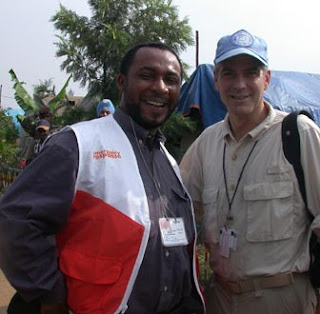
He may not be Rambo, exactly, but Horeb got along quite well with George Clooney, nonetheless."That's George Clooney!" I said to Horeb. By then, the Indian officers went into the mess hall to facilitate the visitors from headquarters. Horeb, Faustin and I sat as we watched about 15 people file past into the mess hall.

"Oh my gosh, that was GEORGE CLOONEY! I can't believe it!"

"Who?" Horeb asked.

"I just saw George Clooney! What's HE doing here!?! Oh my gosh!"

"What?" Horeb asked again, wondering what I was prattling on about.

"He's a big film star in America. Even bigger than your favorite, Rambo!"

"No! Really?"

"Yes. I can't believe he's here!" I squealed. How weird. Waiting in the midst of hills, jungle, and possible danger; hoping for a military escort out of danger, and we see George Clooney file in, as comfortable and modest as if he was supposed to be there.

"Would you like to come in for breakfast?" asked one of the officers who had been chatting with us. "Sure!" I wasn't hungry, but I wasn't going to pass this meal up.

We joined the line circling the table which had laid out boiled eggs, chapatis, chutney, naan bread, fried cheese, potato patties and meat sandwiches. There were plastic chairs arranged in a circle next to the table with food. As the honored guest, George Clooney was among the first to go around, and he took a seat on his own, rather shyly looking at his plate.

The officers were very kind to us, and let us go ahead of them. I quickly picked up a sandwich, chapati and some chutney and sat down about four chairs away from George. I picked at my food, and then I finally plucked up the nerve to sit in the empty chair next to him. Then something clicked and I went into my "Washington mode."

"So, what in the world brings George Clooney to Eastern Congo?" I started the conversation as I settled in beside him (just before one of his handlers could zoom in to try and take the seat).

"I'm just here checking things out," he responded, modestly, still looking at his plate, but with a shy smile. He was a pleasant, modest fellow. He is of rather small build, not much taller than I, but just as handsome in real life as he is onscreen. Same beautiful eyes.

At this point I could easily descend into drooling over episodes of ER and Oceans 13 and make a complete fool of myself. So, I had to put those out of my head.

"Where are you from?" he asked.

"Washington, D.C."

"That's rare, to find a native from D.C."

"Actually, not among African-Americans," I responded. "My family goes back about four generations in DC. And many Blacks have been in DC since the time of Fredrick Douglass."

"Right," he nodded in polite acknowledgement to my lecture. "But what brings you here to eastern Congo?" Mr. Clooney flipped my question back at me with a shy smile, never quite looking me in the eye.

"I work for World Vision, a relief and development agency that is doing work in the area. But I work in the DC office as a lobbyist, doing advocacy for those impacted by the conflict in the Congo. Everyone works the system in DC. I figure we ought to work the system to help the poor in the Congo, too."

"Hmm, interesting." We quipped a bit about the DC scene. Then I asked him for his impressions of the Congo. He recalled his trip to Darfur; he expressed more optimism and saw more potential in the Congo. I asked why he cared to come all, particularly because he did not have to. He briefly talked about his father ... as a TV journalist, his father covered a lot of the conflicts in Central America, making many efforts to try and get attention and action to those forgotten areas.

"I hope that by coming here we may get a bit more attention to the Congo." I smiled and nodded. "Yes, I'm sure your visit will. Thank you for coming. It is much needed."

Inside my head, I was screaming: MOM, I MET, GEORGE CLOONEY!!!!!!

Yes, girls, I met George Clooney and I even talked with him!

So what were my impressions of George Clooney? A pleasant, modest fellow. In this setting, he seemed taciturn, yet strong. He had a natural air of confidence which comes from traveling among those of influence.

In the midst of our conversation, I remembered to introduce Horeb to George Clooney: "This is my colleague, Horeb Bulambo. He also makes films and has made his own films on sexual violence in the east."

Horeb and George Clooney shook hands. "Hello, Mr. Clooney. I am a big fan of yours. We know you here in the Congo. If possible, I'd love to take a picture with you."

"Sure! No problem," he replied. At that moment, some announcements were made and thanks given. One of Mr. Clooney's UN handlers came by and asked that I keep the visit hush-hush, etc.
Sure thing (even though a BBC reporter was traveling with him)! No problem. I understood that he wanted to keep a low profile, etc.

"No problem. I understand. We were just here trying to get a military escort up to Kanyabayanga. And then you guys come. Looks like we'll have to wait on our escort."

"Yeah, must be surreal," his UN handler responded. Indeed. His handler asked for my business card, which I had left in our jeep, so I made my way back to the parking lot. By the time I got some cards, George Clooney and the group had migrated out of the mess hall and were making their way toward the parking lot. I passed my card to his handler, then found Horeb in the midst of the crowd. I plucked up my courage again, returned to "Washington-mode," and wedged my way up to Mr. Clooney again. I gave him my business card and wished him luck. "We are traveling up north in search of a 9 year-old child soldier who is reported to be a general in a child army," I said as I handed George Clooney my card.

"What?!?" he responded, with true incredulity.

"Yep," I replied. "I think we can get video of this, and I'd be glad to share it with you so that we can get more publicity about the tragedy of child soldiers in this area."

"A 9-year-old general?" He looked me dead in the eye this time (I almost fainted!). "Wow, good luck with your trip! Safe travels to you." He folded my card and put it in his pocket, then the crowd swallowed him. He paused briefly, turned around and pointed to Horeb -- "You! I promised I'd take a picture with you. Come, let's take a picture."

So, Horeb gave me his camera and I fumbled with it, not knowing how to use a digital camera; Horeb had to break out of his pose to show me where the shutter button was as Mr. Clooney and his crowd waited patiently for me.

I took the picture and then George Clooney and the crowd evaporated, and Horeb and I were left standing and watching as they disappeared with an escort out of the compound.


Surviving Virunga National Park

After George Clooney left, we waited about another two hours, intermittently making conversation with the Indian officers, drinking tea and eating biscuits, and twiddling our thumbs with increasing anxiety.

By 11 a.m., Faustin, our driver, was getting nervous. "It's getting late," Faustin said, in English, pointing to his watch. "We need to be out of the park and in Butembo before dark." I didn't quite understand the problem--it wasn't even noon, so how could it be late? Still, when your local staff get nervous, especially one known as "Rambo," I knew I needed to be concerned as well.

Horeb spoke to me in French so that the Indian officers would not hear his urgency and concern, asking that I play the fussy American and demand an escort. I cleared my throat, and with the biggest smile and the sweetest voice I could muster, I asked about our escort. "No problem, ma'am. We should be able to escort you guys to the bridge."

"No, to Kanaybayanga, we need you to go to Kanyabayanga," urged Horeb. There was a back and forth between Horeb and the Indian logistics officer. "No we can't spare any other vehicles, as they have all gone with the New York contingent. I've got two cars coming back in the next 20 minutes. They can escort you to the bridge. No problem, but only to the bridge."

Horeb and I both sighed. I thanked them. Horeb explained to Faustin in French that we would only get an escort about a fourth of the way. Faustin shook his head, got up and walked away, making some calls to his military friends on his cell phone.

"Well, that is the most dangerous part. Faustin will call his FARDC people and we should be okay through the park." We left Rutshuro at 11:30 a.m. with a military escort, one before our vehicle and another behind us. It was mostly a dirt road along the way to the bridge. Along the way we saw some Mai-Mai (local militia) standing guard, and a few FARDC troops, but mostly, we saw forest and savanna. We got to the bridge without incident, waved goodbye to the Indian officers, and then Faustin kicked up dust.

Virunga National Park used to be a haven for big game ... now it is filled with the world's most dangerous rebels."Now, you need to sit in the back, Rory. I don't want the officers to disturb you." I crawled in the back, and we drove about 300 miles for the next eight hours along a relatively good road (by African standards), but still very bumpy all the same. We were entering Virunga National Park -- which used to be a major tourist attraction during the 1960s, with big game like what you would see in the Serengeti -- but now home to rebels and armed factions.

The road was long, and much of the way we saw many, many FARDC officers. "But I see many antelope," Horeb chirped. "See the antelope, Rory? That is a good sign. It means that the lions will come soon."

"And once the lions come, so will the people," I replied.

"Yes, in 10 years there will be no war here; instead, people. Tourists will come to see this beautiful land." Every time we passed a group of antelope, Horeb would point them out to me; and every time we passed a group of FARDC troops, Horeb would wave and smile and shout "thank you!" out of the vehicle as we sped along. They would wave back at us.

Faustin kept speeding along. About an hour after we parted from the MONUC escort, we came upon a truck piled high with soldiers and some sort of cargo, blocking part of the road. We were forced to stop. I could see many of the officers looking at me; some were pacing the road.

One of the officers came up to us and peered into the window. He eyed me in the back seat. He and Horeb had a few exchanges in the local Swahili. The officer looked back at me again and then walked along. Horeb lifted his hands and said "Merci!" The officer shook his head and Faustin slowly maneuvered our vehicle around the truck.

Once again we were speeding along the windy road. "What did you say to that guy, Horeb?" I asked.

"Nothing much. He asked me for money, but I said that I was with my boss [referring to me] and that I wouldn't approve."

"Oh," was all I could say.

Crossing the equator on the long road to Goma.We were stopped only one other time, but Faustin knew the commander at that point so we were fine. The road continued to snake upwards into the hills, past beautiful forests, military checkpoints, and even across the equator. I got my pictures and my views of both the Nile and Congo River basins.

Once we got to Kanaybayanga, the village-town up in the hills, beyond the point of danger, Horeb exhaled and exclaimed, "Rory, this drive was dangerous! Did you know that?!"

"No, I didn't. But you told me it was safe! And MONUC said it was ok."

"Rory, MONUC is not God. You must like danger," he smiled.

No, I definitely do not -- but I had a feeling we would make it through. Or maybe it was just blissful ignorance which enabled me to trust that we would be okay. And, by God's grace, we made it safely through Virunga National Park, once home to the big game ... and now to some of the most violent guerillas in the world.

Posted by Larry Short on behalf of Rory Anderson in the Congo.

Tuesday, January 29, 2008

Just a Dumb Muzungu

A child miner heads to work in the pits.Yesterday, we traveled to see the king, or the paramount chief of the area. During our first visit to the mines, we met with the various sub-chiefs of the mining area, retroactively asking their permission after we had taken photos and talked with people in the mining area.

We didn't follow protocol, so all the sub-chiefs and their relatives were insistent that we visit the king. So, on Sunday we drove along a relatively good (not flooded out, no major holes) dirt road, about 14 miles from the mining area, to visit the paramount chief who, by traditional law, owned most of the land in the area around Likasi town.

The few surrounding houses in the village were made of mud bricks with thatched roofs. But the chief had a tiny brick house, perhaps 15 feet by 7 feet, with a tin roof and two windows facing a dirt driveway that cut through tall grasses adjacent to a patchy front yard.

In the front yard was a shady mango tree and an open square shelter-- a thatched roof held up by four wooden poles, about 10 foot by 10 foot. As we drove up and parked on the lawn, we saw an old man sitting alone under the shelter, waiting, planted like a bush, smoking a cigarette.

The chief was perhaps in his late 60s, dark-skinned, wizened, with a salt-and-pepper afro and mustache. Dressed in western clothing, he wore a pink, green and white diagonally-striped button downed shirt, dark brown dress slacks, and black, shiny leather dress shoes. Underneath his chair was a pad and pen, just in case we said anything worth writing down.

We piled out of the car -- Horeb, Maitre, and Christian (another friend and colleague who does media and communications for World Vision in the eastern DRC). He and Horeb are childhood friends; they are both hilarious. We have lots of good conversations and laughs together.

Along the way we also picked up the chief's daughter, her husband and her child, who came to present us to the chief.

"You must bow before the chief. Keep bowing." Okay. Monkey see, monkey do. Making myself as small as possible, I followed the line and came behind, bowing.

Four of the chief's sons brought out blue plastic chairs, and under the shelter we formed a semi-circle facing the chief. Many adorable toddlers and young children hovered and played nearby, watching with interest this delegation of strangers. I, the "muzungu," drew the most stares. Throughout the visit, I frequently smiled and waved at the children in response.

We sat silent for a bit. Then Horeb asked the chief's daughter to introduce us.

A local variation of Swahili and some French was spoken. The chief nodded to each of us as we were introduced. He welcomed us, and then spent some time scolding us, saying that his small square brick house was the capital of the area and should have been our first stop before going anywhere in his territory. He then entreated us, as representatives from World Vision, to do more in the area to help the people. Silence, and many nodding heads.

Sometimes, protocol can obstruct progress. Shrewdly, at Horeb's direction, we had gone straight to the mines, relying upon Maitre, our local mining contact, to walk us around, rather than going to the paramount chief, knowing that the chief would most likely notify the authorities of our visit, who would have then prevented us from taking pictures and video or talking with people.

In cases like this, it is sometimes best to ask for forgiveness rather than permission. Recognizing this, I decided to apologize, hoping to ameliorate our insolence. "Is it alright for me to speak?" I whispered to Horeb. "Yes," he replied, "go ahead."

I spoke in English. Horeb translated. I earnestly thanked the chief for taking the time to meet with us, and profusely apologized -- "I am a dumb muzungu, and did not know to stop by here, the capital, first. Please forgive me. I am very, very sorry."

I think my apology was accepted, and that seemed to break some of the ice. The chief mildly nodded in acceptance and continued on, pragmatically asking World Vision to build a school and a hospital. He had a gravelly, raspy voice, like Charlie Rangel, and as he spoke, he smoked, poking fun at us ... "Many people like you have come by, seemingly like tall white warriors ready to fight, saying many words, writing things down, but no action."

All of us in the circle laughed. He was absolutely right. Many promises and no action is meaningless. I admired his pragmatism. By now, the chief was on his third or fourth cigarette.

"I will pray, but I won't hope. But I am glad you are here. Perhaps it is a sign from God." Under the shade of the shelter and the tree, the group continued in dialogue for about an hour, and the chief continued to crack sardonic, pragmatic quips at the promises of NGOs and outsiders.

"Are there other needs in the community?" Horeb asked.

"Yes, many," the chief replied, "but I won't ask, for fear that you will do nothing. Let's go slowly -- slowly. The most important thing is to at least build a school for our children, delivering us from this slavery."

Yes, indeed. Though we never raised the issue of children in the mines, the chief was aware of the problem and also grasped the solution.

I liked the chief; I admired his pragmatism and wit.

After our talk, the group briefly walked around the area. We stopped by the village well, a covered cistern with a crude metal ladle attached to the lid. Horeb took pictures. The water inside looked like watery chocolate milk.

"This is what they drink," said Christian.

"God, how awful," I replied. "The children must suffer with diarrhea and sickness."

"Yes, and cholera is a big problem in this area."

Piles of spent ore litter the jungles and grassy savannahs of the Congo.We walked back to the chief's house, through a small field of tall grasses. "Horeb, are there snakes in these grasses?"

"No, Rory, those are only in the jungle, in Ituri, and in North Kivu." Yeah, right.

"Here, only small snakes."

"I'd better not get eaten like that UN guy who got swallowed by a boa in his tent!" I exclaimed. "Can you imagine calling home to my dear sweet mother and telling her that her daughter got swallowed by a snake in the Congo! She would hunt you down and cut you guys!"

My mom is 5'3" and about 110 pounds, but, indeed, I have no doubt she would.

"No, Rory, we are putting you in the middle, so no snake will get you," said Christian, smiling. "And I'm telling you, they are not here."

"Never fear. We have you protected," promised Horeb.

"Just like George Bush," I answered. We all laughed.

"George Bush. I like that man!" Horeb declared, wagging his finger. "Small words, big actions. I like that man!"

As we walked through the grasses, Horeb and Christian continued to laugh and joke about snakes and how different plants can make you strong. We returned and again thanked the chief before piling back into the LandRover. As a group, we left laughing, but with resolve to urge our World Vision colleagues to help this community.

We were glad and relieved at the pleasant, patient exchange with the chain-smoking chief.

Posted by Larry Short on behalf of Rory Anderson in the Congo.