Showing posts with label Sponsorship. Show all posts

Tuesday, June 12, 2007

Make a Difference ... for One Child


Share Your Own Sponsorship Story: Click the "Comments" Link Below


For more videos or to sponsor a child:
http://www.WorldVision.org/


One of the coolest things about World Vision isn't simply that the Christian humanitarian organization helps large numbers of people affected by disasters or humanitarian crises ... it's that we have created a way for people who care about those who are suffering to get connected to a single child who needs their help.

There are a number of ways we do this, but one of the most tried and true is called "child sponsorship." When sponsors find a child in a developing country to connect to, not only do they provide desperately needed financial support which resources a program, designed with full participation by community leaders to strategically meet the needs of that community's children, to provide things like healthcare, education, nutritious food, clean water and sanitation ... but they also create a one-to-one relationship with that child which benefits both the donor and the child (as well as her family and community). By praying for each other, communicating regularly via e-mail or postal mail, and even the occasional visit, for many this relationship has blossomed into a lifelong growing experience more precious than money.

Personally, my daughter Mandy and I saw the benefits of sponsorship firsthand when we visited Gracia, our sponsored child in the Congo, last summer. It was one of those life-changing experiences which neither of us will ever forget.

Our creative team here at World Vision has just developed a series of unique new videos highlighting the joys and benefits of child sponsorship. I have attached the very first one at the top of this blog entry. We are planning on launching it on our homepage later today ... but I wanted you to be the first to see it! I would appreciate you posting any comments you might have about this video.

And also be sure to share it with your friends. They can even go on YouTube and view it there, rate it, provide their comments or share it with their network of friends.

And, let them know about how fun and easy it is to sponsor a child on the World Vision Web site! You can search the online photo profiles of thousands of available children in dozens of developing world countries for that perfect child God has selected for you to connect with. (You can even search by birth date!)

Ever think the enormous problems of the world are too big to do anything about? Think again. You are just one person ... but you can make a difference in the life of a child who needs your help!


SPONSORS: BE THE FIRST TO SHARE YOUR STORY

We invite you to share your own story about the joys of sponsorship on this blog. Please click the "comments" link below to send us your story or to read the stories shared by other sponsors.

Tuesday, July 11, 2006

Another Killer in the Congo: Diabetes

"I AM NOW ALONE"

In the southern Katanga Province, in or near cities such as Lubumbashi, Kipushi, and Kolwezi, World Vision is assisting large numbers of orphans and vulnerable children. As the killer pandemic of AIDS strikes and divides families, so many children lose one or both parents. Typically they are "adopted" by extended family members, but the stress of AIDS on a society already devastated by war and economic catastrophe makes the challenge especially difficult for these families who are now caring for the children of their deceased relatives.

"HopeChild" support provided by our donors is assisting in meeting the needs of orphans and vulnerable children. The latter may not have lost parents, but they nonetheless have special levels of critical need in an impoverished society, due to a debilitating illness such as AIDS.

In addition to HIV, there are also a number of other serious illnesses which can make a child vulnerable. Diabetes and sickle cell anemia are common examples of illnesses which affect children in the Democratic Republic of Congo (DRC).

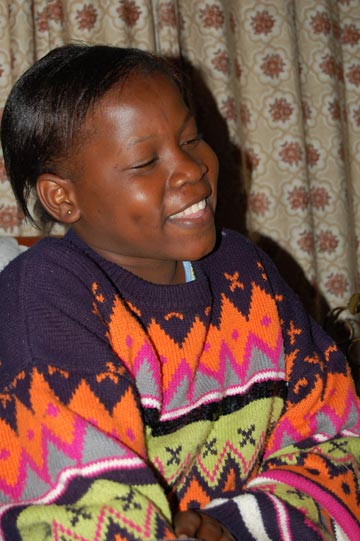
Felicite Nzabandora is one such vulnerable child, due to a 15-year fight with diabetes. Felicite's surname means "I will see" ... which is sadly ironic, as Felicite is in the process of losing her eyesight. She also has other complications resulting from her battle with a disease which might be relatively easy to control in places where access to medical care is taken for granted; but here in the Congo, in Felicite's home town of Kolwesi, such a disease can and often does create early childhood mortality.

But her first name, "Felicite," means "Joy," and World Vision is working with the Nzabandora family to try and create a hope for a brighter future and a reason for joy for Felicite. Though she has recently turned 18, her small frame and childlike face could easily be mistaken for a child four years younger. In addition to struggles with her eyesight, she also experiences pain and circulation problems in her hands due to the disease.

Felicite is the sixth in a family of seven children, but even her younger sister is a head taller and looks older than she. Her father, Joseph, is a civil engineer, and her mother, Agnes, is a registered nurse ... which is good fortune for Felicitee, since Agnes takes such an active role in trying to ensure her good health in the face of such a debilitating disease. Agnes ensures that Felicite faithfully takes her daily injections of insulin, provided by World Vision, which has helped to arrest the negative progress of the disease.

However, unlike a country such as the U.S. where blood sugar testing tools are readily available and affordable, and diabetics can therefore test their need for insulin several times each day -- enabling them a finer level of control in their administration of the important but dangerous substance -- unfortunately, in the Congo, the only place where blood sugar testing can be done is in a medical clinic or hospital. So Felicitee is only able to get her blood sugar tested occasionally, when World Vision takes her to a nearby clinic for checkups.

In addition, Felicite is now in need of surgery to remove the cataracts which have developed in her eyes. She was forced to suspend her schooling because of her inability to read due to the deterioration in her eyesight.

“I cannot see properly," Felicite explains. "And it is very difficult for me to make a fist. I cannot go to school and it is painful for me. When I see other children going to school, I am really sad. I wish I could also join them, but ….” and she begins to cry.

After she is able to speak again, Felicite says her career goal is to become a medical doctor, so she can help other children who are suffering with diseases such as diabetes.

When asked if she has other friends who struggle with diabetes, Felicite nods her head but remains silent for a moment. Then she explains, through her tears: "All my colleagues suffering from diabetes have already died." At one time, her mother explains, she had four friends suffering from the disease. But each has since died of complications. "I am now alone," Felicite says sadly.

In addition to her health care and medicines, World Vision is also providing food assistance to Felicite and her large family, in the form of milk, rice, potatoes, biscuits, and apples.

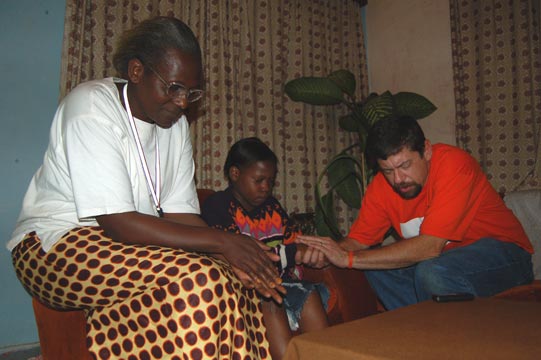
I had the privilege of praying for Felicite and her mother, Agnes, during our time together. Please join me in praying for a full recovery of her eyesight and use of her hands.

Saturday, June 24, 2006

The Heart of Africa

Ever have an experience so wonderful that afterwards you thought, "Okay, I could just die happy right now!"

That's the week we just had, and it was in one of the last places you'd expect -- the war-torn Democratic Republic of the Congo (DRC).

We visited World Vision projects in three cities in the southern part of the Congo's Katanga Province: Lubumbashi, Kipushi and Kolwesi.

Time Magazine (see "Congo: The Hidden Toll of the World's Deadliest War") called Katanga "a cursed province." An estimated 4 million people have been killed by conflict in the last eight years. Nothing short of a holocaust, even though you probably haven't heard much about it in the media. And the impact of all this trauma is nearly unfathomable, as recounted by a very interesting article in Christianity Today (see "Hope in the Heart of Darkness").

So, we wondered exactly what we were getting ourselves into as we approached Katanga Province from the south. Certainly, getting there was half the fun. We flew from Johannesburg, South Africa, to Ndola, Zambia, and were then driven overland two hours north to the border with the DRC. Then came the border crossing, a scene of utter and incomprehensible chaos. Cash changes hands at so many points when you cross a border outpost like the one we crossed. The whole crossing took about two hours and included a visit to the office of the DRC commandante in charge of the entire border crossing operation, who said he just wanted to see for himself the white people who were trying to get into his country. Hmmm.

Then another two hours north, and we arrived in Lubumbashi, as bustling and noisy a city as I have ever seen. Horns honking, goats bleating, taxi drivers calling out for fares at every hour of the day or night, music blaring: the city is a blur of frenetic activity. Add the white UN peacekeeper vehicles with their armed soldiers everywhere and it reflects an interesting atmosphere of tension, balanced with hope for a better future to come out of next month's long-awaited democratic elections.

Once in Katanga, we were grateful for the cautious supervision of the World Vision staff who accompanied us and made us feel both welcome and secure. But one of the things I had a hard time getting used to is seeing young men (hired police officers) guarding the entrance to a World Vision office ... wielding automatic weapons.
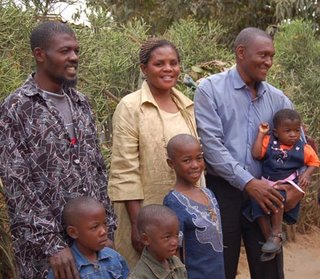
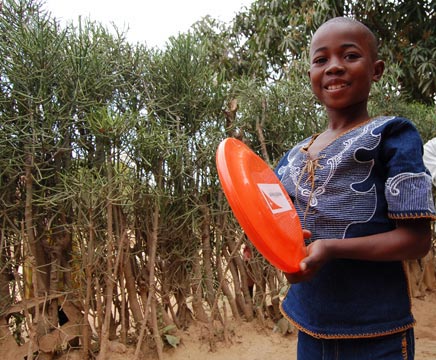
One of the purposes of our visit was our source of greatest joy, and that was the opportunity to meet our sponsored child, Gracia, and her family in Kipushi. Gracia is a pretty and very intelligent young girl of 8. She seemed understandably shy at first. We brought a few simple gifts, including an orange "frisbee," which we had to try out for size out of doors. Our demonstration drew a curious crowd of dozens of friends and neighbors to witness a game which probably isn't played very often in the Congo!

Gracia's father and mother are street vendors, and her mother was in Zambia when we visited so we missed her. But we enjoyed very much the time spent with her father, brothers and sisters, and aunt and uncle. The day's activities included attending a soccer game together, where Gracia helped us with our videotaping.

Despite the language difference, by the end of the day we had become such fast friends that parting ways was difficult indeed.
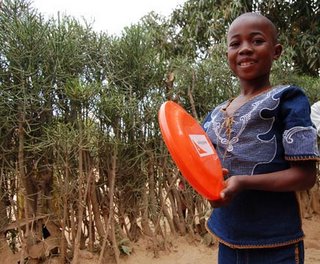

I know it's not possible, and that what we experienced was an enormous privilege, but I wish that somehow every sponsor was able to visit his or her sponsored child. If so, you could see for yourself what an amazing difference sponsorship makes.

The entire south portion of the Congo was once ruled by large mining company interests, which provided a large portion of the population with work and also built a significant amount of infrastructure ... including schools, hospitals, roadworks, public utilities and even tracts of homes ... for their communities of workers. Unfortunately these mining interests have largely collapsed, and now large portions of the population are unemployed and in desperate poverty, turning to subsistence farming and street vending in order to survive.

I found the Congolese to be a highly creative, resourceful and industrious people. They understand the importance of relationships and know how to take time to build them. They laugh a lot, sing a lot, and dance a lot. They seem to find great joy in simply living. In the midst of great challenges, they have great hope for the future.

And the challenges are enormous. Government is in large part unable to provide even the most basic services. Health care is a significant challenge, with 80 or 90% of the population suffering from malaria and various other serious illnesses. HIV and STDs are also a serious problem, particularly in the south where thousands of trucks stream across the border with Zambia every day, delivering goods from South Africa and elsewhere. In addition to their goods, the foreign truckers are exposing large numbers of girls and women to HIV.

During the week in the DRC I discovered several significant stories I am eager to tell. I visited:
  • a nearly abandoned hospital which is a last vestige of hope for a number of sickle cell anemia sufferers

  • a school for the deaf and mute which draws students from all over the province ... many walking long miles each day, on treacherous roads, in predawn hours to reach it

  • a support center for street children, run completely by volunteers, which feeds and helps hundreds of children each day, many of whom have been abused and expelled from their homes as "sorcerers" because of suspicion that they have somehow brought AIDS on their parents

and more!

I hope to present these stories on this blog in the days to come. However, early Monday morning we catch our flight to our next destination: Harare, Zimbabwe. The one thing we weren't able to do in the Congo is to get a solid internet connection that we could use to upload our daily blogs, which is why you haven't heard from us in so long! Hopefully we will be able to post more regularly from Zimbabwe. So stay tuned! Or else check back next weekend, after we return to Johannesburg.