Showing posts with label disabilities. Show all posts

Thursday, July 20, 2006

Sapalo Survives a Silent Killer

Ten-year-old Sapalo Satshilenge was walking peacefully along the relatively deserted and lonely country road in the pre-dawn darkness when there came, unexpectedly, a moment he would never forget.

He never heard the approaching motorcycle. It wasn't until some time after the motorcycle struck him that he learned exactly what had happened.

It wasn't that the motorcycle was silent. Most vehicles on such roads on the Congo make a lot of noise as they navigate, usually honking their horns every time they see a pedestrian to warn them that they have no intention of slowing down.

But for Sapalo, a deaf-mute, the warning of the oncoming danger was never received.

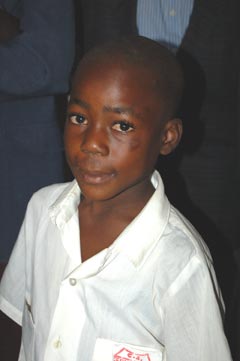
Fortunately, Sapalo survived the terrible accident, and now has scars on his head and elsewhere to show how lucky to be alive he really is. Many other pedestrians in similar situations haven't survived an accident on the Congo's treacherous roads, where any kind of emergency medical help, if it is available at all, is most likely many hours away.

Sapalo was on the road in the darkness because, like many of the deaf-mute students at the World Vision-assisted Ephrata school, they have no other option but to walk long miles to and from the school each day. Some students walk as far as 20 miles, each way, to reach the school, their only hope of living a life freed from the worst effects of the poverty that enslaves so many families in the Congo.

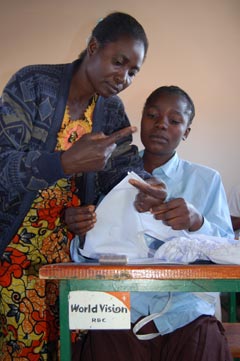
It is at Ephrata, which is one of four schools established for the deaf and mute in the Congo's enormous Katanga Province, that these students are taught not only a classical education but also valuable career skills such as sewing and carpentry.
And they are taught something else as well: hope for a better life, both now and in eternity to come. For Ephrata carefully and strategically conveys Christian values to its students and isn't afraid to help equip them to grapple with what the Bible has to say about how to truly be successful in life, despite whatever disabilities you may be born with or accumulate along the way.

Unfortunately, the vast majority of families of Ephrata's students are far too poor to figure out any better way to get them to and from school each day. In this part of the Congo, school buses are unheard of, and very few people own cars. Only the "upper crust" even own rudimentary bicycles, which are usually used like small trucks for conveying various goods to and fro for business purposes.

So most of the students walk the distance. And it is because of this walking, on very hazardous roads under poor conditions, that Sapalo was just one of two of Ephrata's students, in May alone, who were struck by vehicles in separate incidents.

To address the hazard, the leadership of Ephrata is hoping to build dormitory facilities on the school's ample land to house students during the week. They are seeking special funding for this project, and accumulating piles of bricks that will eventually be used in the construction.

World Vision is supporting Ephrata and the three other deaf-mute schools in Katanga Province, and their enthusiastic and hopeful students, in a variety of ways: with educational supplies, teacher training, desks, sewing machines, and more. This support is a vital investment in the future of the Democratic Republic of Congo, and that of many families and their disabled children in the Katanga Province.


Top photo: The marks of Sapolo's run-in with a motorcycle are evident on his face and head.

Bottom photo: One of Ephrata's teachers demonstrates a sewing technique to a female student.

Thursday, June 15, 2006

A Model of Hope for Fathers Everywhere

"BABA" BRIAN XHALA

Have you ever been stabbed in the back before? I think all of us would answer "yes" to that question ... but we would be speaking figuratively, not literally.

After we arrived in Bergville, South Africa ... a town where World Vision's "Okhahlamba Area Development Program" is headquartered ... we met a man who, quite literally, had been stabbed in the back. It happened during a train robbery that occurred when he was just a young man of 20-something. He left the hospital, after six months, in a wheelchair as a paraplegic. He now walks with the aid of crutches -- thanks to sheer determination -- and even drives a car with a manual transmission. Which is no small feat, as I have been trying hard to do the same thing here!

"Baba" Brian Xhala is now 55 years old and his life has undergone a remarkable transformation. (By the way, like "Mama," "Baba" is a term of respect and endearment here.)

He was raised in Durban but after his injury lived with his grandparents on their farm in the Okhahlamba area. Like most people he knew, he hated anyone whose skin was white because they represented the oppressive Apartheid regime. "We told ourselves that our hatred was merely political, but that wasn't what it was. It was simply hatred."

Thus his life, already quite complicated as a disabled person in a very impoverished place, became even more complicated when he learned that this organization called World Vision, led in Okhahlamba by a white-skinned Canadienne named Monika Holst, was moving into his neighborhood. "We were sure that they would soon move their fences and try to take over our land," he recalls.

He tried to avoid World Vision. But Xhala, a natural born leader and eloquent spokeman for his cause, soon found this to be daunting. He was serving on various civic committees representing the disabled, and World Vision soon began partnering with these organizations.

After several years of exposure to World Vision and its growing ministry among children in the area, Xhala says he gradually became convinced of the truth. "It was the love World Vision has for children. The way they helped them without reservation." He began attending meetings with World Vision. And in these meetings, something else happened. The Bible was opened. People prayed, and they worshipped.

Xhala was not a man of faith; like many around him, he believed "white man's religion" was just another tool of oppression. But what he read in the Bible startled him. The Bible proclaimed justice, and freedom from oppression for all people. Its hero, the Son of God, was crushed to bring freedom to the captives. Like Xhala's own back, Jesus' back was also scarred by human sin ... but he bared it willingly to the scourging so that others could be healed by His stripes.

Soon Xhala found that, just as he could not avoid World Vision, neither could he any longer avoid the Savior who loved him and gave His life for him.

Eventually Xhala became World Vision's director of disability ministries. He works specifically with a group of disabled sponsored children and others in the communities of Okhahlamba. His heart's desire, he says, is to teach and model for them a vision and a hope for a future bright with promise, even for those whose very disabilities tend to rob them of courage and hope.

"Training is the key," he proclaims. He has arranged computer skills training for many of the disabled students, and is very pleased at how well they have done. Some have already obtained very good jobs using their newfound knowledge; computer skills are very valuable in a society like South Africa's which is on the very verge of such technological advancements.

He is also working toward the startup, with microeconomic development funding from World Vision donors, of a casket-making business with mostly disabled staff. Casket-making is big business in South Africa, with its one-in-four prevalence of HIV.

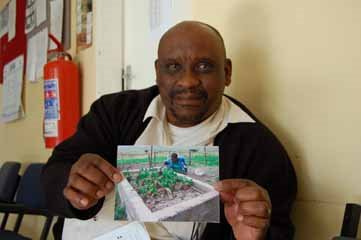
And he finds that hope thrives in even the simplest achievements. While we were speaking, he produced a photo of a young woman in a wheelchair, who was tending a raised garden bed. "What her family really needed was food. When I suggested a garden, at first she scoffed. But together we came up with a plan on how it could work. Now she has one of the best gardens around."

Baba is a busy man, but he is well aware that he can't do it all. This knowledge gives rise to his focus on mentorship. He is pouring himself into the young people God brings into his life, and has already identified at least one that he can turn the reins of leadership over to when he retires.

Xhala, who is married and has two daughters of his own, now grown, is modeling hope for many in South Africa who were simply surviving before. I don't believe Father's Day is celebrated here in South Africa as it is at home in the U.S. (at least not on June 18), but I was sure Baba's story would be a great encouragement for the many fathers, like me, who want our lives to be an example of hope and faith to those around us.