Friday, December 01, 2006

World AIDS Day in Chicago


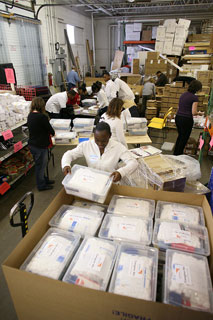
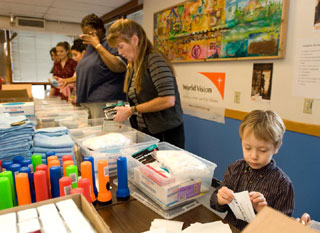
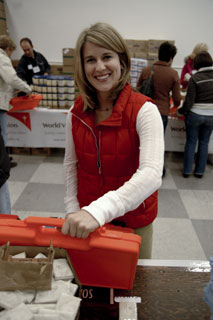
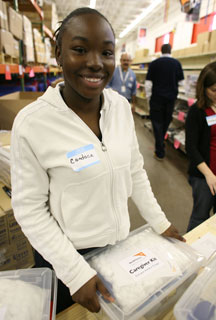
Eighth graders from a Chicago area elementary school stopped by the World Vision Storehouse to help put together caregiver kits for aids workers that will be sent to Africa. This is Candace Mason Woods preparing one of the finished kits for shipping.


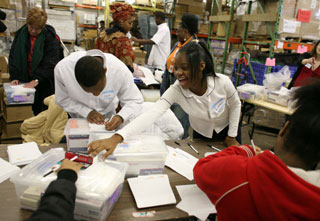
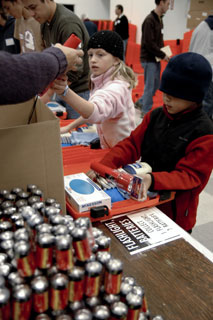
Christopher Walker (left) and Imari Townsend.


Eighth grade teacher Ms. Brandy Bolden (left) helps Princess Zulu of Zambia assemble Caregiver Kits.


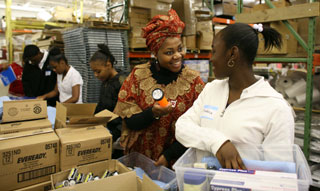
Princess Zulu helps student Candace Mason Woods assemble kits.


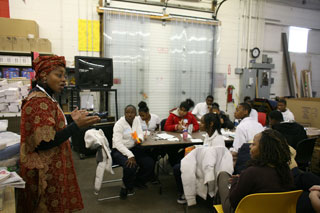
Princess Zulu, who is a prominent Zambian who is HIV-positive, shares her story and her hope with the visiting students.


AIDS Walk

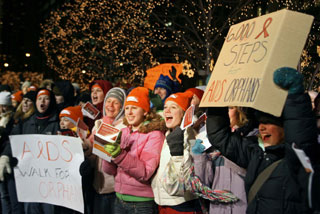
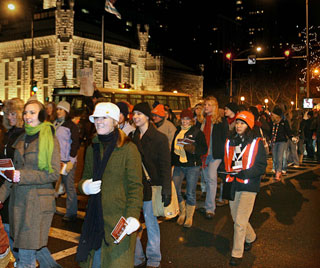
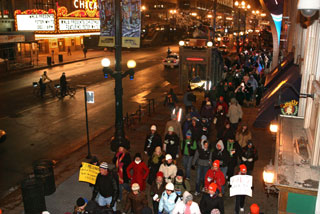
Despite 20 degree weather and snow and ice on the ground over a thousand marchers from World Vision took to the streets of Chicago to support International AIDS Day which took place around the world Friday. The route of the march took the marchers through down town Chicago in the early evening hours. As the marchers made their way past the NBC 5 TV studios they found themselves part of the evening news.

All Photos by Bob Black/Genesis Photos.

The group of marchers makes its way past the old water station on North Michigan Ave.


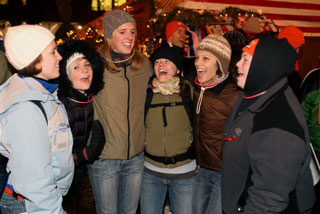
Warming up with a few good marching songs.


All photos courtesy Bob Black/Genesis Photos.

- Back to Top -

Giving Back at the Shelter

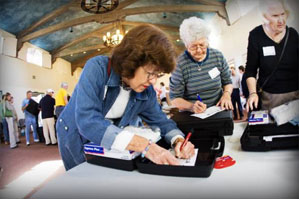
Women at Seattle's Union Gospel Mission’s Women and Children’s Shelter make Caregiver Kits.

Ryan Smith is assistant editor with World Vision’s publications department. He graduated from Seattle Pacific University in June 2006. All photos by Jon Warren, photo director for World Vision.

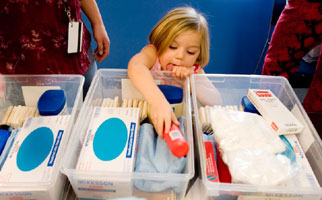
Braxton, 4, enthusiastically loaded towels, soap, and other items into plastic containers—World Vision caregiver kits. “We’re helping sick people in Africa,” she announced.

When Braxton finished one, she pulled her mom back to the front of the line of assemblers. “She’s put together at least 12 containers,” her mother, Jamie, said with a proud smile. And the pair made at least five more before the supplies ran out.

In less than two hours, women at the Union Gospel Mission Women and Children’s Shelter put together 500 kits for caregivers across the world who take care of AIDS sufferers. The supplies in the kits are basic—things like notebooks, pens, soap, towels, gloves, and a flashlight—but their impact on the quality of care in rural villages is profound.

This was the first opportunity for the women of the shelter to create something that helps other people, said Gloria Hall, the director of the shelter. “I knew the women would love to do this because they love to connect with people.”

The Women and Children’s Shelter houses up to 90 people, providing short-term care and long-term rehabilitation for women and children in Seattle. “We try to create a safe environment for the women to heal and get back their dignity,” Gloria said. “[Creating these kits] is something that gives them dignity, because they have something to offer.”

“We don’t get many opportunities to do things like this, so it’s good to be able to give back,” said Maria, a woman with a big smile and overflowing enthusiasm. “We’re very blessed here, at the Union Gospel Mission and in the United States.”

Another resident, Nancy, was glad to have the opportunity to help. “I used to work with Alzheimer’s patients, and it’s been a long time since I’ve been able to help people,” she said. But making the “gift boxes” for caregivers was a good way to do that again.

When the work was done, Gloria said, the ladies asked for the opportunity to make more caregiver kits. “These women, even though they’re in poverty, are the most giving people.”

- Ryan Smith

- Back to Top -

World AIDS Day Events in New York City

First Lady of Zambia, Maureen Mwanawasa: "AIDS a Global Challenge"


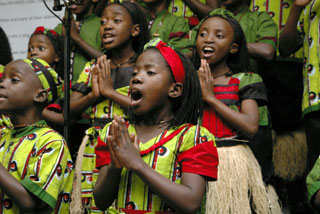
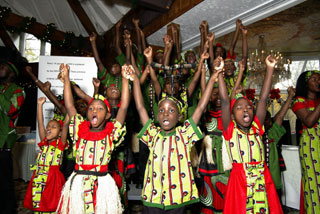
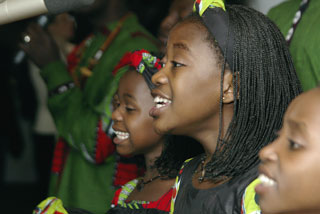
The Watoto Children's Choir is Comprised of AIDS Orphans* From Uganda


*Orphans who have lost one or both parents, presumably to HIV or AIDS.

World Vision's World AIDS Day celebration in New York City was blessed by the Ugandan Kids Watoto Choir singing at the "Tavern on the Green" in Central Park West on Friday, December 1. All photos by David Singer/Genesis.


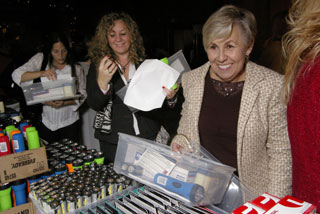
Festivities included putting together Caregiver Kits that will be shipped to Africa, where AIDS is an epidemic.


- Back to Top -

Seattle, Washington Event: Students Respond with Music and Art

Blog contributor: Ryan Smith. Photography by Jon Warren.

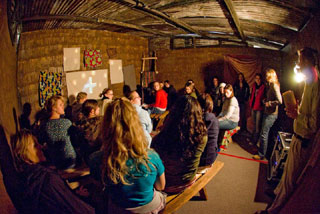
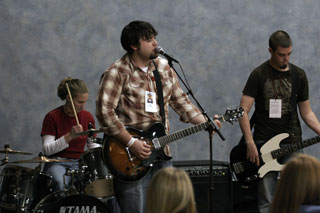
World AIDS Day at Seattle Pacific University (SPU) kicked off yesterday with a benefit show featuring students responding to the AIDS pandemic through music and art. About 100 students packed the room, gathering to enjoy some great music and to support AIDS orphans around the world.

Danielle Henry, one of three musicians who performed, shared a beautiful ballad titled “Blessed.” She jokes that some of her friends call it “The AIDS Song.” She wrote it after walking through the World Vision AIDS Experience last year.

"I Went Home and Wept"

“[The Experience] was really inspiring, because I was putting myself somewhere besides my little Christian college campus. I was seeing what other people had to walk through on a daily basis,” Danielle says. “I went home and wept, and the song came out of that.”

Lyrics like "How do we get away from that little box of pride that’s filling up our lives?" and "Where do we draw the line between what is right and that little selfish thing inside?" were a challenge to look past immediate surroundings — and a challenge for students to visit the AIDS Experience that’s currently on campus.

In fact, the concert event itself was sparked from that song, says Wendy Whitley, a sophomore who leads SPU’s Acting on AIDS chapter. “I heard Danielle perform the song, and the idea for a concert got rolling,” she says. “I think that this event is important because it shows that students are responding to the AIDS crisis in their own creative ways.”

Representing a World Affected by AIDS

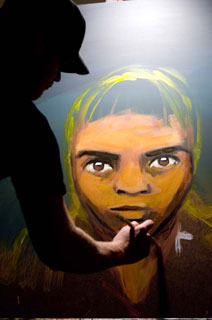
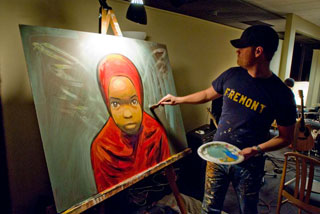
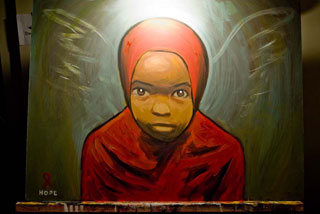
While Danielle and others played their music, Scott Erickson was painting to the side of the stage. He painted an African girl and an Indian boy to represent the world affected by AIDS. “A lot of the attention about AIDS goes to Africa, and rightly so,” Scott says. “But it’s spreading to the rest of the world, and especially India, and I wanted to show the global spread of the disease for World AIDS Day.”

“Scott the Painter,” as he is more commonly known, isn’t a student, but he has painted for many SPU events and regularly works with churches and non-profits to add a visual experience to events, in addition to his studio work.

To see stories, photos, and video about other World AIDS Day events at Seattle Pacific University, check back to this site throughout the rest of this evening!

Check out Danielle’s music at www.myspace.com/daniellehenry.
See some of Scott’s artwork at www.myspace.com/seescottart.

SPU students: Please click the "comments" button below ... are you planning on making any changes to your life as a result of this campaign? Tell us about the child you chose, and why. Let us know what you are thinking!

- Ryan Smith

- Back to Top -

Seattle, Washington Event: "Lives on the Line"

Blog contributor Ryan Smith; all photos by Jon Warren.

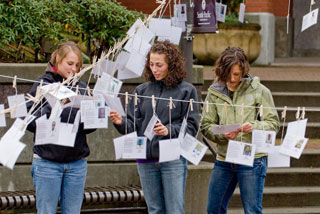
December 1 is a cold and rainy morning here is Seattle (what else is new?) ... but seven students from Seattle Pacific University woke before the sun in an effort to raise awareness about the AIDS pandemic.

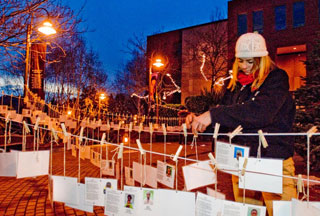
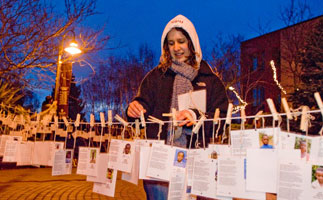
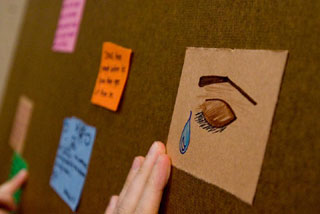
They braved the 35-degree cold to create an interactive display, in the heart of their campus, depicting the plight of children orphaned or made vulnerable by AIDS. The display, called “Lives on the Line,” gives their fellow students the opportunity to take a card with a photo and story of a child in need and pray for him or her throughout World AIDS Day.

“I think people know that there is a problem with AIDS, but it can be hard to find things to do about it,” said sophomore Amy McNair. “We’re trying to find outlets for people to get involved.” The photo is a reminder to pray for and learn about a child from across the globe, Amy said. She and most of the others working this morning are members of the Acting on AIDS chapter on campus.

Students Turn Out in Droves

“It’s been overwhelming to see the number of volunteers,” says sophomore Wendy Whitley. “People are excited and willing to help and be involved, and whether they can come to every meeting or not, students want to do something.”

One of those students is Jon Viducich, a 19-year-old sophomore. He became aware of the AIDS crisis when his friends became passionate about it, and he has begun to learn more and get involved. “With all the things going on at college, I can’t do all the activities, but I like to be involved when I can,” he says.

These students have been working for weeks to lay the groundwork for the events of the day. And as dawn breaks, they are beginning to see the fruits of their efforts. A student tentatively walks up to the string of cards. “Go ahead and take a picture of an orphan,” Amy calls out. “Take it with you and pray for them throughout the day.” The girl smiles, takes a card, and continues on to class.

- Ryan Smith


Watch video.


World Vision AIDS Experience -- Africa Exhibit

A "miniature" version of the World Vision AIDS Experience was also available at SPU for students to examine this week ...


- Back to Top -

Tacoma, Washington Event: The Mayor Rocks the House

Mayor Bill Baarsma spoke to students and community members last night about his recent trip to Lesotho with World Vision.

A World AIDS Day Rally featuring the Tacoma city mayor and others was held at Pacific Lutheran University in Tacoma, Thursday.

Baarsma, who signed a friendship city agreement with the mayor of Maseru, Lesotho during his trip, told the audience that his goal is to have city of Tacoma residents sponsor 1,000 children (orphaned or made vulnerable by AIDS), provide 10,000 Caregiver Kits (for volunteers in Africa who are caring for HIV sufferers), raise $50,000, and provide 300 desks for Lesotho by the end of September.

"I'm a citizen of Tacoma, you are a citizen of Lesotho, but we are all a part of the same community," Baarsma reported telling the people of Lesotho during his recent trip. "Dealing with this horrific pandemic requires more than just prevention, although that's certainly one part of it." The mayor said it also requires the holistic approach to bettering the community which is used by World Vision.

- Mike Nichols, World Vision Communications


VIDEO: Pacific Lutheran University Students Speak Out


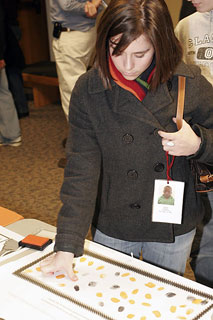
Lindsay Cook adds her orange thumbprint to the "Make Your Mark Campaign" at the Tacoma World AIDS Day Rally at Pacific Lutheran University in Tacoma. The "Make Your Mark" Campaign is an advocacy campaign asking President Bush and Congress to allocate at least $5 billion of the 2008 budget for the global AIDS pandemic, with 10 percent dedicated to the care of orphans and vulnerable children.


Members of The Gathering Band cover U2's "One" at the Tacoma World AIDS Day Rally at Pacific Lutheran University Thursday night, giving those in attendance a chance to reflect on what they had heard from the event speakers.


PLU students: Please click the "comments" button below ... are you planning on making any changes to your life as a result of this campaign? Let us know what you are thinking!

- Back to Top -

World Vision AIDS Experience in Charlotte, North Carolina


- Back to Top -

Menlo Park Caregiver Kit Event


Video submitted by Tom Costanza, featuring World Vision's Andrea Dearborn.

Pre-AIDS Day activities at Menlo Park Presbyterian Church in Menlo Park, California included putting together AIDS Care Packages and Prayer Notes. The packages will be shipped to Africa, the world's most AIDS-ravaged continent.

An "AIDS ribbon sculpture" which was created yesterday (Thursday, November 30) out of 3 million pennies, became the centerpiece at the warehouse where volunteers packed Caregiver Kits up for shipping. At left of the ribbon, volunteers are writing prayer cards to enclose in the kits.

Photos in this post by Gary Fong/Genesis Photos.

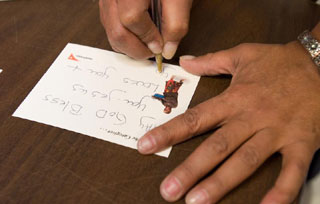
Participants Jessica Duggins and Alica Portman write personal Prayer Cards before putting them into the Caregiver Kit packages.


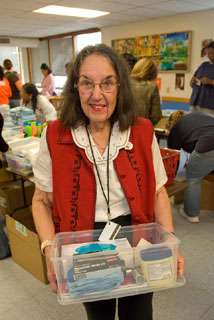
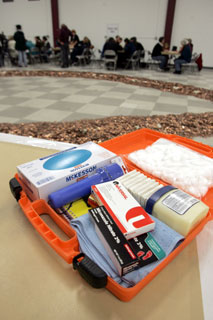
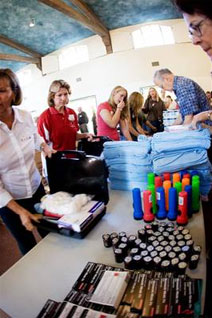
Close-up of the Caregiver Kits prepared yesterday by Menlo Park event attendees. Kits include petroleum jelly, soap, cotton, note books, pens, batteries, and personal Prayer Cards.


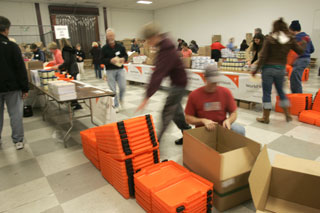
The Caregiver Kit assembly point at Menlo Park Presbyterian Church is a blur of activity as volunteers rush around, preparing kits for shipping to Africa.


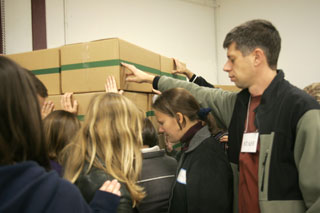
Volunteers laid hands on the boxes and prayed that their efforts, prayers and hopes would touch people in other lands.


The following photos are provided by Andrea Dearborn ...

Jill Tremblay, a member of Menlo Park Presbyterian Church, assembles a caregiver kit. She built her first caregiver kit in April. One of her kits ended up in the hands of a caregiver named Davis Tembo in Makungwa ADP, Zambia.


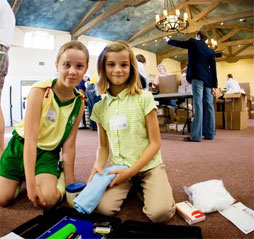
Priscilla, 9, and her friend Derek, 7, assemble caregiver kits. "I want to help people," says Priscilla. Both children diligently assembled caregiver kits all night, building so many that they lost track of the number.


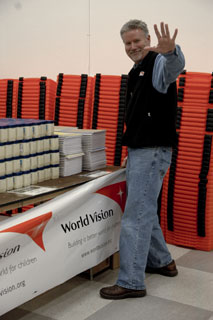
Members of Menlo Park Presbyterian Church in California marked World AIDS day by building 8,000 caregiver kits. Five truckloads of supplies arrived at a warehouse on Wednesday November 29, and volunteers spent hours arranging the event and sorting the supplies. On Thursday night, 1,400 kits were assembled. World Vision staff member Dana Buck helps prepare for the event.


- Back to Top -

Thursday, November 30, 2006

You Can Do Something This World AIDS Day

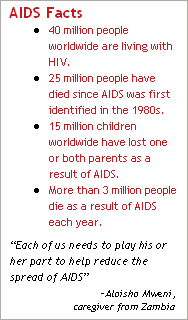
AIDS FactsTomorrow, December 1, is World AIDS Day. And you can do something to make a difference in the battle to defeat the biggest pandemic ever to hit the planet!

Four churches in Santa Barbara, California, recently got together to assemble "Caregiver Kits." These are packets which provide desperately needed resources for families and health workers in Africa who are giving care to people living with AIDS.

On hand was photographer Mark Kuroda, who took these great shots of the attendees at work, writing messages of encouragement to the caregivers, assembling the kits and even praying over them before they went out.

For more of Mark's work, check out www.markkuroda.com/worldvision.

Event participants write messages of encouragement to be included in Caregiver Kits assembled at El Montecito Presbyterian Church.


Event participants assemble Caregiver Kits at El Montecito Presbyterian Church.


Event participants assemble Caregiver Kits at El Montecito Presbyterian Church.


Event participants pray over assembled Caregiver Kits at El Montecito Presbyterian Church.


Event participants assemble Caregiver Kits at El Montecito Presbyterian Church.


Event leaders pose in front of stacks of assembled Caregiver Kits at El Montecito Presbyterian Church.


For a more detailed list of ideas of things you can do tomorrow, see this page of 12 things you can do this World AIDS Day.

If you'd like to help build AIDS Caregiver Kits tomorrow, join Menlo Park Presbyterian Church in Menlo Park, California. Other similar Caregiver Kit events are also being held at these locations:


- Back to Top -

Tuesday, November 21, 2006

It's Time To Take a Stand


Click to play videoJames Pedrick is an advocacy associate for World Vision, working with the "Acting on AIDS" college advocacy organization. Click the link at left to play a brief video of James explaining about this site.

World AIDS Day has been commemorated on December 1 for several years to draw worldwide attention to the global pandemic that is destroying so many lives and making millions of children into orphans.

But this year promises to be different. For the first time, college students, young people, and churchgoers from across the country are going to be standing up, through a variety of events, to say "We've had enough. We must do something about AIDS."

World Vision has created this site to share with you information about many of the events which are scheduled. Hopefully you can participate in an event near you.

Also, we would like to hear from you. What are you planning this World AIDS Day? How has your life been changed by the fight against AIDS? Simply click the "Comment" link at the bottom of this blog and submit your comment for our blog editor to review and publish, or review other comments which have been posted.

And stay tuned. Return to this site on Thursday, November 30, when we will begin our complete coverage of World AIDS Day events across the nation.

- James Pedrick

Read how "Acting on AIDS" got its start at Seattle Pacific University.

PARTIAL SCHEDULE OF WORLD AIDS DAY EVENTS IN THE U.S.

"Lives Are at Stake" events, occurring on CCCU member campuses nationwide on World AIDS Day, December 1.

Acting on AIDS' Fall Tour events on college campuses:

Thursday, Nov. 30 - John Brown University, Siloam Springs, Arkansas

Friday, Dec. 1 (World AIDS Day):

Monday, Dec. 4- King College, Bristol, Tennessee
Tuesday, Dec. 5 - Princeton Theological Seminary, Princeton, New Jersey
Waynesburg College, Waynesburg, Pennsylvania
Wednesday, Dec. 6 - George Mason University, Fairfax, Virginia

World Vision AIDS Experience (interactive exhibit) at these locations on December 1:

  • Charlotte, North Carolina
  • New York (mini-exhibit)
  • Seattle (mini-exhibit at Seattle Pacific University)


- Back to Top -

Thursday, August 31, 2006

Hands off the Children!

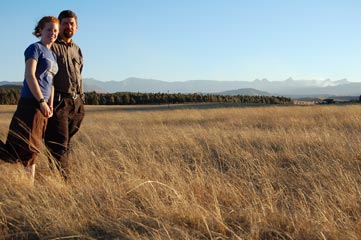
Larry Short, 49, is web editor for World Vision's office in the U.S. He is visiting World Vision projects in four countries in Southern Africa along with his daughter, Amanda, 20, a Safety Technician for Recreational Equipment Inc. (REI) in Sumner, Washington. Daughter and father are shown here in the Okhahlamba / Drakensberg area of South Africa. The mountains of eastern Lesotho are in the background.


I am so glad that the tragic situation of the Congo's so-called "sorcery children" (see article below) is getting some traction in the media. The Los Angeles Times just posted an excellent piece on the topic, intriguingly titled "They say I ate my father. But I didn't."

The article focuses on the plight of a 5-year-old girl who was accused of killing her parents ... through sorcery.

I was pleased to read that the Congolese constitution actually has made an accusation of sorcery against a child illegal. But plainly in this case there is a large gap between what is legal and what is common practice in the large cities of this troubled country. With up to 30,000 children on the streets of Kinshasa -- at least 20,000 of them there due to a sorcery allegation -- and 3,000 on the streets of Lubumbashi, the majority for the same reason, something must be done to protect the lives and welfare of these innocents.

And the same thing holds for the elderly, who (in the Congo and also in countries such as Ghana) are also being scapegoatted for societal problems.

Enforcing the law is a start. The next step is providing badly needed resources to take "sorcery children" off the dangerous streets of the Congo's large cities, and get them back into loving homes, or provide them with food, healthcare and shelter, and back to school. World Vision is helping with this, but much more is needed.

And, finally, we also need to work with "independent" church leaders in the DRC who are perpetuating this tragedy through their ignorance or misinterpretation of biblical teaching.

Out of all the gut-wrenching stories I was able to gather in the Congo this summer, this is the one that has really burned a hole in my heart since I returned. We all need to pray for these innocent children who are being abused in unimaginable ways because of the superstitions of the adults around them.

Monday, July 24, 2006

Sponsored Children Grateful for Gift of Goats

While in the Congo we had the privilege of working alongside World Vision's Communications Manager for the DRC, Vianney Dong Tshisekedi. Please pray for this wonderful woman, who has the enormous task of covering (alone!) the entire Congo ... an area larger than Texas and Alaska combined ... during a very challenging time in their history.

And pray for the results of Congo's historic democratic elections which began on July 30. Results won't be known for about a month. But this process is obviously very important to long-term peace and stability in this troubled country.

Vianney wrote the attached account of one of the interviews we did together in the Katanga Province.

Gifts given from a heart of love have a funny way of multiplying in impact. Just ask Manfela Musambo Julias, 12, and his sister Nialu Netty Lydia, 8, who are sponsored children in Kolwezi, Congo.

Their sponsor recently gave the family a special gift, above and beyond their ordinary monthly sponsorship gift. With the money, the children received new clothing and also two goats ... which can be a very important source of income and sustenance in this part of the world.

The children's father, Musambo Kamota, 76, is a subsistence farmer who cultivates maize (similar to corn), cassava, beans and sweet potatoes. He does not have regular source of income apart from his harvest, which makes keeping his nine children clothed and fed a challenging task.

The children's mother, Manfela Lydia, 36, explained why the goats were so important: "What we harvest cannot allow us meet our basic needs." Musambo added that their plot is too small to provide sufficient food for the family.

But the goats changed the outlook for the family. "We started with two goats and we have been blessed so far with six more," Lydia explained. "We can sell in order to meet other basic needs of the family, such as school fees and food."

"We are really grateful to our child‘s sponsor for the gift allowing us to develop an income generating activity on top of our farming," Lydia said. "Please convey our gratitude to him!"

Julias is in the third grade at Maleozo primary school, while his sister is in grade 2. His favorite subject is French and he says he would like to become a doctor in order to help others. During his leisure time, Julias plays football with his friends. "I like to play with my friend and it makes me happy," he said.

In addition to the special gift from their sponsor, Julias and Netty have benefitted from other assistance, such as school fees, school supplies, and health care.

Thanks to World Vision, the Diur community where they live now has access to a neighborhood health center, safe water, and school supplies. "We used to walk more than 10 kilometers for health care," said Julias’ mother.

Since Julias and Netty have been sponsored by World Vision, many things changed in their families. They are very happy to be sponsored children and expressed their gratitude to their sponsors, Livingstone and Lynne.

"Look at my sponsor’s family picture!" Netty showed the photo and pointed to her sponsor, Lynne, while holding tightly to a small toy, a stuffed animal she received as a precious gift from her sponsor two years ago.

Thursday, July 20, 2006

Sapalo Survives a Silent Killer

Ten-year-old Sapalo Satshilenge was walking peacefully along the relatively deserted and lonely country road in the pre-dawn darkness when there came, unexpectedly, a moment he would never forget.

He never heard the approaching motorcycle. It wasn't until some time after the motorcycle struck him that he learned exactly what had happened.

It wasn't that the motorcycle was silent. Most vehicles on such roads on the Congo make a lot of noise as they navigate, usually honking their horns every time they see a pedestrian to warn them that they have no intention of slowing down.

But for Sapalo, a deaf-mute, the warning of the oncoming danger was never received.

Fortunately, Sapalo survived the terrible accident, and now has scars on his head and elsewhere to show how lucky to be alive he really is. Many other pedestrians in similar situations haven't survived an accident on the Congo's treacherous roads, where any kind of emergency medical help, if it is available at all, is most likely many hours away.

Sapalo was on the road in the darkness because, like many of the deaf-mute students at the World Vision-assisted Ephrata school, they have no other option but to walk long miles to and from the school each day. Some students walk as far as 20 miles, each way, to reach the school, their only hope of living a life freed from the worst effects of the poverty that enslaves so many families in the Congo.

It is at Ephrata, which is one of four schools established for the deaf and mute in the Congo's enormous Katanga Province, that these students are taught not only a classical education but also valuable career skills such as sewing and carpentry.

And they are taught something else as well: hope for a better life, both now and in eternity to come. For Ephrata carefully and strategically conveys Christian values to its students and isn't afraid to help equip them to grapple with what the Bible has to say about how to truly be successful in life, despite whatever disabilities you may be born with or accumulate along the way.

Unfortunately, the vast majority of families of Ephrata's students are far too poor to figure out any better way to get them to and from school each day. In this part of the Congo, school buses are unheard of, and very few people own cars. Only the "upper crust" even own rudimentary bicycles, which are usually used like small trucks for conveying various goods to and fro for business purposes.

So most of the students walk the distance. And it is because of this walking, on very hazardous roads under poor conditions, that Sapalo was just one of two of Ephrata's students, in May alone, who were struck by vehicles in separate incidents.

To address the hazard, the leadership of Ephrata is hoping to build dormitory facilities on the school's ample land to house students during the week. They are seeking special funding for this project, and accumulating piles of bricks that will eventually be used in the construction.

World Vision is supporting Ephrata and the three other deaf-mute schools in Katanga Province, and their enthusiastic and hopeful students, in a variety of ways: with educational supplies, teacher training, desks, sewing machines, and more. This support is a vital investment in the future of the Democratic Republic of Congo, and that of many families and their disabled children in the Katanga Province.


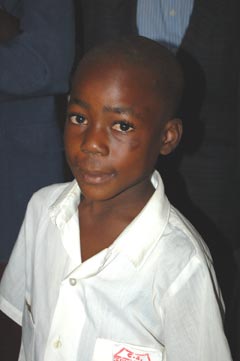
Top photo: The marks of Sapolo's run-in with a motorcycle are evident on his face and head.

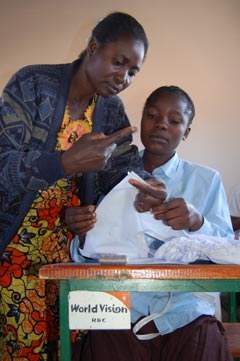
Bottom photo: One of Ephrata's teachers demonstrates a sewing technique to a female student.

Tuesday, July 11, 2006

Another Killer in the Congo: Diabetes

"I AM NOW ALONE"

In the southern Katanga Province, in or near cities such as Lubumbashi, Kipushi, and Kolwezi, World Vision is assisting large numbers of orphans and vulnerable children. As the killer pandemic of AIDS strikes and divides families, so many children lose one or both parents. Typically they are "adopted" by extended family members, but the stress of AIDS on a society already devastated by war and economic catastrophe makes the challenge especially difficult for these families who are now caring for the children of their deceased relatives.

"HopeChild" support provided by our donors is assisting in meeting the needs of orphans and vulnerable children. The latter may not have lost parents, but they nonetheless have special levels of critical need in an impoverished society, due to a debilitating illness such as AIDS.

In addition to HIV, there are also a number of other serious illnesses which can make a child vulnerable. Diabetes and sickle cell anemia are common examples of illnesses which affect children in the Democratic Republic of Congo (DRC).
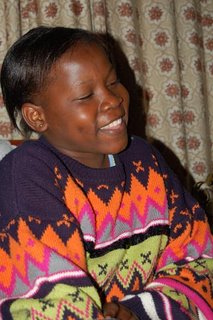
Felicite Nzabandora is one such vulnerable child, due to a 15-year fight with diabetes. Felicite's surname means "I will see" ... which is sadly ironic, as Felicite is in the process of losing her eyesight. She also has other complications resulting from her battle with a disease which might be relatively easy to control in places where access to medical care is taken for granted; but here in the Congo, in Felicite's home town of Kolwesi, such a disease can and often does create early childhood mortality.

But her first name, "Felicite," means "Joy," and World Vision is working with the Nzabandora family to try and create a hope for a brighter future and a reason for joy for Felicite. Though she has recently turned 18, her small frame and childlike face could easily be mistaken for a child four years younger. In addition to struggles with her eyesight, she also experiences pain and circulation problems in her hands due to the disease.

Felicite is the sixth in a family of seven children, but even her younger sister is a head taller and looks older than she. Her father, Joseph, is a civil engineer, and her mother, Agnes, is a registered nurse ... which is good fortune for Felicitee, since Agnes takes such an active role in trying to ensure her good health in the face of such a debilitating disease. Agnes ensures that Felicite faithfully takes her daily injections of insulin, provided by World Vision, which has helped to arrest the negative progress of the disease.

However, unlike a country such as the U.S. where blood sugar testing tools are readily available and affordable, and diabetics can therefore test their need for insulin several times each day -- enabling them a finer level of control in their administration of the important but dangerous substance -- unfortunately, in the Congo, the only place where blood sugar testing can be done is in a medical clinic or hospital. So Felicitee is only able to get her blood sugar tested occasionally, when World Vision takes her to a nearby clinic for checkups.

In addition, Felicite is now in need of surgery to remove the cataracts which have developed in her eyes. She was forced to suspend her schooling because of her inability to read due to the deterioration in her eyesight.

“I cannot see properly," Felicite explains. "And it is very difficult for me to make a fist. I cannot go to school and it is painful for me. When I see other children going to school, I am really sad. I wish I could also join them, but ….” and she begins to cry.

After she is able to speak again, Felicite says her career goal is to become a medical doctor, so she can help other children who are suffering with diseases such as diabetes.

When asked if she has other friends who struggle with diabetes, Felicite nods her head but remains silent for a moment. Then she explains, through her tears: "All my colleagues suffering from diabetes have already died." At one time, her mother explains, she had four friends suffering from the disease. But each has since died of complications. "I am now alone," Felicite says sadly.

In addition to her health care and medicines, World Vision is also providing food assistance to Felicite and her large family, in the form of milk, rice, potatoes, biscuits, and apples.
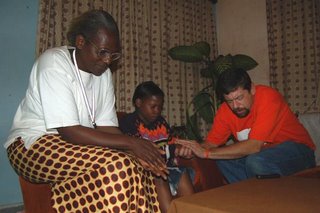
I had the privilege of praying for Felicite and her mother, Agnes, during our time together. Please join me in praying for a full recovery of her eyesight and use of her hands.

Friday, July 07, 2006

"Sorcery Children"


Sometimes, when things in life don't go the way we planned, we blame our children. Sad, but sometimes true.

In the Congo, we discovered an extraordinary tale of what is happening as some adults are taking this sad reality to a frightening extreme.

Meet Belinda Kaji Manengu. At only 8 years of age, Belinda should (like other children her age) be enjoying all the carefree fun that life has to offer a child.

Instead, her parents both died of AIDS, and she went for a time to live with an uncle. But, angry about his brother's death, her uncle and his family accused Belinda of witchcraft and blamed her for the tragedy.

Unbelievably, this is a fairly common occurrence in the Congo. In Lubumbashi alone -- a major city near the southern border with Zambia, and an area with a relatively high prevalence of HIV thanks to thousands of truck drivers who cross the border every day -- there are an estimated 2,000 to 3,000 children living on the streets, and the majority of these are there because they have been accused of witchraft. The locals here call them "sorcery children."

In Kinshasa, Congo's capital in the west and largest city, the number of street children is estimated at between 25,000 and 30,000, and at least 60% of them are estimated to be on the streets because of a sorcery accusation. Children as young as 5 have been abused or thrown out onto the streets because of a sorcery allegation.

We were told that pastors and churches are sometimes complicit in this tragic practice. Families upset about a misfortune, such as the death of a family member due to AIDS, will consult ill-informed pastors, who -- for a fee -- "diagnose" the root of the problem as a child practicing withcraft. These children are then subjected to a horrific cure -- "exorcism."

In this case, exorcism doesn't mean what you probably think it does. In order to "cure" these children of their supposed inclination to sorcery, they are basically abused -- even tortured.
We were told about one girl whose skin was burned with fire in order to "cast out the demon." And they are even expelled from their homes and left to wander the streets. Fending for themselves and sleeping in public areas such as parks, alleys, or train stations, they become all-too-easy prey for child sex predators. In addition to being victimized by HIV or violence, they also have a high rate of accidents, being struck by vehicles or run over by trains.

And naturally, many simply run away to escape the abuse. We asked the founder of the World Vision-assisted Faradja Center for orphans and vulnerable children, Mrs. Maguy Numbi, 47, how Belinda came to be at the center. "She ran away. After sleeping at the train station and other places for a number of months," she said, "one morning we discovered her sleeping under the window of our office here and took her in."

"And why did you run away?" we asked Belinda.

"I cannot go back to my family," she replied. "I was beaten every day."

The Faradja Center is far too small to house all of the 230 children they are working with. They have one small bedroom with a bunk bed, where nine boys sleep each night -- two to a mattress, and five on the floor. The room is a third the size of most hotel rooms.

As for Belinda, Mrs. Numbi managed to get her placed with another relative who now cares for her and shields her from abuse. With World Vision's help, providing school fees and uniforms and funds for health care, she also works to ensure that the children are placed in local schools so they can resume their education, and gets them regular checkups and urgent medical attention at local clinics.

But for the Faradja Center, this daily struggle to get children off the streets is a life and death matter. World Vision assists by providing food for meals and other needs, and the 15 volunteer caregivers who work with the children have all received training from UNICEF. They also employ creative means to pay the rent and purchase more of the food they need; the older girls knit sweaters and other garments by hand and they barter them in the market for the cash and supplies they need to stay afloat.

They need far more than they have to work with ... more space, more financial resources (every staff member is 100% volunteer, including Mrs. Numbi, who has nine children of her own to feed), more trained volunteers, and simply more capacity to help children. Mrs. Numbi says that every time they venture out into the marketplace or other public places, they find more "sorcery children" who need to be rescued from almost certain victimization on the streets.

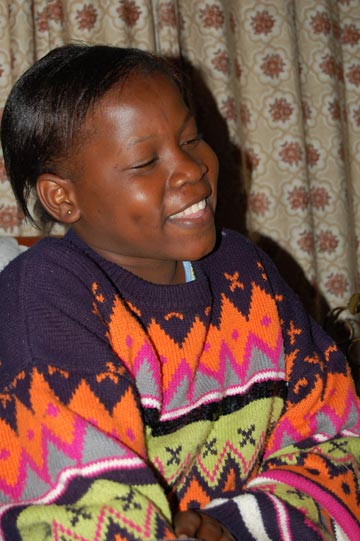
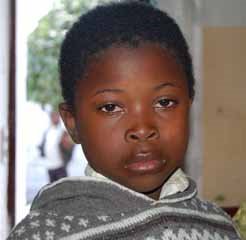
Captions: Top photo -- Belinda's eyes betray just a fraction of the tragedy that has thus far marked her young life.

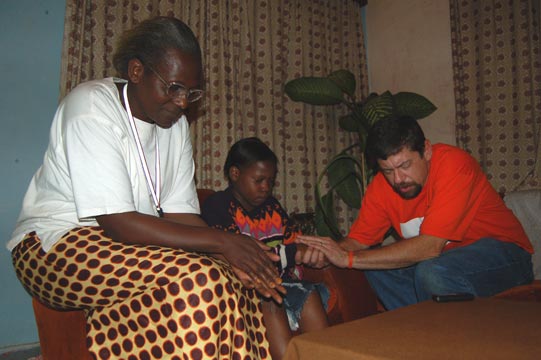
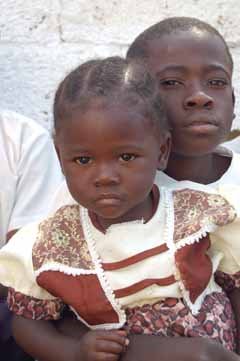
Bottom -- Two more "sorcery children" at the Faradja Center. In addition to all the other struggles these children have to deal with, many of the orphans served by the Center are themselves also HIV-positive, as a result of sexual abuse or vertical transmission from infected mothers (in utero or sometimes due to breastfeeding).

More Info on Sorcery Children -- April 2006 Human Rights Watch report highlighted by BBC News, Worldwide Religious News, and ReliefWeb.

"They say I ate my father. But I didn't." Los Angeles Times, August 29, 2006.

Watchlist Report on child trafficking and exploitation in the Congo

U.S. State Department information on sorcery as a religious practice in the DRC.

Congolese blame Ebola deaths on "sorcery"

IRIN News: NGOs, public authorities denounce killings of suspected "sorcerers" in the Congo

Wikipedia article on how indigenous beliefs in sorcery intersect with Christian faith in the Congo

March 2004 New Humanist article on the torture of child "sorcerers" in the Congo

May 2002 Global Action on Aging article about how sorcery is used as an excuse to abandon the elderly in the Congo

Information about shelters offered by the Catholic Church in the Congo for children and the elderly accused of sorcery and expelled